
Chemistry Apps for Teachers
7 min read
Short answer: Periodic Mole is a set of chemistry games built to absorb the fluency drilling, element symbols, reading formulas, basic balancing, that eats up class time. A mastery-gated ladder finds each student's gaps and closes them automatically, so students arrive at your lesson already equipped, and you get the period back for the reasoning and the phenomena that made you want to teach chemistry.
Why does chemistry class always feel like it's moving at the wrong speed?
Because it is, for most of the room, most of the time. Twenty-eight students walk in with twenty-eight different chemistry histories: some can name every element on sight, some still mix up a subscript and a coefficient, some missed the unit on ionic bonding because they were out sick. A single calendar can't rewind for the kid who needs one more pass at reading a formula without also stalling the kid who mastered it in September. So class time gets spent re-teaching the basics to the room as a whole, which shortchanges the students who are ready to move and shortchanges the students who needed something more targeted than a group re-teach.
That's not a complaint about effort. It's math. One teacher, one pace, thirty different starting points.
Do learning apps replace the teacher?
No. Periodic Mole is a complement to the classroom, not a replacement for it. It has no lecture, no lab, no explanation of why electronegativity matters, no relationship with the student. It does one narrow job: it drills the recall-level facts, element symbols, names, formula reading, basic balancing, until a student is fluent, and it tracks that fluency per student so nobody's gaps are guessed at. What a student does with that fluency, reason through a mechanism, design an experiment, argue from evidence, still happens in your room, with you.
Think of it as the multiplication-table problem, moved into chemistry. A math teacher doesn't reteach times tables during a unit on ratios; students either know them or they practice them on their own time. Chemistry has an equivalent layer of rote fluency, symbols, formulas, the mechanics of balancing, and until now there hasn't been a good way to hand that layer off.
How does the app help students who are behind?
It finds the specific gap and closes it, one student at a time, without anyone raising a hand and announcing they're behind. Each student climbs a mastery-gated pack ladder: every question they get is one small step above what they've already shown they know, starting with the periodic table (symbols and names) and climbing into reading formulas, bonding, the mole, and stoichiometry. Nothing advances until the current step is mastered, and nothing sits idle waiting on a calendar date. A student who's shaky on symbols gets more reps on symbols; a student who's solid gets carried forward into harder material instead of parked on a review they don't need.
This is the practical version of two ideas that have been in the education research for decades. Benjamin Bloom's 1984 "2 Sigma Problem" found that students who received one-on-one tutoring, each paced to their own mastery, scored roughly two standard deviations above students taught at a single classroom pace. That figure comes from studies of human tutors. Software can't promise that exact effect size, but it can carry over the underlying principle: advance a student the moment they've mastered the material. Lev Vygotsky's zone of proximal development (1978) describes a similar target: the band just above what a learner can already do alone, where the next step is close enough to be reachable. A ladder that only ever hands a student the next small step is trying to live inside that band for every student, all the time, without needing thirty individual lesson plans to do it.
What does this actually free up for the room?
Two things: your time, and the room's attention. When students arrive at a lesson already fluent in the basics, you spend less of the period re-explaining what a formula means and more of it on the reasoning that's actually chemistry, why this reaction runs the way it does, what the evidence says, where the model breaks down. That's the part of the job most teachers signed up for, and it's the first thing to get squeezed when class time goes to fundamentals instead.
The second effect is subtler but real: a lost student rarely stays lost in silence. They act out, check their phone, or pull a neighbor off task, and that drags on the whole room's attention. Closing the gap before the lesson starts helps that student keep up, and it also removes a source of drift that derails a period for everyone else. Teachers looking for classroom-ready tools built with exactly this in mind can start at Free chemistry games for your classroom.
What do students actually do inside the games?
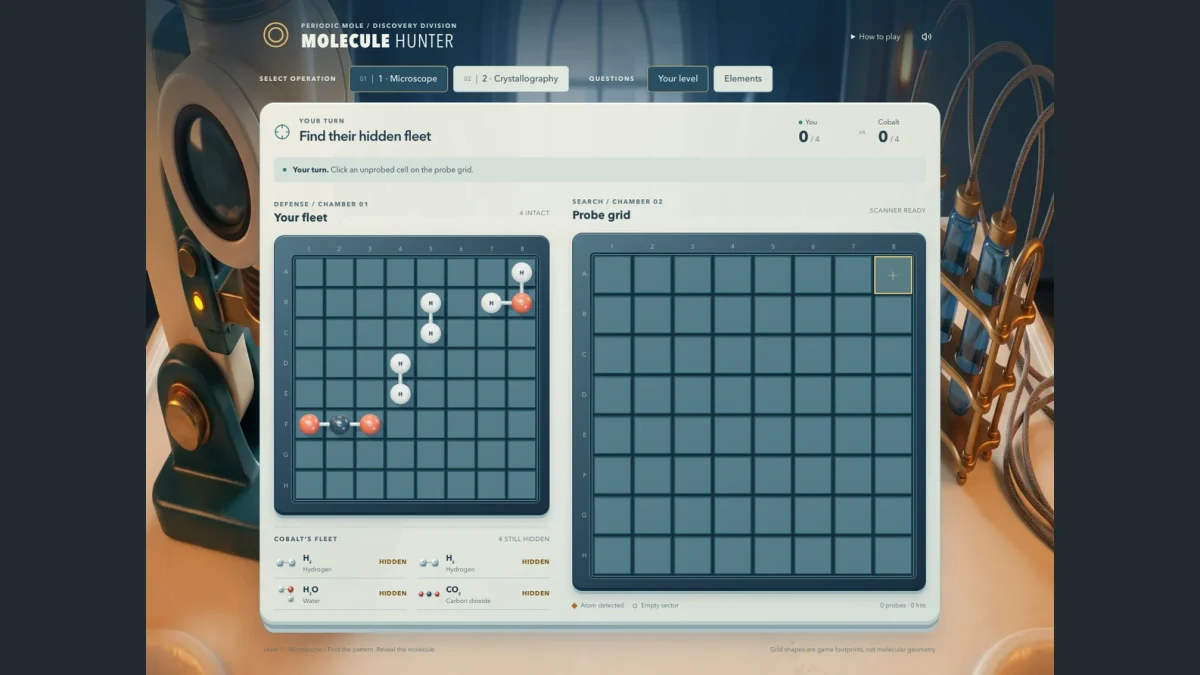
In the element-recall games, students answer chemistry questions to play. On Bond Forge’s three-dimensional forge table, they answer to draw a bond and close boxes to score. In Pt Paddle’s Platinum Arena, they earn longer molecular paddles with correct answers, and in Molecule Hunter’s scanning observatory, they answer questions to fire probes at a hidden fleet. We track all three on the same element-mastery ladder.
In Acid Boy & Base Girl, students practice a different kind of reasoning. They guide two heroes through a 3D laboratory, using pH and neutralization to choose routes and operate reactors. They can play solo by switching heroes, or in co-op with an invited friend.
For activities beyond element recall, use our chemistry games by lesson topic. It includes formula-building, molecular shapes, and balancing-equation challenges with answers.
Is there a free option for my classroom?
Yes, on both sides of the desk. Chemistry teachers get a free full-access account through Free chemistry games for your classroom, granted after a quick review, no cost, no card. Students get an anonymous free tier with no account required: Bond Forge and Pt Paddle cover the first 12 elements, and Acid Boy & Base Girl opens its first two missions. The full interactive periodic table (all 118) is free to browse. For a student who wants the full ladder, every game, and all the content, there's $59 for one year or $79 for two, paid upfront, with progress saved.
Try it free. Bond Forge is free to play with a starter set of elements, no account needed. Full access is $59 for a year: every game and all 118 elements, with progress saved. No subscription.
FAQ
Are chemistry apps for teachers worth assigning, or just another gimmick? Worth assigning when the app forces real recall instead of recognition, and when it adapts to each student instead of running everyone through the same review. Periodic Mole’s element-recall games connect answers to play and track mastery per student, so it's closer to a fluency drill than a quiz app.
How can I help students who are behind in chemistry without slowing down the whole class? Give them practice that adjusts to their own gaps instead of the group's pace. Periodic Mole's mastery-gated ladder finds what a specific student hasn't mastered yet, symbols, formulas, bonding, and serves the next small step automatically, so catching up doesn't require a separate lesson plan or a slower unit for everyone else.
Do learning apps replace the teacher? No. Periodic Mole complements the classroom. It handles rote fluency, element symbols, formula reading, basic balancing, so class time can go to the reasoning, the phenomena, and the relationship that only a teacher provides.
Is there chemistry practice I can assign my whole class? Yes. Students can play Bond Forge, Pt Paddle, Molecule Hunter, and Capture the Nucleus solo against our lovable robot Cobalt, and two classmates can play Bond Forge or Pt Paddle against each other live. In Acid Boy & Base Girl, two students can play in co-op. A classroom tournament can run a whole-class bracket on Bond Forge, no per-student setup beyond sharing a link.
Is Periodic Mole free for teachers? Teachers get free full access after a quick review at Free chemistry games for your classroom. Students can play Bond Forge and Pt Paddle free with no sign-up, covering the first 12 elements, and Acid Boy & Base Girl opens its first two missions; $59 for one year or $79 for two opens every game and all the content, with saved progress.
Related
Sources
- Bloom, B. S. (1984). The 2 Sigma Problem: The Search for Methods of Group Instruction as Effective as One-to-One Tutoring. Educational Researcher.
- Vygotsky, L. S. (1978). Mind in Society: The Development of Higher Psychological Processes. Harvard University Press.