Periodic Table Games: What to Play
5 min read
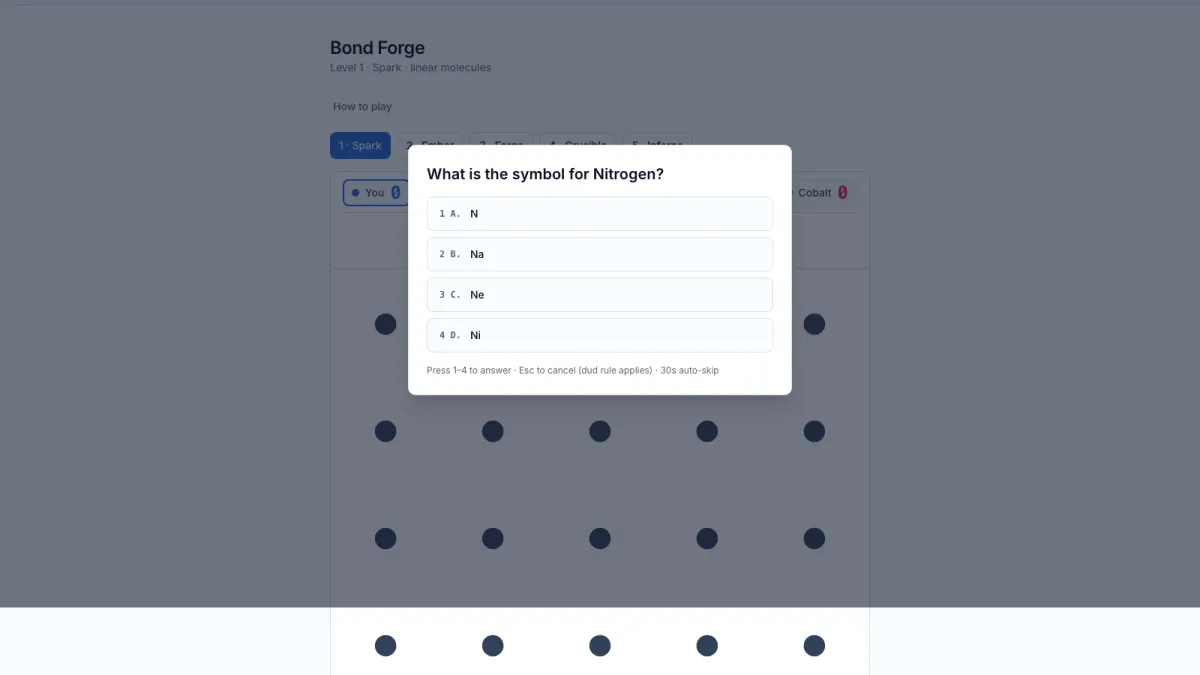
Start with Bond Forge for element questions between turns, Pt Paddle for faster play, or the free periodic table quiz to type names from symbols. Run the Table adds timed grids for full-access players. Choose the activity that asks you to recall the facts you’re working on in class.
Knowing that sodium is Na and finding sodium on a blank table are different skills. Before choosing a game, try both. If you can place the element but can’t remember its symbol, a few rounds of symbol-and-name questions are a useful place to start.
Which periodic table game should I choose?
These are Periodic Mole’s games and quiz. The links take you to each game’s public page; paid games show a preview before asking for full access. You can also browse the games collection.
| Activity | What you do | Choose it for | Access |
|---|---|---|---|
| Bond Forge | Answer chemistry questions to draw lines and close boxes | Element practice with time to consider your next move | Free starter content |
| Pt Paddle | Answer questions to grow your paddle during paddle ball | Element practice with arcade play | Free starter content |
| Periodic table quiz | Type element names from their symbols | Checking what you can recall without answer choices | Free |
| Run the Table | Fill a chosen grid against the clock | Recall by atomic number, symbol, or name | Full access |
| Capture the Nucleus | Move hidden-rank pieces and answer questions during attacks | A longer strategy game with periodic-table practice | Full access |
Bond Forge and Pt Paddle work without signing up. Their free element set runs from hydrogen through magnesium, atomic numbers 1–12. Full access opens the other games and the full element set. The pricing page currently offers one year for $59 or two years for $79, paid upfront.
What happens in a round of Bond Forge?
Bond Forge starts with a dots-and-boxes board. Answer a chemistry question correctly to earn a line. Close a box and you score a point and get another turn. A wrong answer gives the opponent a bonus line before their normal turn, so a missed symbol can change the board.
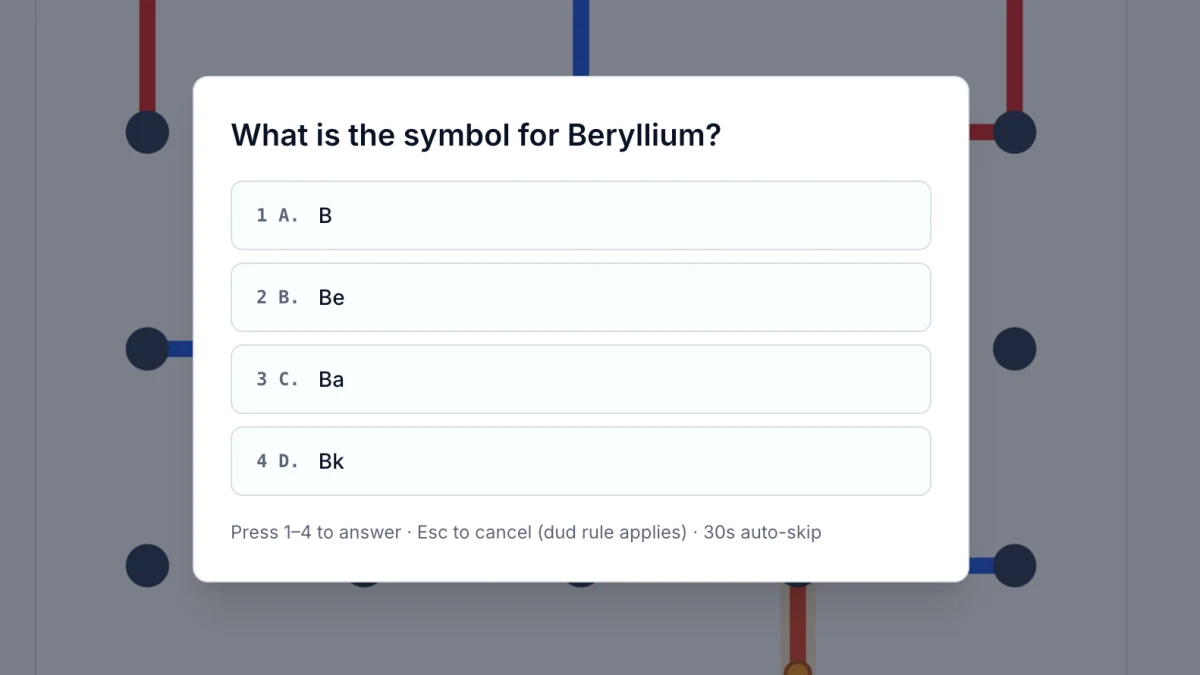
The question shown here is multiple choice. You’re choosing the symbol for beryllium from similar-looking alternatives. To check whether you can recall it without that help, say the answer before reading the choices, or follow the match with the typed periodic table quiz.
Play alone against Cobalt, the computer opponent, or invite a friend. If you already know dots and boxes, the board rules will be familiar. Our Bond Forge guide explains the bonus turns and levels.
Try it free. Bond Forge is free to play with a starter set of elements, no account needed. One payment of $59 unlocks every game and all 118 elements, with progress saved. No subscription.
When is a timed quiz the better choice?
Run the Table is for the moment when you want to find out what you can supply from memory. Choose how you’ll be cued: by atomic number, symbol, or name. Then pick a grid. The options include the first 12, first 20, first 36, individual chemical families, and all 118 elements.
Start with the first 20 if that’s what your class is studying. After a run, check the missed elements before trying again. A faster finish is useful only if you’re still getting the answers right.
For a free check without a game opponent, use the periodic table quiz. It shows element cards one at a time and asks you to type the names. Skip an element you don’t know and review the answer. This is a separate activity from the paid Run the Table game, which lets you choose a grid and recall mode.
How can I practice for ten minutes?
Pick one game and keep a scrap of paper beside you. Spend about two minutes looking up a few elements from this week’s work, five playing, and the last three checking anything you missed. Adjust those times to fit the match.
Write the actual mix-up: “B is boron; Be is beryllium” is something you can check tomorrow. A total score won’t tell you which pair caused trouble. When you return, cover the correction and try it before looking.
If you want to practice where the elements sit, use the blank periodic table exercises. The numbered worksheet and completed answer chart work alongside any game.
Can I use these games with a class?
For a class trying Periodic Mole for the first time, open Bond Forge on the devices students will use and play a few turns before assigning a match. That gives you a chance to check the question level and show what happens after a wrong answer.
The classroom tournament kit has a Bond Forge bracket. For a quieter lesson, students can play against Cobalt and hand in two corrected answers afterward. Pair work also works as a teacher-led activity: one student explains the answer before the other selects it, then they swap after the match.
Teachers can request free full access. That request is reviewed; it doesn’t automatically give every student a full-access account. Check the access arrangements before planning a lesson around a paid game.
Do periodic table games help students learn?
Games give students a reason to answer another question. What they learn still depends on those questions, the feedback, and whether they practice again. A win at dots and boxes doesn’t by itself show that someone knows the elements.
Roediger and Karpicke’s 2006 study found better delayed retention after retrieval tests than after repeated study in experiments using prose passages. It supports making time to recall answers, but it wasn’t a test of Periodic Mole or chemistry games. Our review of game-based learning research covers the chemistry evidence and its limits.
After a few sessions, check the same symbols without the game’s answer choices. If Be comes to mind where it didn’t before, you’ve learned something you can use on the next worksheet.
FAQ
Which periodic table games are free? Bond Forge and Pt Paddle are free without an account, with element content limited to atomic numbers 1–12. The separate periodic table quiz is also free. Run the Table and Capture the Nucleus require full access.
Can I play periodic table games with a friend? Bond Forge and Pt Paddle support solo play against the computer and live play with a friend. Run the Table is an individual recall challenge.
Which activity checks recall without multiple-choice answers? The free periodic table quiz asks you to type element names from symbols. Run the Table offers timed grids with atomic-number, symbol, or name cues for full-access players.
Do I need to memorize all 118 elements before playing? No. Start with the elements your class uses. The free games begin with the first twelve elements, and Run the Table has smaller grids and chemical-family options.
Related
- How to Memorize the Periodic Table Fast
- Do Learning Games Actually Work? 34 Studies
- Bond Forge: Chemistry Dots and Boxes
- How To Use A Blank Periodic Table
- How to Study Chemistry With Friends
Sources
- Periodic Mole’s games collection, for the playable roster and game previews.
- Periodic Mole pricing and teacher access, for access options.
- Roediger and Karpicke (2006), Test-Enhanced Learning, for the retrieval-practice study.