
The Best Interactive Periodic Table
7 min read
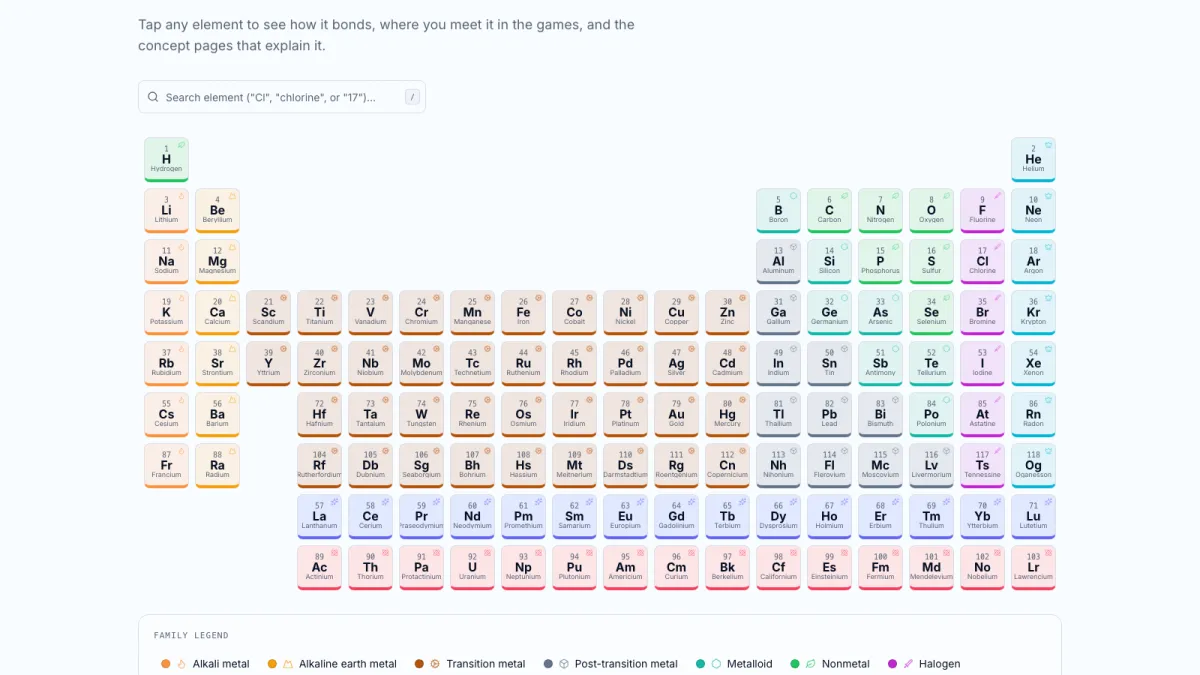
The best interactive periodic table depends on the job. To look up data, use Ptable. For photographs of real element samples, Theodore Gray's periodictable.com. For stories and authority, the Royal Society of Chemistry. To actually learn the elements and keep them, you want one built around recall and daily play, not a reference grid you read once and close.
The internet has a dozen good periodic tables, and most are built to look something up: tap an element, read its data, close the tab. Several are genuinely beautiful, and more than one is a labor of love for chemistry. The thing few of them set out to do is help you remember what's on the table after you've closed it. For a student, that's the part that counts.
So this sorts them by the job each does. The right table for a chemist checking an ionization energy is the wrong one for a 14-year-old who wants to walk into class already knowing that Au is gold. And that head start counts for more than it sounds: working memory holds about four things at once (Cowan, 2001), so a student still sounding out which symbol is sodium has nothing left over for the reaction itself.
What makes a periodic table "interactive"?
An interactive periodic table lets you do more than read a wall chart. At a minimum you click an element and get its details. The better ones add search, filtering by family, trend overlays, a temperature slider that re-colors every tile by its state at that temperature, or a quiz.
The split that matters for a student is between tables built for reference (look one thing up, leave) and tables built for learning (come back, recall, remember). Most of the famous ones are reference tools. That isn't a knock on them; it's what they're for, and several are very good at it.
The best interactive periodic tables at a glance
| Periodic table | Best for | Standout feature | Helps you remember it? |
|---|---|---|---|
| Ptable | Looking up data | Temperature slider, isotopes and compounds tabs | No (reference) |
| Theodore Gray (periodictable.com) | Seeing real samples | 2,300+ photos of physical specimens | No (reference) |
| Royal Society of Chemistry | Stories and context | A podcast for every element, commissioned art | No (reference) |
| PubChem (NIH) | Raw, citable data | Full data download and an open API | No (reference) |
| WebElements | Deepest property data | Near-encyclopedic per-element pages | No (reference) |
| Google's built-in table | A two-second lookup | A rotatable 3D Bohr model, no app to install | No (reference) |
| Sporcle / Quizlet | Drilling the list | Timed recall, matching, leaderboards | Drill only, no scheduling |
| Periodic Mole | Learning the elements | Spaced repetition and games gated by recall | Yes, it's the whole point |
Which interactive periodic table has the best data?
Ptable is the one to beat for raw lookup, and it earns it. Michael Dayah built it as a high-school student and has kept it sharp since 1997, in dozens of languages, with no account required. Drag the temperature slider and every tile switches between solid, liquid, and gas in real time. Tabs cover electrons, isotopes with half-lives and decay modes, and the compounds an element forms. It's fast, deep, and woven into real classrooms.
Two others share the reference crown with it. WebElements, online since 1993 out of the University of Sheffield, carries the deepest per-element data of the bunch: multiple electronegativity scales, full ionization series, crystal structures. PubChem, the U.S. National Institutes of Health's chemistry database, lets you download every value as CSV or pull it through an API, each number traced to a named authority like IUPAC or NIST. If your job is to look something up and cite it, start with one of these three.
Which interactive periodic table tells the best stories?
The Royal Society of Chemistry's table is the one to wander when you want chemistry to feel human. The 180-year-old UK chemistry society pairs every element with a commissioned "Visual Element" artwork by Murray Robertson and a short podcast, a few minutes on each element's history, uses, and quirks. It adds a "supply risk" rating most tables skip, so you learn which elements the world is running short of. It's built for reading and listening rather than recall, but few periodic tables match it for narrative and trust.
Which interactive periodic table quizzes you?
A few tools test you instead of just showing you, and the kind of recall they ask for matters more than it looks. Sporcle runs the strongest free version: a blank grid and a clock, and you type the element names from memory before time runs out. Producing the answer from nothing is real retrieval, the kind that builds memory. Seterra and PurposeGames ask you to click the right tile, which is recognition, an easier task that sticks less well. Quizlet's Learn mode is the closest any of them comes to adapting, and it's generic, the same engine behind its Spanish-vocab decks.
They share one limit: the quiz hits the whole set every session, which rewards the kid who already knows it and does little for the one who keeps forgetting chlorine. The single technique proven to fix that, spacing reviews out over days, is missing across the board.
Which interactive periodic table looks the best?
Periodic Mole's table is the most modern-looking of the group, which is a deliberate choice for who it's for. Open it and the elements are soft, family-colored tiles under a journal serif, with a search box that takes a symbol, a name, or an atomic number and a grid that reflows to a clean list on a phone. It looks like it was made this year, because it was.
Theodore Gray's periodictable.com is what people mean by "most beautiful periodic table," and it earns the title. More than 2,300 real element samples he gathered and photographed, many rotatable in 360 degrees, shot on the hand-built wooden "periodic table table" that won him an Ig Nobel Prize. It's a genuine wonder to browse and a labor of love for chemistry that's hard to overstate.
It's also a gallery, made for marveling more than studying. The photographs sit in a rich montage per element, built to be admired rather than drilled. That's the line between something you browse and something you study with, and there's room for both.
Periodic Mole takes the part Gray got right, real-looking images of real substances, and puts them on a page built to teach. Open zirconium and you see the bare silvery metal beside the cubic zirconia it becomes, the fake diamond in a jewelry-store ring, one captioned "what it looks like" and the other "where you'd see it," both taped into a lab notebook. Every element pairs the substance with the place you actually run into it, which a gallery of pure samples isn't built to show. The images are generated rather than photographed off a shelf, the colors kept accurate to chemistry instead of prettified: cesium reads gold, bromine red-brown. For the handful too unstable to photograph, like astatine, you get a short note on why instead of a blank.
What about a printable periodic table?
Sometimes the best interactive table is the one taped above a desk. We publish free printable periodic table PDFs rendered from the same database as the interactive table, so the numbers never drift out of date: a minimal chart and a color classroom chart in Letter, A4, and 11×17, a blank practice worksheet, a four-page wall poster with trim guides, and a one-page poster for each of the 118 elements. All of it is CC-licensed for classroom copying. For how ours compares with the other good free options, see Printable Periodic Table PDFs for Class.
Which interactive periodic table actually helps you learn the elements?
The tables above are built to show you what's on them, not to get it into your memory, and that gap is the whole reason Periodic Mole exists. Two of the most replicated findings in learning science do the work: retrieval practice, recalling an answer beats re-reading it (Roediger and Karpicke, 2006), and spacing, reviews spread across days beat cramming (Cepeda et al., 2006, over a hundred studies).
The table itself is free to browse, and each element page links out to where you meet that element in the games and the concept pages that explain it. Under it sits the part the other tables skip:
- One recall rule. The symbol is the cue, the name is the answer. You see "O" and produce "oxygen," the actual chemistry skill, not a multiple-choice guess. The atomic number is the reward on the back of the card, not a hint on the front.
- A real spaced-repetition scheduler (FSRS) decides when each element comes back, based on how well you recalled it last time, so your minutes go to the ones you're about to forget.
- Games you'll reopen. You can't take your turn until you answer a chemistry question right, set at your level, solo against the computer or head-to-head with a friend. The table fills in, square by square, as you master elements.
It is not the deepest reference, and it doesn't pretend to be. There's no temperature slider, no isotopes tab, no data export. To look up an electron affinity, use Ptable. Periodic Mole is built for the opposite job: getting the table off the page and into your head, and keeping it there.
So which interactive periodic table should you use?
Pick by what you're actually trying to do:
- A quick lookup or a class demo: Ptable.
- A beautiful hour of real element samples: Theodore Gray's periodictable.com.
- Stories, history, and context: the Royal Society of Chemistry.
- Raw data to compute on or cite: PubChem or WebElements.
- Starting chemistry and wanting the elements cold by fall: Periodic Mole.
Try it free. Bond Forge is free to play with a starter set of elements, no account needed. One payment of $59 unlocks every game and all 118 elements, with progress saved. No subscription.
FAQ
What is the best free interactive periodic table? For pure reference, Ptable is the best free one: deep data, dozens of languages, no sign-up, only a small banner ad. For learning the elements, Periodic Mole's table is free to browse, and its Bond Forge and Pt Paddle games are free to play with no account, covering the first dozen elements.
What is the best interactive periodic table for students? It depends on the student's goal. To look up a property during homework, Ptable. To genuinely memorize the elements before or during a chemistry course, use a table built on recall and spaced repetition rather than one built for lookup, so the work actually sticks.
Is there an interactive periodic table that quizzes you? Yes. Sporcle has you type the element names against a timer, and Quizlet offers matching and its Learn mode. Both test the whole set every session. Periodic Mole goes further by scheduling your reviews with spaced repetition and wrapping the recall in games, so you keep showing up.
What is the best-looking interactive periodic table? Theodore Gray's periodictable.com holds the most celebrated collection of real-sample photography, a gorgeous gallery to browse. For a modern interface and element pages built for studying, Periodic Mole's table is the best-designed for learning.
Related
Sources
- Ptable, About. ptable.com/about
- Theodore Gray, periodictable.com. periodictable.com
- Royal Society of Chemistry, Periodic Table. periodic-table.rsc.org
- PubChem, Periodic Table of Elements. National Institutes of Health. pubchem.ncbi.nlm.nih.gov/periodic-table
- Cowan, N. (2001). The magical number 4 in short-term memory. Behavioral and Brain Sciences.
- Roediger, H. L., and Karpicke, J. D. (2006). Test-enhanced learning. Psychological Science.
- Cepeda, N. J., et al. (2006). Distributed practice in verbal recall tasks. Psychological Bulletin.