
Free Chemistry Printables for Teachers
7 min read
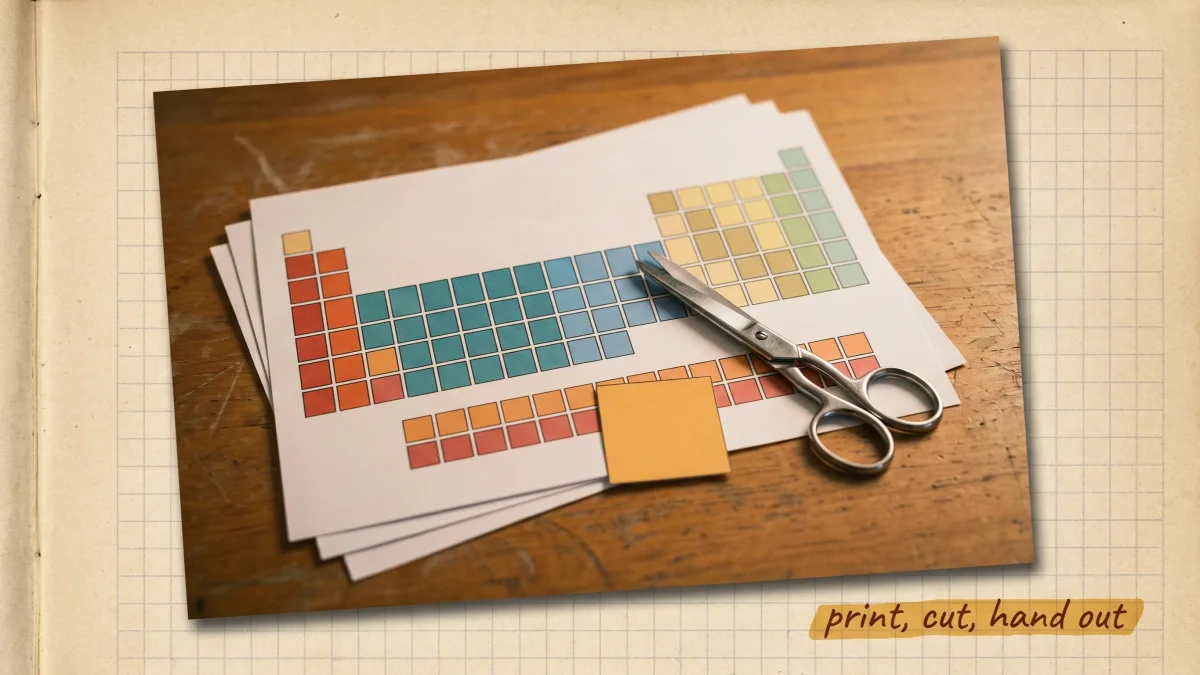
Short answer: Periodic Mole publishes a free, CC-licensed set of chemistry printables for the classroom: two periodic table designs in Letter, A4, and 11×17, a blank practice worksheet, a four-page wall poster, duplex flashcards, and one-page posters for all 118 elements, most with an image and all with a 0–5 hazard rating.
Most printable periodic tables show the grid of symbols and stop there. These go further: the element posters add images and a hazard rating, the classroom chart comes at three data levels, and the blank worksheet works as a retrieval-practice drill. Everything is licensed CC BY-NC-ND 4.0: copy it, hand it out, put it on the wall. The only things you can't do are sell it or publish an altered version, and please credit Periodic Mole.
What free chemistry printables can teachers download?
Everything lives on one page, the printable periodic table hub. Here is the full set and when each one earns its paper.
| Printable | What it is | Best for |
|---|---|---|
| Minimal table | A clean designer chart, one color dot per family | Handouts; prints sharp in B&W |
| Classroom table | A color chart at three data levels (names, mass, full) | The reference every desk needs |
| Blank worksheet | Atomic numbers only, symbols and names left empty | Retrieval-practice drills |
| Wall poster | The color chart tiled across four Letter sheets | A full-size wall table |
| Element posters | One page per element, all 118, in three print tones | Bulletin boards, element-of-week |
| Duplex flashcards | Eight cards a sheet, symbol front, name and a fact back | Cutting into a class card deck |
Print at Letter for a binder, A4 outside the US, or 11×17 for a display copy that dresses up the classroom wall. Two of these deserve their own note.
Which printable periodic table should I use?
Pick your printable periodic table by printer and purpose. The minimal chart uses hairline cells and marks each chemical family with a single color dot, so it stays legible when a black-and-white copier flattens it. The classroom chart uses filled family colors and comes in three information levels: element names only, names with the IUPAC 2021 atomic masses, or the full version that adds electron configuration. Give a first-year class the names-only version in September and the full one once they hit electron shells.
Both print at Letter, A4, and 11×17. The wall poster takes the color chart to roughly 21 by 16 inches by tiling it across four Letter pages you tape together, which is how you get a wall-size periodic table without a plotter or a lamination bill.
What's on the blank periodic table worksheet?
The blank worksheet keeps the atomic number in each cell and clears the symbol and name for the student to fill in. That is not a formatting choice, it is the pedagogy: pulling a fact out of memory builds a stronger, longer-lasting trace than reading the same fact again, an effect cognitive scientists call the testing effect (Roediger and Karpicke, 2006). A blank table is a retrieval sheet you can hand out cold on a Monday.
Pair it with the interactive periodic table as the answer key, and the loop closes: guess, check, correct. Three ten-minute runs across a week beat one long copy-the-table session, because spacing the practice is what moves it into durable memory.
For a ready-to-use lesson, try our blank-table exercises and answer key: a ten-element quiz, group and period questions, and family marking.
Are the element posters really free for all 118 elements?
Yes, one page each, for every element from hydrogen to oganesson, in three print tones (a bold ink version for a wall, an everyday color version, and black and white). Eighty-seven of the 118 carry an image of the element. The other 31 are synthetic, vanishingly rare, or too radioactive for anyone to have a usable image, so those posters carry a short note on why instead. Einsteinium's says the largest samples ever made glow from their own radioactivity, and essentially no one has seen it.
Every poster also shows a hand-painted hazard emblem and a 0 to 5 danger rating, drawn from the element's worst hazard rather than an average, so lead and helium never look equally tame. That danger layer covers all 118, which makes the posters double as a quick lab-safety reference on the wall.
What else is free for the classroom?
The printables are the core, but a few other teacher-facing resources are also free:
- The mole poster. The mole explained with a carton of eggs turns Avogadro's number into something a 15-year-old can picture.
- The interactive periodic table. Browse every element with images, real-world uses, and the hazard data on screen.
- What elements look like. A photo reference covers where each element actually shows up in the world.
- A printable tournament bracket. The classroom tournament kit is an eight-player single-elimination bracket you can run as a review-day activity.
And if you want the review-day game the bracket is built around, students can jump straight in:
Try it free. Bond Forge is free to play with a starter set of elements, no account needed. Full access is $59 for a year: every game and all 118 elements, with progress saved. No subscription.
What's the license, and what isn't free?
Everything above is licensed CC BY-NC-ND 4.0. In plain terms: teachers and students may share and copy the files freely, but nobody may sell them or publish altered versions. The license is stated on each page and in a dedicated licenses page, so a librarian or a district reviewer can confirm the terms before adopting the resource.
The paywall covers the learning system: saved progress, spaced-repetition decks tuned to each student, and the full set of games across all 118 elements. The reference sheets stay free. The printables and the free games are the open front door; you never need to walk through the paid one to use them.
FAQ
Are these periodic table printables really free? Yes. Every file is free under a CC BY-NC-ND 4.0 license. You may copy and distribute them to a class or a whole department; the only restriction is that you can't sell them or publish a modified version.
Can I print the periodic table on a regular classroom printer? Any office printer handles it. Every table comes in Letter and A4, and the minimal chart is designed to stay sharp in black and white, so a standard copier manages it. For a wall-size table, the four-page poster tiles across four Letter sheets you tape together.
Do the printables include a blank periodic table for practice? Yes. The blank worksheet keeps the atomic numbers and clears the symbols and names for students to fill in, which makes it a ready-made retrieval-practice activity. Use the interactive table on the site as the answer key.
Are the atomic masses correct? Yes. Atomic weights follow the IUPAC 2021 abridged values, and every file is generated from the same data as the interactive table, so the printed numbers match what students see on screen. Bracketed values are the mass number of the longest-lived isotope, the standard convention for elements with no stable form.
Can homeschoolers use these too? Nothing here is tied to a school account or a district. A homeschool parent can download, print, and use the whole set the same way a classroom teacher does, under the same license.
Related
Sources
- IUPAC (2021). Atomic weights of the elements 2021. Pure and Applied Chemistry. Standard atomic weights used on every printable.
- Roediger, H. L., and Karpicke, J. D. (2006). Test-enhanced learning. Psychological Science. The testing effect behind the blank worksheet.
- Creative Commons. CC BY-NC-ND 4.0 deed. The license on every file (creativecommons.org/licenses/by-nc-nd/4.0/).