
What Every Element Looks Like
6 min read
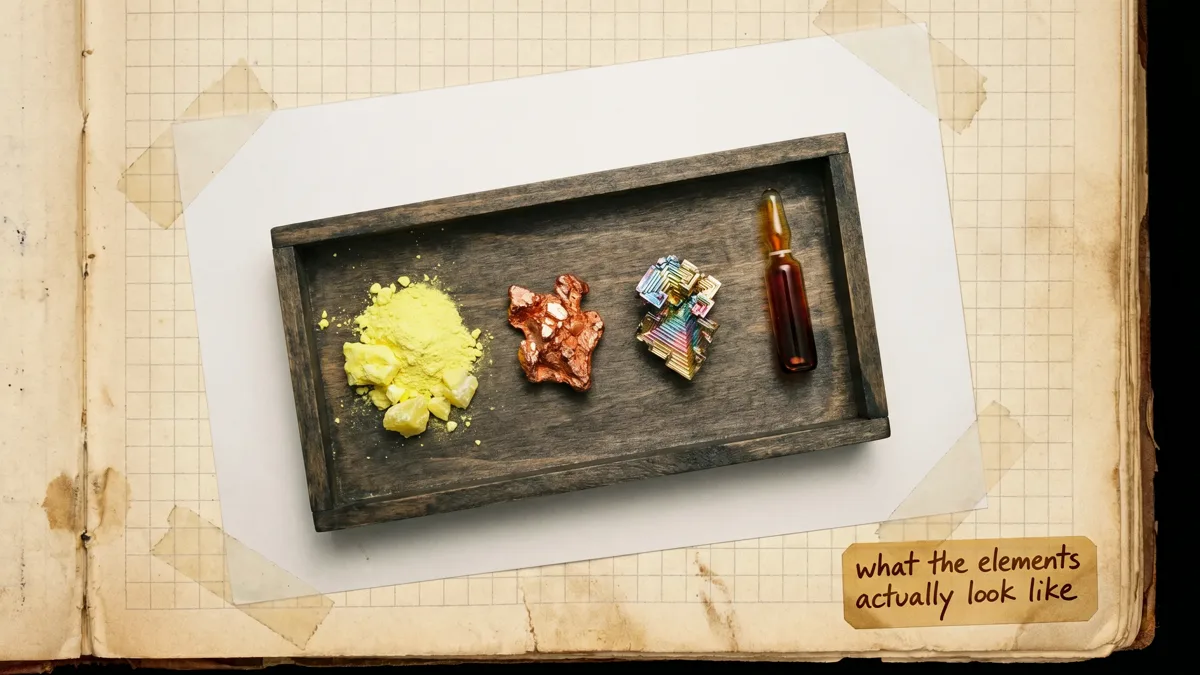
Short answer: Most of the periodic table is silvery-grey metal, so the oddballs are the ones worth knowing. Bromine is a dark red-brown liquid, cesium is gold, and sulfur is bright canary yellow. Gallium melts in a warm hand; bismuth grows crystals that shimmer in rainbow colors. A few elements, like astatine, no one has ever seen.
Roughly 90 of the 118 elements are metals, and most of those are some shade of silver or grey (Royal Society of Chemistry). Iron, nickel, titanium, zinc, and nearly all the rare earths would be hard to tell apart in a lineup. That sameness is exactly why the exceptions are worth knowing. This is the periodic table you can actually see.
Which elements have real color?
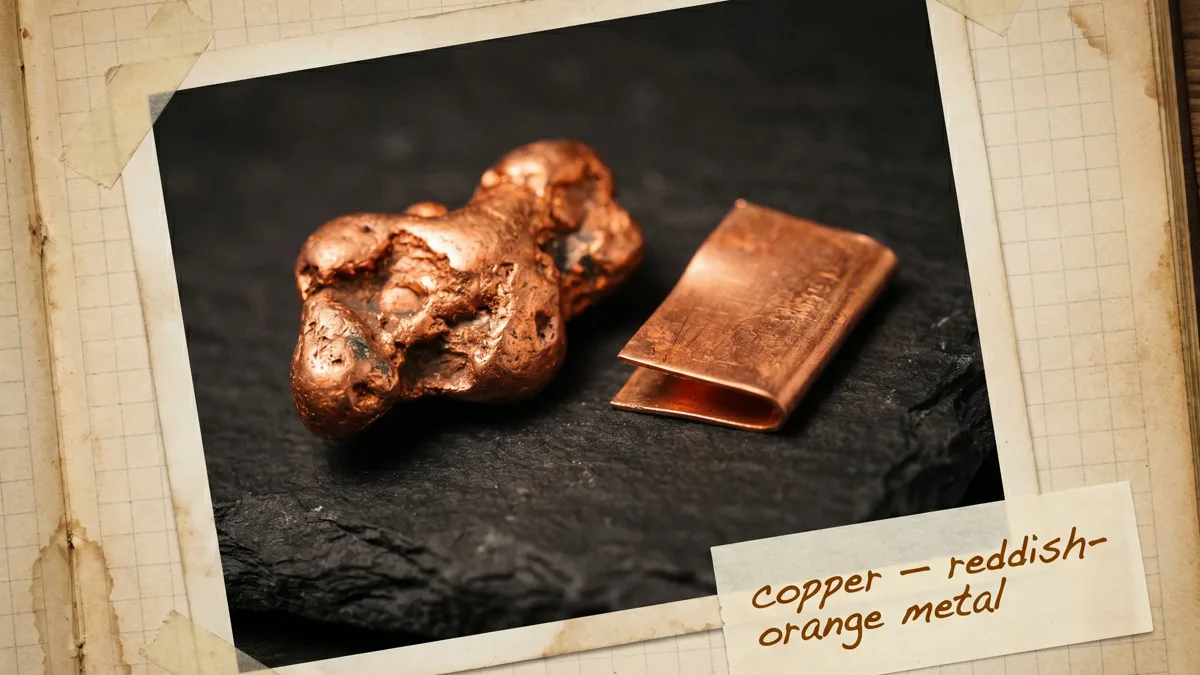
Real color is rare on the periodic table, which is what makes the colored elements easy to remember. Among the metals there are only two strong cases: copper is reddish-orange and gold is yellow. (Cesium carries a faint gold tint, and osmium a slight blue, but those are subtle.) The vivid colors live among the nonmetals: sulfur is canary yellow, chlorine a pale yellow-green gas, fluorine a pale yellow gas, and iodine forms grey-black crystals that give off a violet vapor.
| Element | Color it actually is | Where you meet it |
|---|---|---|
| Copper (Cu) | Reddish-orange metal | Bare wires inside a cable |
| Gold (Au) | Warm yellow metal | Jewelry that never tarnishes |
| Sulfur (S) | Bright canary-yellow powder | Match heads, gunpowder |
| Chlorine (Cl) | Pale yellow-green gas | Keeps pool water clean |
| Bromine (Br) | Dark red-brown liquid | Hot-tub sanitizer |
| Iodine (I) | Grey-black crystal, violet vapor | Brown antiseptic for cuts |
Which elements are liquid at room temperature?
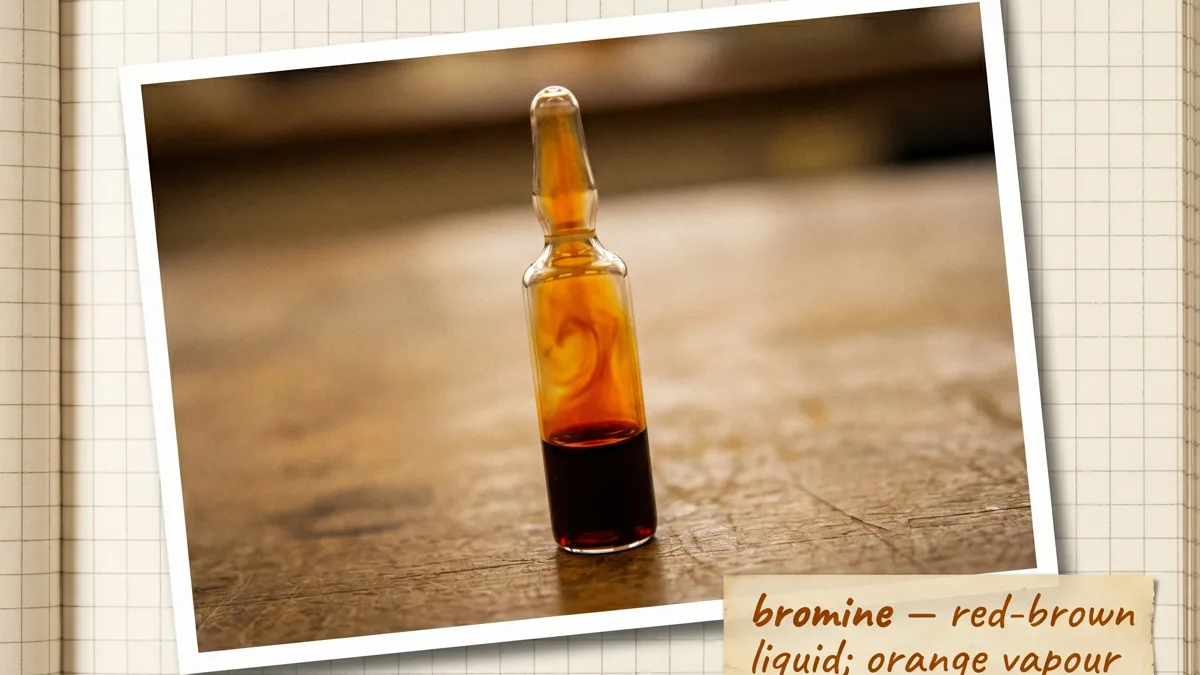
Only two elements are liquid at room temperature: mercury, the familiar mirror-bright silver of an old thermometer, and bromine, a dark red-brown liquid that gives off an orange-brown vapor (CRC Handbook). Bromine is the one students forget, because a liquid nonmetal feels like it breaks the rules.
Two more elements sit right on the edge. Gallium melts at about 30 °C (85 °F), cooler than body heat, so a piece held in a warm hand slowly turns to liquid. Stand a gallium spoon in a glass of warm water and the water alone melts it down into the cup. Cesium melts even lower, near 28 °C, though it is a soft gold-tinted metal far too reactive to hold the way you can hold gallium.

What is the most surprising element to look at?
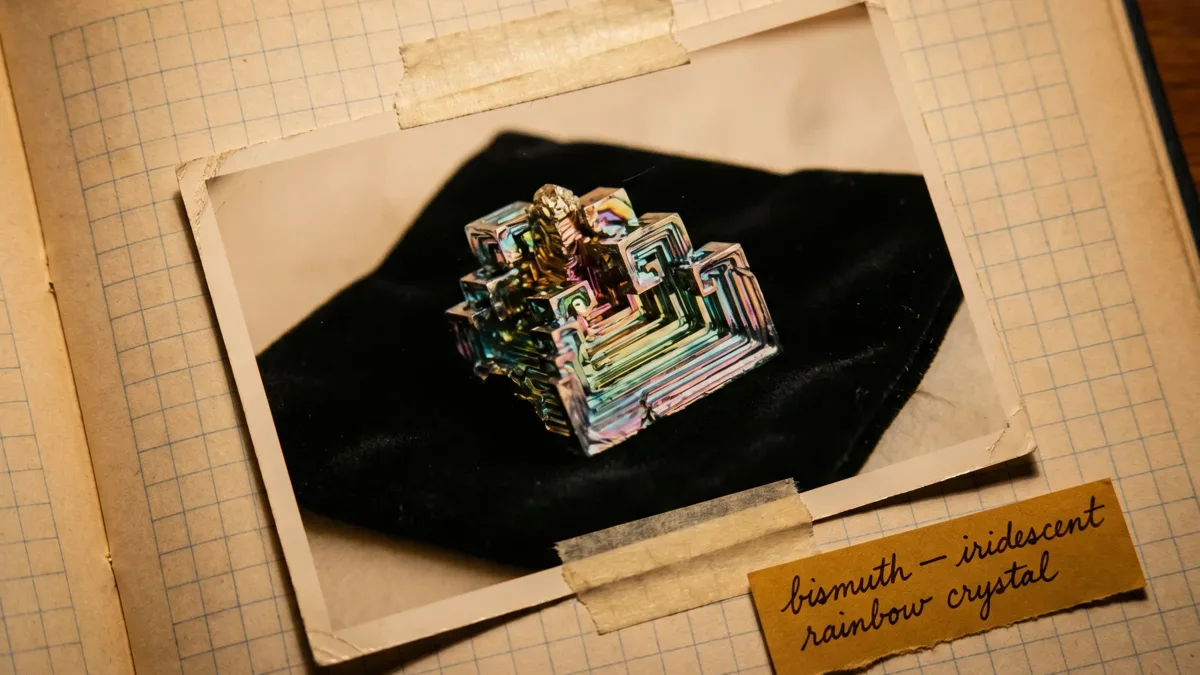
Bismuth is the showstopper. Cooled slowly from a melt, bismuth grows stair-stepped "hopper" crystals, and a thin oxide film on the surface splits light into a rainbow of pink, blue, and gold. It looks engineered, but the geometry is just how the crystal grows. Bismuth is also the metal hiding in pink stomach medicine, where a bismuth compound is the active ingredient.
Where do you run into these elements every day?
The elements are easier to remember once you can point to where they hide. Each of these is doing a job you have seen, even if you never saw the element itself:
- Tungsten (W) has the highest melting point of any element, which is why it glows as the filament inside an old light bulb without melting.
- Neon (Ne) is colorless until electricity runs through it, then glows the red-orange that gave "neon" signs their name.
- Americium (Am) is a synthetic, radioactive metal, yet a microscopic sealed speck sits inside almost every household smoke detector.
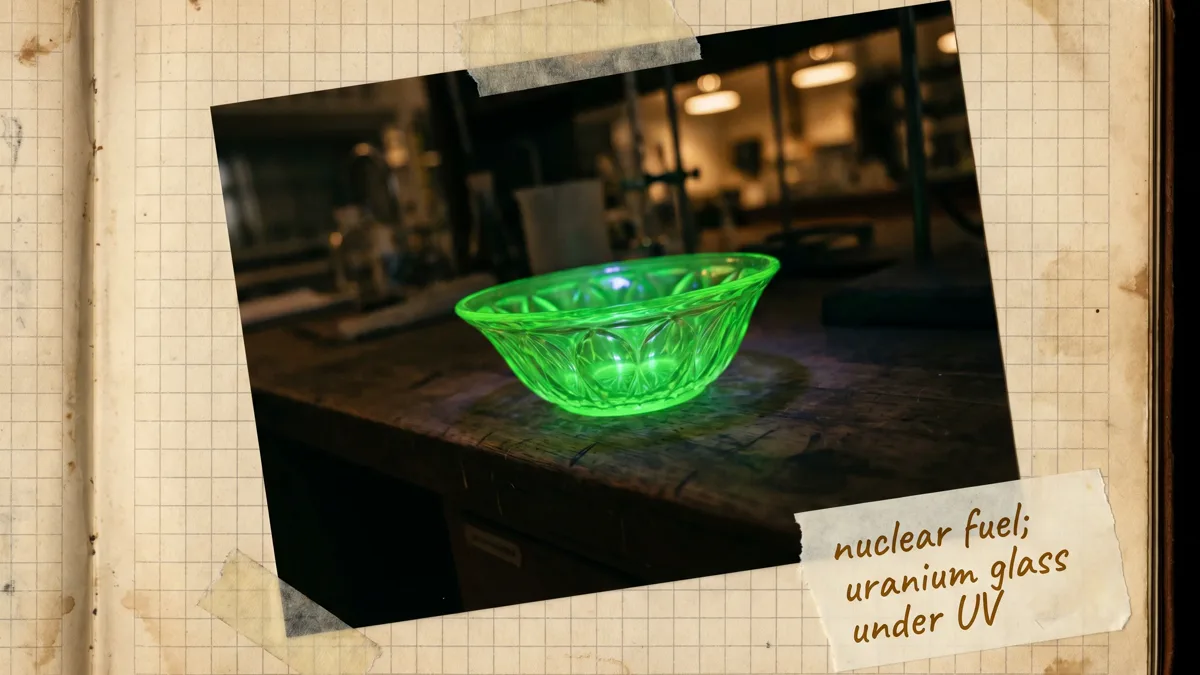
- Uranium (U) turns vintage glass a soft green that glows vivid fluorescent green under an ultraviolet lamp.
- Neodymium (Nd) makes the strongest permanent magnets, the kind in headphones and electric-motor rotors.
Why has no one ever seen astatine?
Astatine is the rarest naturally occurring element on Earth, and it is so radioactive that any visible piece would instantly boil away in the heat of its own decay, so no one has ever seen it (Royal Society of Chemistry). It is not the only element you can never meet. Francium survives only minutes in its longest-lived form, and the synthetic superheavies past uranium decay an atom at a time, so a piece big enough to see has never existed. For about a quarter of the periodic table, the real picture is no picture at all, and the reason why is the chemistry.
How can francium exist if it lasts only minutes?
Francium is not left over from when Earth formed. Nothing with a 22-minute half-life could survive 4.5 billion years, so every francium atom on Earth was made within the last hour or so. The source is ordinary uranium ore. Uranium-235 decays down a long chain to actinium-227, and about 1.4% of the time actinium-227 alpha-decays into francium-223 (Royal Society of Chemistry). That francium decays away within minutes while fresh atoms keep appearing behind it, so the whole crust holds less than an ounce of it at any moment, never gathered in one place. Francium is the second-rarest naturally occurring element, after astatine, because you cannot stockpile something that decays in minutes; you can only catch it mid-flight.
See every element for yourself
Periodic Mole has a generated, true-color image for every element you can actually see, paired with where it shows up in daily life, in the elements in real life gallery. Each element also has its own page in the interactive periodic table, with the appearance, the everyday use, and the chemistry behind it.
Knowing what an element looks like is the easy, fun end of chemistry. The harder skill is recalling the names, symbols, and patterns on demand, and the way to build that is short, regular practice rather than one long cram session.
Try it free. Bond Forge is free to play with a starter set of elements, no account needed. One payment of $59 unlocks every game and all 118 elements, with progress saved. No subscription.
FAQ
What color is each element? Most elements are silvery-grey metals. The strongly colored ones are the exceptions: copper is reddish-orange, gold is yellow, sulfur is canary yellow, chlorine is a pale yellow-green gas, bromine is a red-brown liquid, and iodine is a grey-black crystal that gives off violet vapor.
How many elements are liquid at room temperature? Two: mercury and bromine. Two more, gallium and cesium, melt just above room temperature, around 30 °C, so they turn liquid from the warmth of a hand or a glass of warm water.
Which element melts in your hand? Gallium. It melts at about 30 °C (85 °F), so a piece held in a warm hand slowly turns to a silvery liquid. Cesium, which melts near 28 °C, behaves the same way but is far too reactive to hold safely.
Why can’t you see astatine? Astatine is intensely radioactive and exists only in trace amounts. Any sample large enough to see would vaporize from the heat of its own radioactivity, so no visible piece of astatine has ever existed.
Related
- How the Hunt Brothers Cornered Silver
- Helium Was Discovered on the Sun First
- When Aluminum Was Worth More Than Gold
- Fireworks Chemistry: Every Color in the Sky
- How to Memorize the Periodic Table Fast
- The Best Interactive Periodic Table
- Free Chemistry Printables for Teachers
- Periodic Table Games: What to Play
- The Mole, Explained With a Carton of Eggs
Sources
- Royal Society of Chemistry. Periodic Table (rsc.org/periodic-table). Per-element appearance, physical state, and everyday uses.
- Emsley, J. (2011). Nature’s Building Blocks: An A–Z Guide to the Elements. Oxford University Press.
- Haynes, W. M. (ed.). CRC Handbook of Chemistry and Physics. Melting points and the two elements liquid at room temperature.