
How the Hunt Brothers Cornered Silver
7 min read
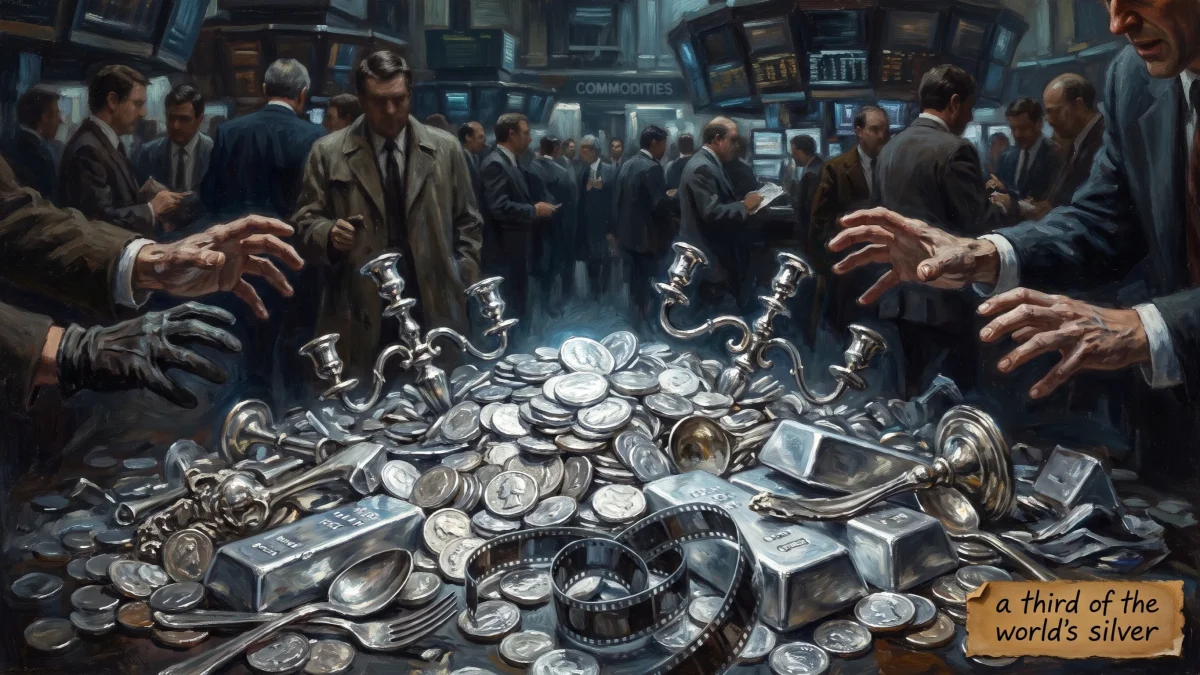
Short answer: In 1979 and 1980 the Texas brothers Nelson Bunker Hunt and William Herbert Hunt bought so much silver they held, by many estimates, around a third of the world's privately deliverable supply, driving the price from about $6 to nearly $50 an ounce. Then it collapsed. Margin calls and new exchange rules broke them, and silver's double life as an industrial metal is why the corner was so hard to hold in the first place.
To corner a market is to buy up so much of a thing that you control its price, and for a few strange months two brothers nearly did it with an entire element. Margin calls and new exchange rules finally broke their position. But the reason a corner on silver was so hard to hold at all is that silver is not just money. It is a working industrial metal, and that turns out to be very hard to hoard.
Who were the Hunt brothers, and what did they do?
They were sons of the Texas oil billionaire H. L. Hunt, and in the 1970s they decided the dollar was doomed and silver was safe. Nelson Bunker Hunt and William Herbert Hunt, with their brother Lamar involved to a lesser degree, began buying silver in the early 1970s at under $2 an ounce and never really stopped (Britannica).
By early 1979 silver was around $6 an ounce, and the brothers kept buying, taking delivery of the actual metal rather than settling in cash the way most futures traders did. Between mid-1979 and the start of 1980 the silver they controlled climbed from roughly 123 million to about 195 million ounces. All told, the Hunts and their partners held something like 200 million ounces. By many estimates that was on the order of a third of the world's privately held deliverable silver, though what counts as the world's available supply is itself a slippery figure (Fay, The Great Silver Bubble). The more they bought, the higher the price went, and the higher the price went, the richer their existing pile looked.
Why silver, of all things?
Because silver is one of the most useful metals there is, which the brothers read as a floor under the price. It is the best electrical conductor of any element, better even than copper, and the best conductor of heat and reflector of light among metals, so it runs through electronics, switches, and mirrors. It is also the heart of photographic film: crystals of silver halides, such as silver bromide and silver chloride, darken where light hits them, and for more than a century that reaction was how nearly every photograph was made (Metalorix; Energy Education).
That constant industrial appetite is real, and in 1980 photography alone consumed a large share of the world's silver every year. The Hunts were betting that steady demand, plus a supply that could not grow quickly, meant a corner would hold. The same usefulness, though, is exactly what undid them.
What happened on Silver Thursday?
The price ran away first. Silver crossed $30 in late 1979 and peaked at about $49.45 an ounce on January 17, 1980, an all-time high that made the Hunts' holding worth roughly $10 billion on paper (Britannica). Then the exchanges intervened. Beginning in early January, they brought in a series of measures, including stricter position limits and, before long, liquidation-only trading, that sharply cut the ability to finance new silver. As credit tightened, the price began to slide.
By late March it had fallen back to around $21. Then came March 27, 1980, still known as Silver Thursday: silver dropped by about half in a single day, from around $21 to about $10 or $11 an ounce. The Hunts, who had bought much of their silver with borrowed money, could not meet the margin calls, and about $7 billion in paper wealth turned into something like $1.7 billion of debt. A group of banks arranged a $1.1 billion line of credit to keep the failure from spreading through the financial system.
| Date | Silver, per ounce (approx.) | What was happening |
|---|---|---|
| early 1970s | under $2 | the Hunts start buying |
| early 1979 | about $6 | the accumulation accelerates |
| Jan 17, 1980 | about $49 | all-time peak; the Hunts hold perhaps a third of deliverable silver |
| late March | about $21 | the slide, after new limits on borrowed buying |
| Mar 27, 1980 | about $11 | Silver Thursday: roughly a 50% one-day fall |
Prices are approximate and quoted as of the date; historical silver quotes vary by source. Figures from Britannica and the Silver Thursday record.
Why couldn't they hold the corner?
The financial machinery did most of the breaking: heavy borrowing, the margin calls, the exchange rule changes, and forced selling. But silver's chemistry is why the position was so fragile to begin with. Gold can be hoarded because the world mostly leaves it alone; it barely reacts, so it sits in vaults and jewelry, and its above-ground stock changes slowly. Silver behaves much more like a flow: because the world actively uses it, high prices quickly pull extra metal out of industry, scrap, and private drawers.
That is exactly what happened. As the price shot toward $50, people melted silverware, candlesticks, and heirlooms for scrap and pulled old coins out to be refined. High prices also made it suddenly worth recovering silver from places that normally keep it, like spent photographic fixer, X-ray film, and electronic waste. Industrial users, meanwhile, used less and switched to substitutes, and they were furious. On March 26, 1980, the day before the crash, Tiffany & Co. ran an advertisement in The New York Times headed "Unconscionable," attacking the hoarding of silver and what it did to everyone who actually needed the metal (Britannica).
So the available silver kept expanding underneath them, even though the amount in the ground never changed. A metal the world recycles out of its own drawers is a metal no one can truly own all of. The margin calls and rule changes sprang the trap; silver's double life as money and material is why the trap was there at all.
Could someone corner silver today?
It is harder than it looks, for the same reason it was in 1980. A working metal like silver answers a price spike with scrap and thrift, and its price is tied to real industrial demand that rises and falls on its own. A metal that mostly sits idle, like gold, has a more fixed above-ground stock, though cornering gold today would be nearly impossible too, given central-bank reserves, exchange-traded funds, derivatives, and the sheer size of the market. The Hunts were later found by a federal jury to have conspired to corner the market, and were ordered in 1988 to pay more than $130 million in damages. Bunker Hunt, once among the richest men alive, filed for bankruptcy.
You can see silver's place in the table, and where it turns up in daily life, on its page in the interactive periodic table, or browse the whole set in the elements in real life gallery.
Try it free. Bond Forge is free to play with a starter set of elements, no account needed. Full access is $59 for a year: every game and all 118 elements, with progress saved. No subscription.
FAQ
Who were the Hunt brothers? Nelson Bunker Hunt and William Herbert Hunt were sons of the Texas oil billionaire H. L. Hunt. In the 1970s they began buying silver as a hedge against the dollar, and by 1980 they and their partners held, by many estimates, around a third of the world's privately deliverable silver, driving the price from about $6 to nearly $50 an ounce.
What was Silver Thursday? Silver Thursday was March 27, 1980, when the price of silver fell by about half in a single day, from around $21 to about $10 or $11 an ounce. The Hunt brothers, who had bought much of their silver with borrowed money, could not meet their margin calls, and the collapse turned billions in paper wealth into debt.
Why did the Hunt brothers buy silver instead of gold? Silver is a heavily used industrial metal, the best electrical conductor of any element and the basis of photographic film, so the brothers expected steady demand to support the price. Its above-ground supply also looked smaller and easier to control than gold's. That same industrial usefulness backfired: high prices pulled scrap silver into the market and cut demand, which made the corner far harder to hold.
Can you corner the silver market? It is very difficult. Silver is constantly recycled from film, electronics, and silverware, so when prices spike the supply grows as scrap floods in and users cut back. Unlike gold, which mostly sits idle, silver's supply is a flow tied to real industrial demand, which makes a lasting corner nearly impossible.
Related
- When Aluminum Was Worth More Than Gold
- Helium Was Discovered on the Sun First
- What Every Element Looks Like
- Fireworks Chemistry: Every Color in the Sky
Sources
- Encyclopædia Britannica. Silver Thursday. The Hunt brothers, the price peak, the March 27, 1980 crash, the margin calls and bank credit line, and the Tiffany & Co. "Unconscionable" advertisement.
- Fay, Stephen (1982). The Great Silver Bubble. The definitive account of the episode; the holdings and the "share of the world's supply" framing (a figure that varies by how "available" silver is defined).
- Wikipedia. Silver Thursday. Corroborates the accumulation figures (about 123 to 195 million ounces) and the timeline.
- Metalorix. Silver's Conductivity Record. Silver as the best electrical conductor of any element.
- Energy Education, University of Calgary. Silver. Silver-halide photography and silver's industrial uses.