
Helium Was Discovered on the Sun First
6 min read
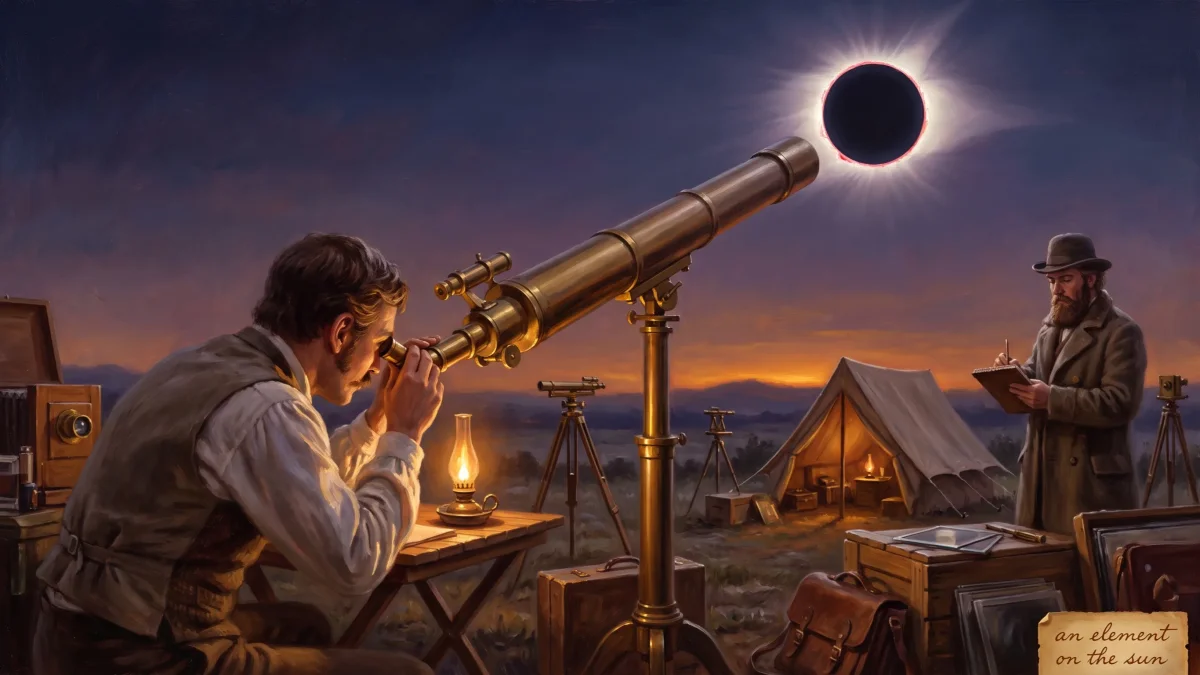
Short answer: Helium is the only element found in space before it was found on Earth. During a total solar eclipse in 1868, astronomers saw a yellow line in the Sun's light that matched no known element. They named it helium, after the Greek word for the Sun. It took 27 years to find the same gas here at home.
Every other naturally occurring element was identified on Earth first, then spotted out in the universe. Helium ran the other way. The story of how anyone could name an element they had never touched is also the story of how we learned to read what stars are made of, and it starts with a trick of split light.
Was helium really discovered on the Sun?
Yes, and the date is on record. On August 18, 1868, the French astronomer Jules Janssen traveled to Guntur, India, to watch a total solar eclipse. With the Sun's blinding disk blocked by the Moon, he pointed a spectroscope at the glowing rim of gas around it and saw a bright yellow line (APS, 2014).
That line sat close to the pair of yellow lines that sodium always makes, but not in the same place. A few months later, working in London, the English astronomer Norman Lockyer saw the same stray yellow line and labeled it D3. He and the chemist Edward Frankland proposed something bold: the line came from an element that existed in the Sun and had not yet been seen on Earth. The idea was not accepted right away, but it held (Smithsonian, 2018).
How can you find an element you cannot touch?
Through the fingerprint that every element hides in light. In 1859 and 1860, the German scientists Gustav Kirchhoff and Robert Bunsen showed that each heated element gives off light at its own fixed set of wavelengths, a pattern as unique as a fingerprint. Split that light with a prism and you see a specific set of bright lines, and no two elements share the whole pattern.
You have watched a rough version of this. Drop table salt into a flame and it burns yellow; copper burns green; strontium burns red. The color is the element announcing itself, which is also why fireworks use metal salts to paint the sky. A spectroscope just spreads that light into its separate lines so you can read them one by one.
Point the instrument at the Sun and you are reading what the Sun's outer layers are made of from 93 million miles away. Most of the lines matched elements already known on Earth. The stray yellow one matched nothing, and that mismatch was the whole discovery.
Why is helium named after the Sun?
Because that is the only place anyone had found it. Lockyer and Frankland built the name from helios, the Greek word for the Sun, and it stuck. The choice left a small fossil in the name that chemists still notice today.
They tacked on the ending "-ium," the suffix used for metals like sodium and magnesium, because they assumed the new solar element was a metal, as most newly found elements then were. It is not. Helium turned out to be the first of the noble gases, the least reactive family on the whole periodic table. So helium is the one noble gas whose name ends like a metal's, a permanent reminder that it was named by people who had never held it (Chemistry World, 2018).
When was helium finally found on Earth?
In 1895, twenty-seven years after the eclipse. The Scottish chemist William Ramsay was hunting for argon, the gas he had helped discover a year earlier, when he treated a uranium mineral called cleveite with acid and collected what came off. He passed it through a spectroscope and saw a bright yellow line in exactly the spot Lockyer had marked D3 (Britannica). The Swedish chemists Per Teodor Cleve and Nils Abraham Langlet found it in the same mineral that year and pinned down its weight.
| Year | What happened |
|---|---|
| 1859–60 | Kirchhoff and Bunsen show each element has a unique spectral pattern |
| 1868 | A yellow line in an eclipse matches no known element; named helium |
| 1895 | Ramsay isolates helium on Earth from the mineral cleveite |
The gas the Sun had shown off in 1868 had been locked in those rocks all along, too inert and colorless to give itself away until Ramsay had the right mineral and method to draw it out.
Why does the Sun have so much of it?
Because helium is what stars make. It is the second most abundant element in the universe, after hydrogen, and the Sun forges more of it every second by fusing hydrogen into helium in its core. Hydrogen makes up about three-quarters of the universe's ordinary matter by mass, and helium most of the rest, close to 24%.
Earth is the odd one out. Helium is so light, and so unreactive, that any of it in the open air drifts up and escapes into space. The helium we use for balloons and MRI magnets is not collected from the air. It seeps up slowly from the radioactive decay of uranium and thorium deep in the crust and collects in pockets of natural gas, which is where drilling draws it from today, and where Ramsay's cleveite pointed. An element named for the Sun, it turns out, hides in the ground.
You can see helium's place in the table, and where it turns up in daily life, on its page in the interactive periodic table, or browse the whole set in the elements in real life gallery.
Try it free. Bond Forge is free to play with a starter set of elements, no account needed. Full access is $59 for a year: every game and all 118 elements, with progress saved. No subscription.
FAQ
Was helium discovered on the Sun or on Earth first? On the Sun. In 1868, astronomers watching a total solar eclipse saw a yellow spectral line in the Sun's atmosphere that matched no element known on Earth. They named it helium. It was not isolated on Earth until 1895, making it the only element found in space before it was found here.
Who discovered helium? Credit is shared. Jules Janssen recorded the yellow line during the 1868 eclipse, and Norman Lockyer, with Edward Frankland, identified it as a new element and named it. William Ramsay, along with Per Teodor Cleve and Nils Langlet, first isolated helium on Earth in 1895.
How was helium found without a sample of it? By spectroscopy. Every element emits light at a unique set of wavelengths, like a fingerprint. Splitting sunlight with a spectroscope reveals those lines, and helium's yellow line appeared where no known element's did, which is how it was identified from 93 million miles away.
Why is helium named after the Sun? Its name comes from helios, the Greek word for the Sun, because the Sun was the only place it had been found. The ending "-ium" was added because its discoverers assumed it was a metal, though it later proved to be a noble gas.
Related
- When Aluminum Was Worth More Than Gold
- How Accurate Is Carbon Dating?
- Greenland Shark Lifespan: How Do We Know?
- Fireworks Chemistry: Every Color in the Sky
- What Every Element Looks Like
- The Mole, Explained With a Carton of Eggs
Sources
- American Physical Society (2014). This Month in Physics History: August 18 and October 20, 1868: Discovery of Helium. The eclipse observation, Janssen and Lockyer, and the D3 line.
- Smithsonian Magazine (2018). How Scientists Discovered Helium, the First Alien Element, 150 Years Ago. Lockyer and Frankland naming the element after the Sun.
- Chemistry World (2018). History of the noble gases. The "-ium" naming, and helium as the first noble gas.
- Encyclopædia Britannica. Sir William Ramsay. The 1895 isolation of helium from cleveite.