
When Aluminum Was Worth More Than Gold
6 min read
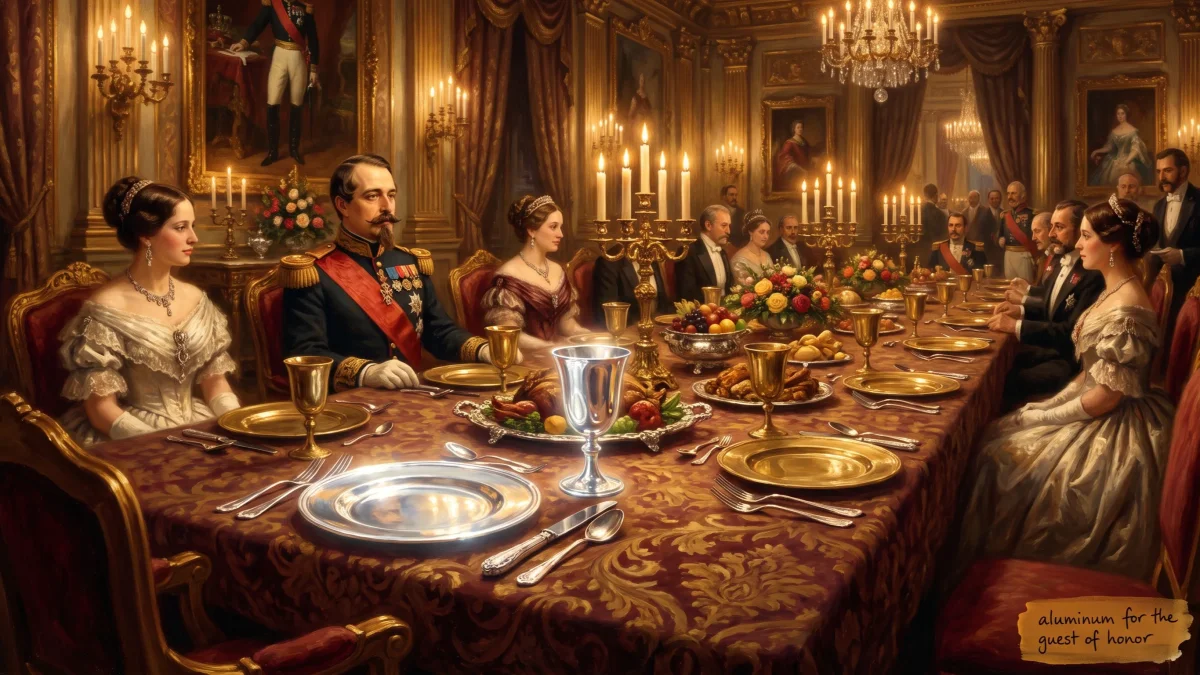
Short answer: In the mid-1800s aluminum was a precious metal, for a time worth more per ounce than gold, because no one could cheaply separate it from its ore. In 1886 two young inventors, working an ocean apart, found how to free it with electricity. Within about fifteen years the price fell by more than 95%, and the metal of emperors became the metal of soda cans.
It is the same element the whole time. The aluminum never changed. What changed was our ability to pull it out of the rock it hides in. That single shift, from nearly impossible to almost free, is why some metals took thousands of years to reach us while others arrived in a rush.
Was aluminum really worth more than gold?
For a stretch of the mid-19th century, yes. Around 1852 aluminum reportedly sold for about $34 an ounce while gold went for roughly $19 (Emsley, 2011). It was rare because separating it from its ore was brutally difficult, even though the Earth is full of it, so the tiny amounts that existed as pure metal were a sensation.
Napoleon III of France saw the appeal at once and bankrolled the research. As the story is usually told, he kept a set of aluminum cutlery for his most honored guests and left everyone else at the table with gold. Historians treat the banquet as reputed rather than documented, so take the forks with a pinch of salt, but the sponsorship was real: the emperor funded the chemist Henri Sainte-Claire Deville, whose process brought the first ingots to the 1855 Paris Exposition, where the metal was shown off as "silver from clay" (NPR, 2019).
Why was the most common metal so hard to get?
Here is the twist that makes the price make sense. Aluminum is the most abundant metal in the Earth's crust, about 8% of it by mass, and the third most abundant element of any kind after oxygen and silicon. The planet is not short on aluminum. The planet is short on loose aluminum.
Gold turns up as nuggets because gold barely reacts with anything, so it sits in the ground as pure metal. Aluminum is the opposite. It grabs oxygen and holds on, so it is always locked away in compounds like bauxite, an ore that is essentially aluminum bonded to oxygen. To get the metal you have to break that bond, and that is a chemistry problem called reduction: the aluminum has to take back the electrons it handed to oxygen.
Iron gives up its oxygen fairly easily. Heat iron ore with carbon in a furnace and the carbon pulls the oxygen away, which is how people have made iron for three thousand years. Aluminum holds its oxygen far too tightly for that trick to work.
The reason is a tug of war over the oxygen. Freeing a metal from its oxide means handing that oxygen to something that wants it more, and carbon wants oxygen more than iron does, so in a furnace the carbon wins and the iron comes out. Aluminum wants oxygen more than carbon does, so carbon has nothing to bargain with. More heat does not change who wins. Only electricity, feeding energy in directly, can separate the two at any workable cost, and that is why aluminum stayed locked in the rock until 1886.
Why is the Washington Monument capped with aluminum?
Because in 1884 aluminum was still a showpiece metal, the kind you would use to crown a national landmark. When the Washington Monument was topped out on December 6, 1884, the point at its summit was a 100-ounce pyramid of cast aluminum, about 8 inches tall (U.S. National Archives, 2014). It was the largest single piece of aluminum anyone had ever cast.
At the time aluminum ran about $1.10 an ounce, roughly twice the price of silver, so the cap was a genuinely extravagant flourish. It was such a curiosity that the maker, William Frishmuth of Philadelphia, put it on display at Tiffany's jewelry store in New York before it shipped to Washington. A jewelry counter was a perfectly natural home for it. Less than two years later, that whole world of prices was about to fall apart.
What made aluminum cheap?
Electricity, and two inventors barely into their twenties, working an ocean apart and unaware of each other. In 1886 Charles Martin Hall, in a woodshed in Ohio, and Paul Héroult, in France, each landed on the same method within months. Both were born in 1863 and, by an odd coincidence, both died in 1914 (Science History Institute).
Their method, still used today and now called the Hall-Héroult process, sidesteps aluminum's stubborn grip on oxygen. You dissolve aluminum oxide in a bath of molten cryolite, which melts at a far lower temperature than the oxide would on its own, then run an electric current through the bath. The current does the pulling that heat and carbon never could, driving the reduction and depositing pure aluminum. Two more advances turned the discovery into an industry. Cheap hydroelectric power, especially from Niagara Falls, made the electricity itself cheap, and the Bayer process of 1888 made pure alumina cheap to pull from bauxite to feed the new smelters. The price fell off a cliff.
| Year | Aluminum, per pound (approx.) | What it compared to |
|---|---|---|
| 1852 | about $550 | more, ounce for ounce, than gold |
| 1884 | about $18 | a precious metal, dearer than silver |
| 1888 | about $5 | falling fast |
| 1893 | under $1 | now a workaday metal |
| 1900 | under $0.30 | pots, wire, and foil |
Price figures are approximate; historical quotes vary by country, purity, and whether they cover lab samples or commercial ingots. They come from the Science History Institute and period records (Emsley, 2011). A metal that cost more than gold in the 1850s was selling for pennies a pound by 1900.
So what actually changed?
Not the element. Aluminum in Napoleon's cutlery, aluminum on the Washington Monument, and aluminum in the foil in your kitchen are the same atoms, with the same 13 protons. What changed was our ability to reduce it, to win the pure metal back from the oxygen it clings to.
The order in which people learned to isolate the metals tracks how reactive each one is. Gold and copper, which barely react, have been worked for thousands of years. Aluminum and the other reactive metals stayed hidden until we had cheap electricity and a workable way to use it to break them out of their ores. The periodic table you study in class is, among other things, a map of that difficulty, and aluminum is the entry that swung from priceless to throwaway in a single human lifetime.
You can see aluminum's real, generated true-color image and where it shows up in daily life on its page in the interactive periodic table, or browse the whole set in the elements in real life gallery.
Try it free. Bond Forge is free to play with a starter set of elements, no account needed. Full access is $59 for a year: every game and all 118 elements, with progress saved. No subscription.
FAQ
Was aluminum ever more valuable than gold? Yes. In the mid-1800s aluminum was harder to purify than gold, so it cost more. Around 1852 it sold for roughly $34 an ounce while gold was about $19. After the 1886 discovery of cheap electrolytic smelting, the price collapsed and aluminum became one of the cheapest metals in daily use.
Why was aluminum so expensive if it is so common? Aluminum is the most abundant metal in the Earth's crust, but it never occurs as pure metal, because it bonds so tightly to oxygen. Before 1886 no one could separate it from its ore affordably, so the small amount of pure aluminum that existed was a luxury.
How is aluminum made now? By the Hall-Héroult process, discovered independently by Charles Martin Hall and Paul Héroult in 1886. Aluminum oxide is dissolved in molten cryolite and a strong electric current is passed through it, which frees the pure aluminum. It is still the industrial method today.
Why is the top of the Washington Monument aluminum? When the monument was finished in 1884, aluminum was still a precious metal worth about twice as much as silver. Capping the landmark with a 100-ounce aluminum pyramid was a display of something rare and modern, two years before the metal became cheap.
Related
- How the Hunt Brothers Cornered Silver
- Helium Was Discovered on the Sun First
- How Accurate Is Carbon Dating?
- Greenland Shark Lifespan: How Do We Know?
- What Every Element Looks Like
- Fireworks Chemistry: Every Color in the Sky
- The Mole, Explained With a Carton of Eggs
- The Best Interactive Periodic Table
Sources
- U.S. National Archives (2014). Topping Off the Tip: Aluminum and the Washington Monument. Cap weight (100 oz), completion date (December 6, 1884), the $1.10 per ounce price, William Frishmuth, and the Tiffany's display.
- Science History Institute. Paul Héroult and Charles M. Hall. The independent 1886 discovery, the cryolite process, and the fall in price after commercialization.
- Emsley, J. (2011). Nature's Building Blocks: An A–Z Guide to the Elements. Oxford University Press. Aluminum's 19th-century precious-metal status and period pricing.
- NPR, Short Wave (2019). A Short History of Aluminum, From Precious Metal to Beer Can. Deville, Napoleon III, and the 1855 "silver from clay" framing.