
The Mole, Explained With a Carton of Eggs
4 min read
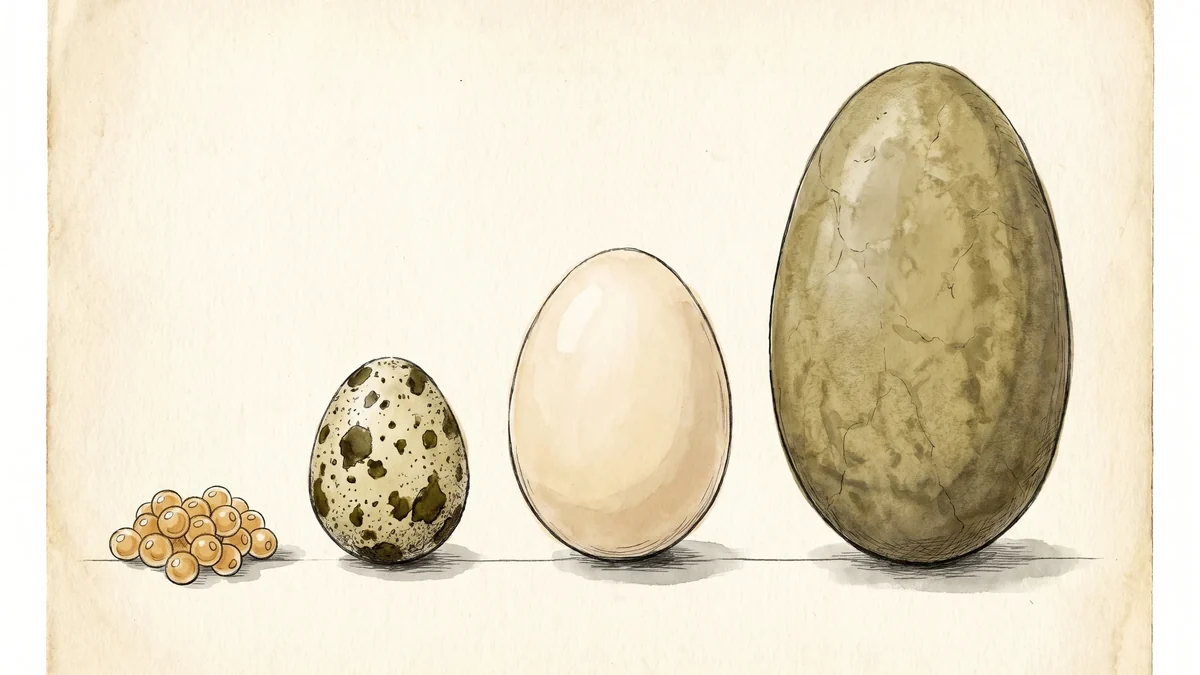
Short answer: A mole is the chemist's word for a count, the way a dozen is. A dozen is 12 of anything. A mole is 6.022 × 10²³ of anything. Neither word tells you what the things weigh, and that missing piece is exactly what trips students up.
Open a carton of eggs and you have a dozen, whether the eggs are tiny or huge. A mole works the same way. The trouble starts when you assume "one mole" means "one weight." It doesn't.
What is a mole, in plain terms?
A mole is a fixed count: 6.022 × 10²³ particles. Chemists fixed that value exactly when they redefined the unit in 2019 (BIPM, 2019), though it is usually written 6.022 × 10²³ and called Avogadro's number, after the Italian scientist Amedeo Avogadro. Atoms are far too small to weigh or use one at a time, so chemists count them in moles the way a grocer counts eggs in dozens. A dozen is 12. A mole is about 602 sextillion. Both are only counting words.
Why doesn't a mole of every element weigh the same?
Because a dozen quail eggs and a dozen ostrich eggs don't weigh the same either. Same count, very different weight. Atoms behave the same way: a hydrogen atom is light and a lead atom is heavy, so a mole of hydrogen weighs about 1 gram while a mole of lead weighs about 207. The count is identical; the mass is not. That weight of one mole has a name, molar mass, and you already own it. It's the atomic weight printed on every square of the periodic table, read in grams.
How the eggs map to atoms
Line up four eggs from smallest to largest and you have the whole idea. Each egg stands for one atom; a carton stands for one mole.
| Egg | Stands for | One mole weighs |
|---|---|---|
| Fish roe | Hydrogen (H) | about 1 g |
| Quail egg | Carbon (C) | about 12 g |
| Hen egg | Oxygen (O) | about 16 g |
| Pterosaur egg | Lead (Pb) | about 207 g |
You could gather a dozen of each, or a mole of each, and the count would match every time. The weights aren't close, and the periodic table tells you each one (atomic weights from IUPAC).
Building water: why 2 + 16 = 18
The payoff is what happens when you combine cartons. Water is H₂O: two hydrogen atoms bonded to one oxygen atom. So one mole of water is built from two moles of hydrogen and one mole of oxygen. Add the grams: two times 1 gram, plus 16 grams, gives 18 grams for a mole of water. Nothing is lost; the atoms only rearrange. That is the molar mass of a compound, and it's how you find any of them: add up the atomic weight of every atom in the formula. It's also conservation of mass, the rule that the grams of the parts equal the grams of the whole.
See it, and put it on the wall
The whole idea runs as a scrolling explainer at the mole, explained with eggs: the dozen, the specimen plate of eggs, the balance that refuses to level, and water coming together one beat at a time.
Teachers get a free 11×17 version of the same picture, sized for the classroom wall. Get the printable poster: one sheet, print-ready, no login. Add your email and it lands in your inbox, or download it straight from the page.
Try it free. Bond Forge is free to play with a starter set of elements, no account needed. One payment of $59 unlocks every game and all 118 elements, with progress saved. No subscription.
FAQ
How big is a mole? One mole is 6.022 × 10²³ particles, about 602 sextillion. It's a counting word like a dozen, only far larger, used because atoms are too small and too many to count one at a time.
Why doesn't a mole weigh the same for every element? A mole is a fixed count, not a fixed weight. Atoms of different elements have different masses, so a mole of light hydrogen weighs about 1 gram and a mole of heavier lead weighs about 207. That weight of one mole is the element's molar mass.
How do you calculate molar mass? Add up the atomic weight of every atom in the formula. Water is H₂O, so two hydrogens (about 1 gram each) plus one oxygen (about 16 grams) give about 18 grams per mole.
Where can I get a free mole poster for my classroom? Periodic Mole has a free, print-ready 11×17 PDF of the egg analogy, no login required. Add your email and it's sent to your inbox, or download it straight from the page. The same explanation runs as an interactive page at periodicmole.com/the-mole.
Related
Sources
- BIPM (2019). The International System of Units (SI), 9th edition. The mole is defined by fixing the Avogadro constant at exactly 6.02214076 × 10²³ per mole.
- IUPAC, Commission on Isotopic Abundances and Atomic Weights. Standard atomic weights of the elements.