
Is High School Chemistry Hard?
5 min read
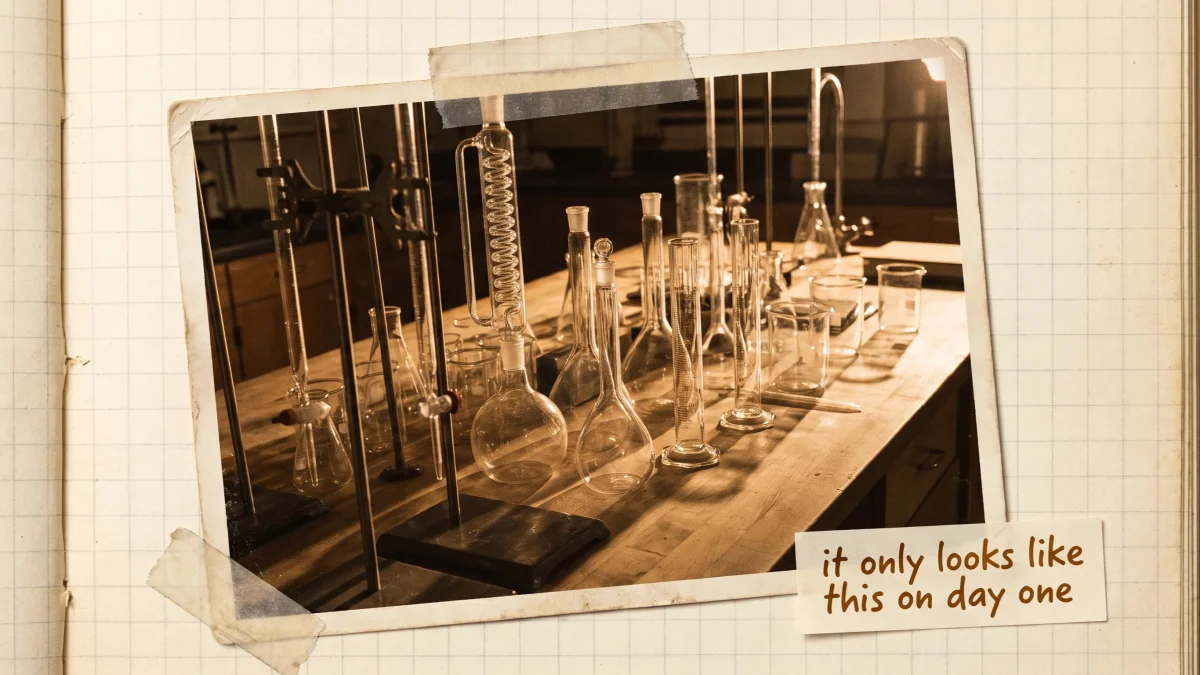
Short answer: High school chemistry is harder than most courses before it, but not because of the math, which rarely passes algebra. Chemistry speaks three languages at once and assumes fluency in one of them: the symbols. Students who make the periodic table automatic before class consistently find the course manageable.
A student who isn't decoding symbols can spend their attention on the ideas, and follows the lesson instead of just surviving it.
Why does chemistry feel harder than biology or earth science?
High school chemistry feels harder than other sciences because it runs on three levels at once. Chemistry education researcher Alex Johnstone's classic analysis (1991) named them: chemistry operates simultaneously on the macroscopic (the fizzing you can see), the sub-microscopic (the invisible particles doing it), and the symbolic (the CO₂ and the balanced equation describing it). A single lesson hops between all three, and a student who hasn't automated the symbolic level has to decode it in real time while also trying to picture invisible particles.
Biology mostly stays on levels you can see or diagram. Chemistry asks you to juggle all three, which is why a student who cruised through earlier science classes can suddenly feel lost in October.
The real bottleneck is working memory, not intelligence
Working memory, the mental scratchpad where you hold things while thinking, fits only a handful of items at once (Sweller, 1988, on cognitive load). Every "wait, what's K again?" eats a slot. A student who has to reconstruct symbols, charges, and formulas on the fly is running the course with half a scratchpad, and what's left isn't enough for the actual new idea being taught that day.
That experience has a predictable emotional sequel: the overload reads as "I'm bad at chemistry," which is wrong but sticky. What the student is short on is automaticity, and anyone can build that in advance, ten minutes at a time.
What actually makes chemistry easier
The research on learning chemistry is unusually clear. Recalling facts from memory, rather than re-reading them, is retrieval practice, one of the most replicated effects in learning science (Roediger and Karpicke, 2006). Spreading that practice across days instead of cramming is spaced practice, which outperformed massed study across more than a hundred studies (Cepeda et al., 2006). Applied to chemistry, the recipe is short daily recall of the foundation, element symbols and names, common ions, the table's layout, started before or early in the course.
| The course when symbols are... | Still being decoded | Already automatic |
|---|---|---|
| A new formula on the board | Letter-by-letter translation | Read at a glance |
| Balancing equations | Two problems at once | One problem |
| The teacher's explanation | Half-followed while decoding | Followed in real time |
| How it feels by October | "I'm bad at chemistry" | "This is actually kind of fun" |
So should you be worried about taking chemistry?
No, but it's worth preparing for differently than other classes. Don't pre-read the textbook; that's passive exposure, and it fades. Make the symbolic language automatic instead. The periodic table is to chemistry what the times tables are to long division: nobody calls multiplication facts "the hard part," but without them every division problem becomes two problems.
A few weeks of ten-minute daily sessions is enough for the core of the table to stick, which is exactly the kind of practice that fits a summer.
The least painful way to do the drilling
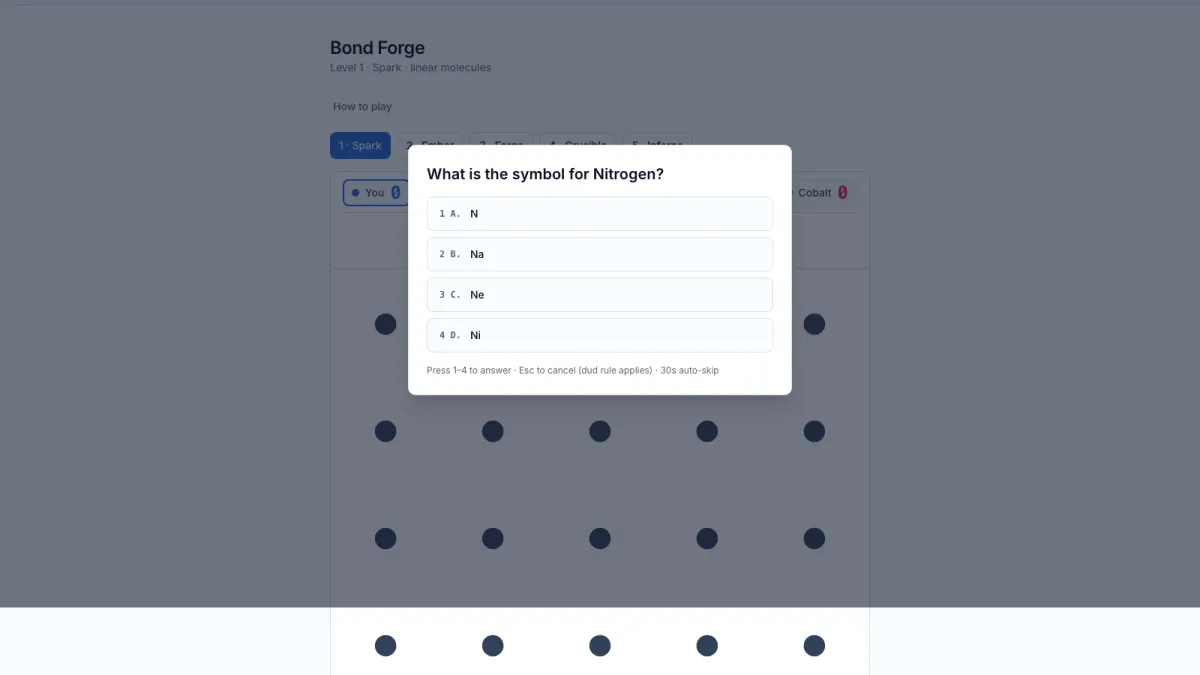
The catch with daily recall practice is that flashcard decks feel like a chore, and the habit dies in week two. Periodic Mole makes the drilling the price of playing: in Bond Forge, you can't draw a bond until you answer a chemistry question right, set at your level. An algorithm tracks your recall across all 118 elements and serves each one back right before you'd forget it. The game is the schedule.
Try it free. Bond Forge is free to play with a starter set of elements, no account needed. One payment of $59 unlocks every game and all 118 elements, with progress saved. No subscription.
FAQ
Is high school chemistry harder than biology? For most students, yes, but not because it demands more ability. Chemistry constantly switches between visible phenomena, invisible particles, and symbolic notation, while biology mostly stays at levels you can see or diagram. Automating the symbols removes most of the gap.
Is high school chemistry a lot of math? Less than its reputation suggests. Most of the math is algebra: ratios, unit conversions, and solving for one variable. Students who struggle with the "math parts" are usually losing track of the chemistry mid-calculation, which is a working-memory problem, not a math problem.
How do I prepare for chemistry before the school year starts? Learn the periodic table: symbols, names, and common ions, in short daily recall sessions rather than one cram. That's the vocabulary the entire course is written in, and it's the highest-leverage thing to have automatic on day one.
What's the hardest part of high school chemistry? Most students hit the wall at the symbolic layer: formulas, equations, and moles, because those topics assume the element symbols are already automatic. The topics themselves are learnable; it's arriving without the vocabulary that makes them feel impossible.
Related
- Get Ahead in Chemistry Before Class Starts
- Element Symbols: Chemistry's Times Tables
- How to Memorize the Periodic Table Fast
- How to Pass the Chemistry Regents in 2027
- The Mole, Explained With a Carton of Eggs
Sources
- Johnstone, A. H. (1991). Why is science difficult to learn? Things are seldom what they seem. Journal of Computer Assisted Learning.
- Sweller, J. (1988). Cognitive load during problem solving: Effects on learning. Cognitive Science.
- Roediger, H. L., and Karpicke, J. D. (2006). Test-enhanced learning. Psychological Science.
- Cepeda, N. J., et al. (2006). Distributed practice in verbal recall tasks: A review and quantitative synthesis. Psychological Bulletin.