
How to Memorize the Periodic Table Fast
4 min read
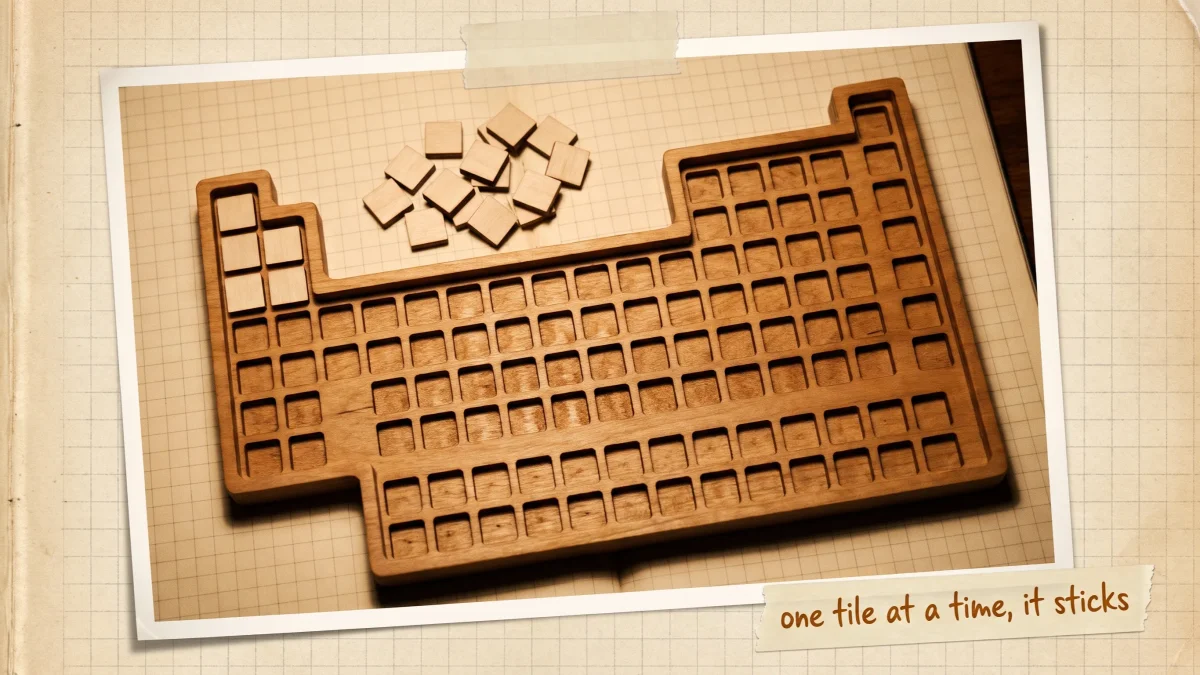
Most people memorize the periodic table the slow, miserable way, then forget it by Monday. There's a faster path that sticks, and it doesn't feel like studying.
Short answer: Don't try to swallow all 118 elements at once. Learn the symbol-to-name link for the first 36 or so elements plus the common ions, and learn it by playing short daily games instead of drilling flashcards. A game makes you recall the answer to win (the thing that builds memory) and it's fun enough that you actually come back tomorrow (the thing that makes it stick). Play against the AI or against a friend. Keep mnemonics as backup.
Start with the elements your class actually uses
Learn the working set first, not all 118. For most high school chemistry that's roughly the first 36 elements, the common polyatomic ions, and the handful that show up constantly: iron, copper, silver, gold, lead, tin. The full table has 118 elements, but the day-to-day set is much smaller, and learning that core first pays off fastest.
Inside that core, the skill worth the most is symbol-to-name recall: you see Na, you think sodium, instantly. The periodic table is the alphabet of chemistry, so reading the symbols on sight makes the rest of the course far easier to follow. Our interactive periodic table has all 118 symbols and names in one place to get familiar with them — free, no sign-up.
Why cramming and mnemonics-alone let you down
Cramming feels productive and evaporates within days, because the brain forgets on a curve. Hermann Ebbinghaus showed back in 1885 that we lose a large share of new information within days unless we revisit it. Mnemonics help you encode a few stubborn items, but they don't build lasting memory on their own either. The thing that actually works is recalling the fact, again and again, spread across days. The problem has always been getting yourself to do that. That's what a game fixes.
The method that's fast, durable, and not boring
Recall to win, not re-read
A game forces you to produce the answer from memory before the clock runs out. Pulling it out of your head, instead of re-reading a chart, is what builds the memory. Researchers call it the testing effect, and students who self-tested remembered far more a week later than students who re-read (Roediger and Karpicke, 2006). A game is just retrieval practice you'd choose to do.
Play a little every day
Five to ten minutes a day beats one long sitting. Spaced practice beats massed practice for long-term memory, confirmed across more than a hundred studies (Cepeda et al., 2006). The hard part is showing up daily, which is exactly where a game you enjoy wins over a deck that's easy to skip.
Bring a friend
Playing head-to-head against a friend is the cheat code for consistency. Not many kids replay flashcards for fun, but plenty will run it back to beat a buddy. More reps, zero extra willpower.
Mnemonics for the holdouts
For the few elements that refuse to stick, reach for a memory trick. As a targeted backup it's great. As the whole plan, it falls apart.
Flashcard drilling vs. learning by playing
| Flashcard drilling | Learning by playing | |
|---|---|---|
| Builds recall | Yes, if you do it | Yes, recall to win |
| Will a teen do it daily | Rarely | Much more often |
| Spacing across days | Only if disciplined | Built into daily play |
| Play with a friend | No | Yes, head-to-head |
| Feels like | A chore | A game |
The fastest setup, step by step
- Focus on the core elements plus common ions, as symbol-to-name.
- Play a short round daily, against the AI or a friend, and recall before the timer.
- Run it back with a friend when you can; it's the easiest way to get the reps.
- Mnemonics for the last few holdouts.
Periodic Mole does this for you: it teaches the table by playing, and you can't take your turn until you answer a chemistry question right, set at your level. It tracks every element as Coming up, Learning, or Mastered, so you watch the table fill in as an algorithm graduates each element once it recognizes you've mastered it. Knowing the table cold is also what makes chemistry class feel fun instead of frantic, which is the actual goal.
Try it free. Bond Forge is free to play with a starter set of elements, no account needed. One payment of $59 unlocks every game and all 118 elements, with progress saved. No subscription.
FAQ
How long does it take to memorize the periodic table? The core working set, about 36 elements plus common ions, is realistic in roughly a week of short daily sessions. The full 118 takes longer, and most high school courses don't require all of them.
What's the fastest way to memorize it for a test tomorrow? Focus only on the elements your test covers and self-test by recalling names from symbols, ideally in a few short game rounds rather than one long stare at the chart. You'll keep more.
Are games actually a good way to memorize the periodic table? Yes. A good periodic-table game is retrieval practice plus daily spacing, the two best-proven memory techniques, in a form you'll actually repeat. The fun is what gets you the reps.
Do mnemonics work for the periodic table? They help for a few stubborn elements but don't build lasting memory alone. Pair them with recall practice, which a game delivers naturally.
For practice on paper, use our blank periodic table worksheet and exercises. The numbered cells give you clues, and the completed chart lets you check symbols and names after each attempt.
Related
- The Best Interactive Periodic Table
- Element Symbols: Chemistry's Times Tables
- Why Students Forget Chemistry So Fast
- Periodic Table Games: What to Play
- What Every Element Looks Like
- How to Study for a Chemistry Test
- How to Study Chemistry With Friends
- How to Pass the Chemistry Regents in 2027
- Master the Periodic Table, Earn Real Money
Sources
- Cepeda, N. J., et al. (2006). Distributed practice in verbal recall tasks: A review and quantitative synthesis. Psychological Bulletin.
- Roediger, H. L., and Karpicke, J. D. (2006). Test-enhanced learning. Psychological Science.
- Ebbinghaus, H. (1885). Memory: A Contribution to Experimental Psychology.