
How to Study Chemistry With Friends
4 min read
Studying with friends is great for morale and terrible for memory. It usually turns into one person explaining while everyone nods, or it dissolves into group chat. The fix isn't more discipline. It's a format where the social part and the learning part are the same thing.
Short answer: Most group study fails because only one person is actually recalling anything; the rest are recognizing along. Head-to-head chemistry games fix that by making everyone answer a question correctly to make a move. You stay social and competitive, but nobody can coast, because you can't take your turn without knowing the answer.
Why ordinary group study doesn't stick
When a friend explains a concept and you nod, that's recognition: it feels like understanding and builds almost no durable memory. The person doing the explaining learns the most, because they're the one retrieving. A widely cited review of study techniques put practice testing among the most effective methods and re-reading-style activities among the least (Dunlosky et al., 2013). Group study tends to be all explaining and no testing, so most of the table is just along for the ride.
Why head-to-head games flip that
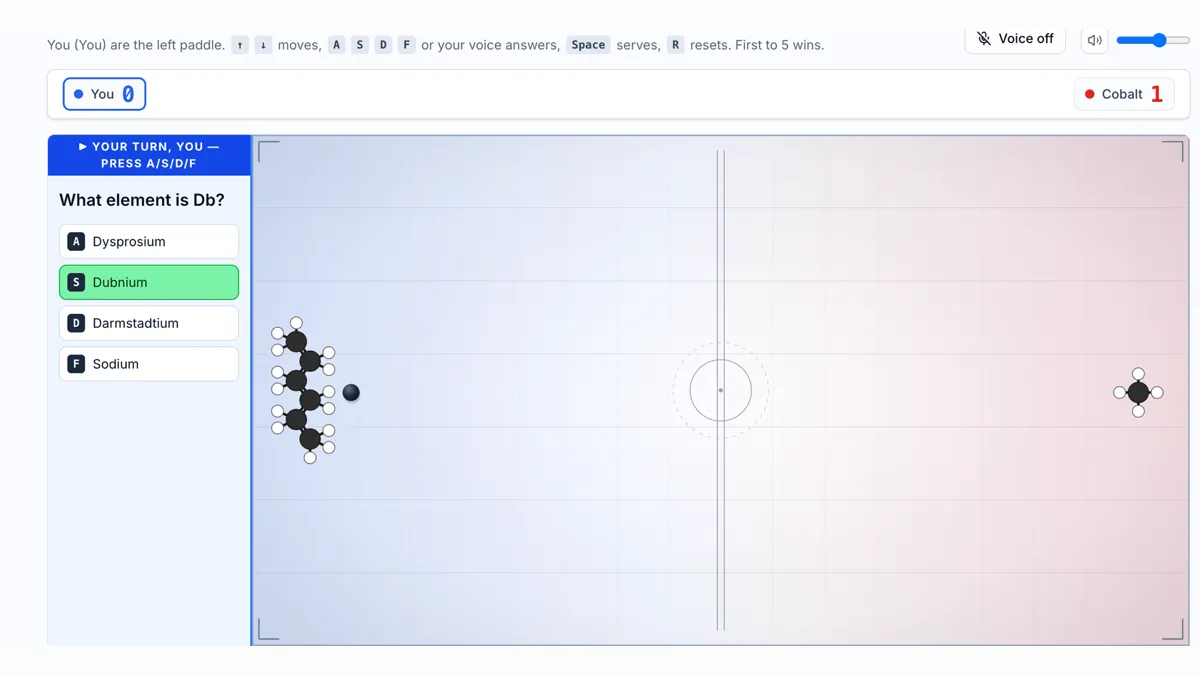
A competitive game makes everyone retrieve, because the game won't let you act until you do. In Periodic Mole, every move is gated on a chemistry question:
- Pt Paddle (free, no sign-up): paddle ball where your paddle grows when you answer right. Play a friend live.
- Bond Forge (free, no sign-up): answer a question to draw a bond; close a box to score and go again. Miss, and your turn is gone and your opponent gets a bonus move.
- Molecule Hunter: hide your molecules and hunt your friend's; every shot is gated by a question, and a wrong answer wastes the turn.
- Capture the Nucleus: hidden-rank tactics where the 12 piece ranks map to periodic-table groups, so a Miner (hydrogen) defusing a Bomb (noble gas) is a strategy move and a chemistry fact at once. Every attack is a question.
Because a wrong answer costs you the move, there's no faking it and no coasting. You're laughing and trash-talking and also drilling the periodic table, at the same time.
You both still learn at your own level
A fair worry about competition: won't the kid who's behind just lose every time and give up? The questions are pulled from each player's own level. Periodic Mole tracks your recall on all 118 elements as Coming up, Learning, or Mastered, and gives each player questions from where they actually are. You both get a real challenge, you both make progress, and you both watch your own table fill in as elements graduate to Mastered.
How to run a good chemistry study session with friends
- Pick a head-to-head game over flat flashcards; the competition is what gets everyone to keep answering.
- Keep rounds short and play a few of them, spread over the week, not one long crammed night.
- Mix who you play. A slightly stronger friend pulls your recall up; a slightly weaker one lets you consolidate.
- Track the table. Watching elements graduate to Mastered is the part that keeps everyone coming back.
Try it free. Bond Forge is free to play with a starter set of elements, no account needed. One payment of $59 unlocks every game and all 118 elements, with progress saved. No subscription.
FAQ
Does studying chemistry with friends actually work? It works when everyone is recalling, not just listening. Plain group study is mostly one person explaining while others recognize along, which builds little memory. Head-to-head games make everyone retrieve to play.
Won't the weaker student just lose and quit? No, because each player gets questions at their own level. Periodic Mole tracks your recall per element and serves you what you're learning, so both players are challenged and both make progress.
Can we play remotely or only in person? Both. The games run head-to-head whether you're side by side or across town.
Is it free to play with a friend? Bond Forge and Pt Paddle are free with no sign-up, including against a friend, though the free versions have a few elements and don't save progress. One payment of $59 unlocks every game and all 118 elements, with progress saved.
Related
- Periodic Table Games: What to Play
- Is Competition Good for Learning?
- How to Study for a Chemistry Test
- How to Memorize the Periodic Table Fast
Sources
- Dunlosky, J., et al. (2013). Improving students' learning with effective learning techniques. Psychological Science in the Public Interest.
- Roediger, H. L., and Karpicke, J. D. (2006). Test-enhanced learning. Psychological Science.