
A Periodic Mole explainer
What is a mole?
It's not the animal or the spy. It's the chemist's counting word, and it hides the one idea that makes chemistry click. The whole thing fits inside a carton of eggs.
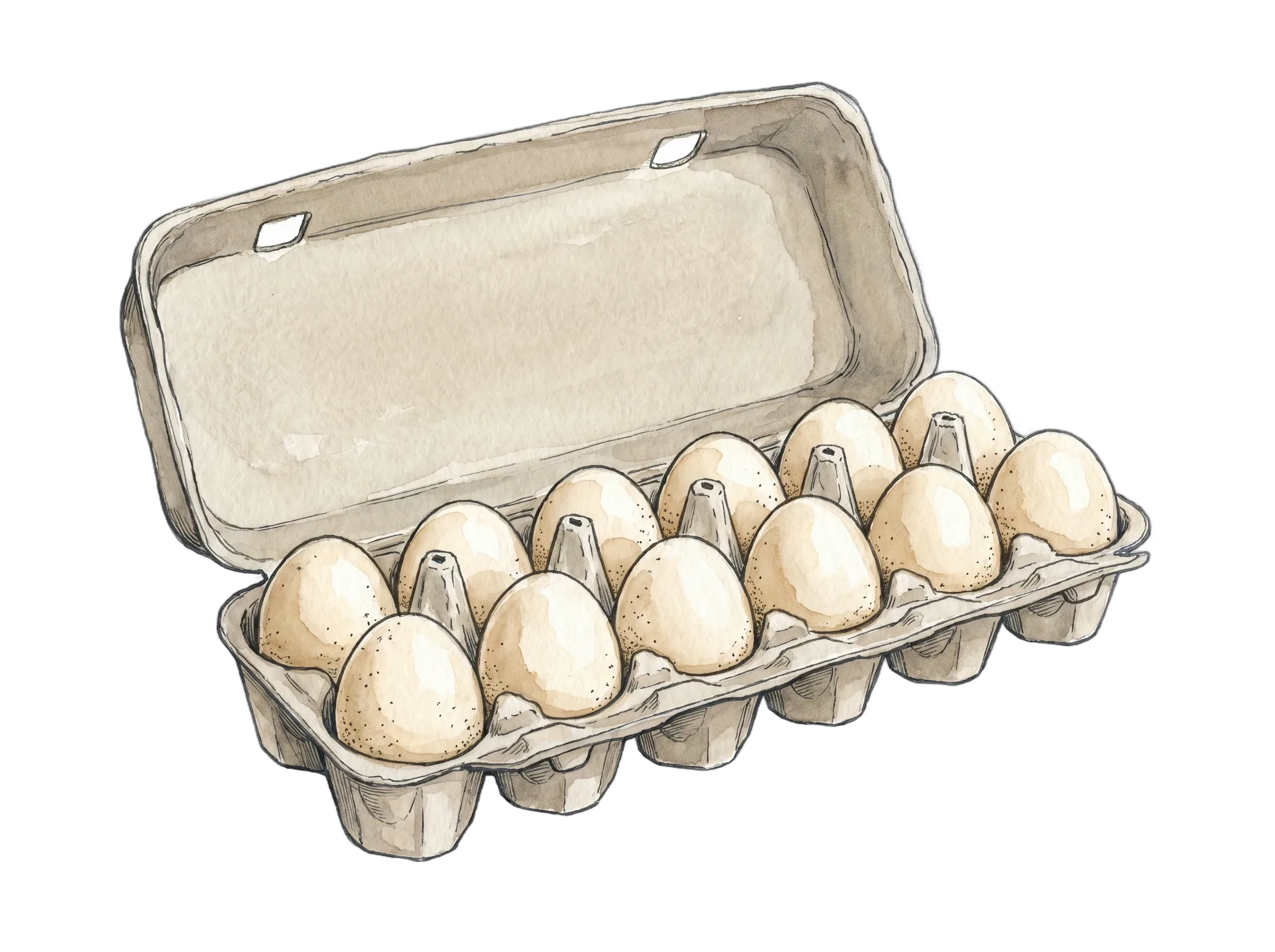
Start with what you know
A dozen is just a count
Twelve eggs is a dozen. Twelve doughnuts is a dozen. The word dozen only ever means twelve. It tells you nothing about what you're counting, and nothing about what it weighs.
Predict first
A dozen quail eggs and a dozen ostrich eggs. Same number. Do they weigh the same?
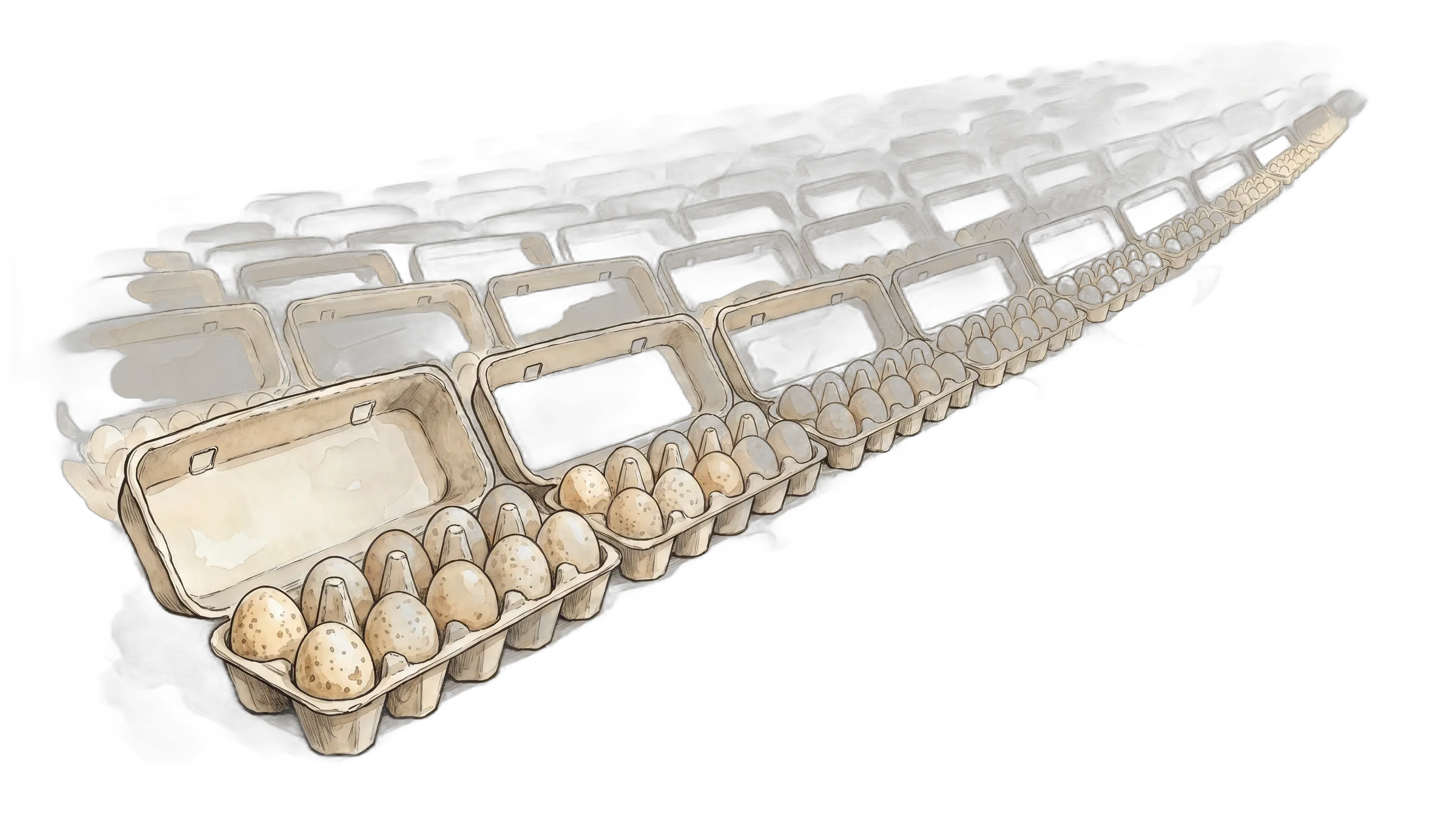
The chemist's dozen
A mole is a count too, just an enormous one
Atoms are so small that a dozen of them is nothing at all. So chemists count them in moles. One mole is
602,200,000,000,000,000,000,000
things, written 6.022 × 10²³, and nicknamed Avogadro's number. A dozen is 12. A mole is that. Both are just counting words. Neither one says a thing about weight.
The part most explanations skip
Eggs don't all weigh the same
Counting tells you how many. It never tells you how heavy. You could gather a dozen of each of these (or a mole of each), and the count would be identical every time. The weights aren't even close.
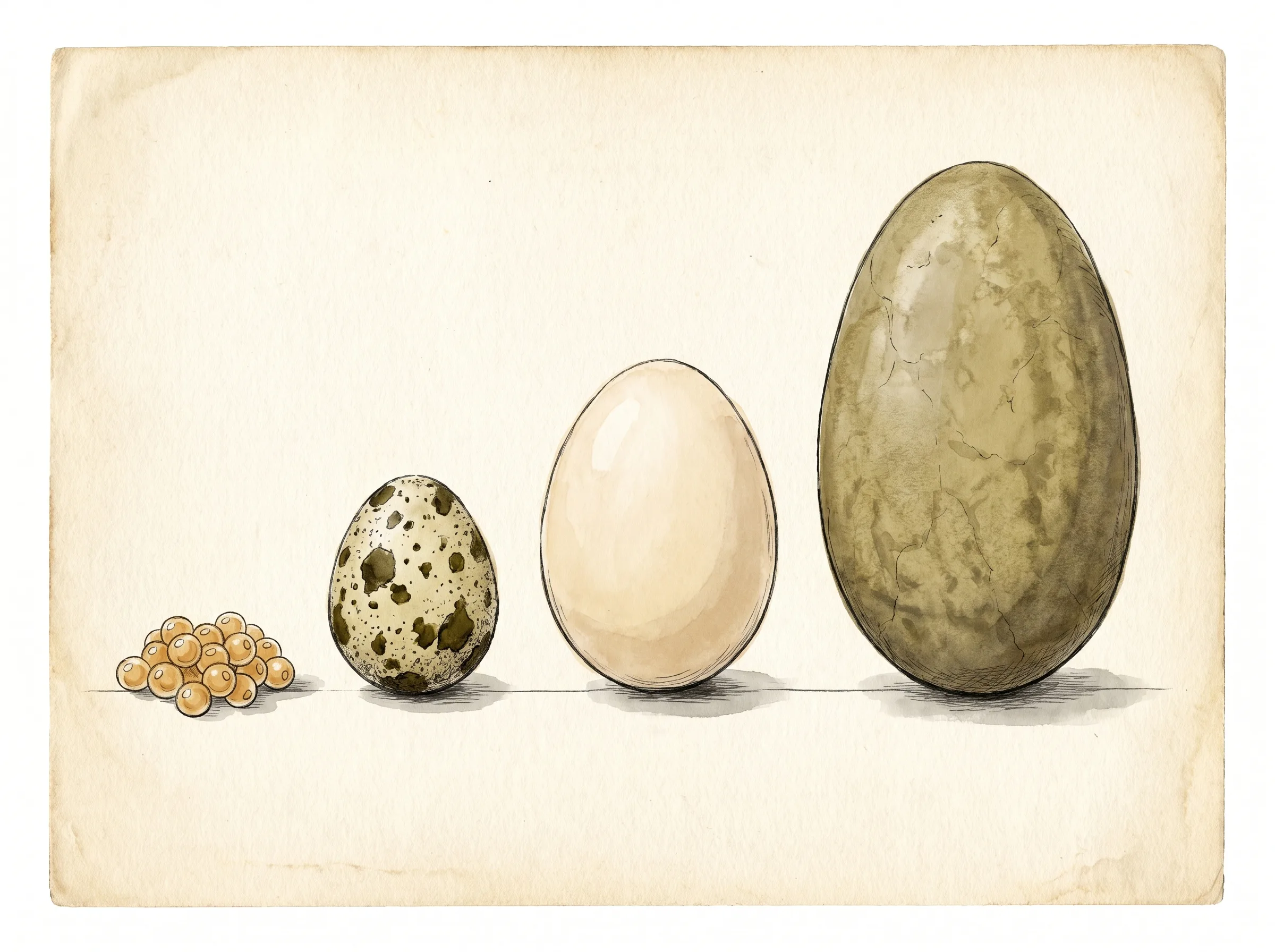
Fish roe
Hydrogen (H)
≈ 1 g / mole
Quail egg
Carbon (C)
≈ 12 g / mole
Hen egg
Oxygen (O)
≈ 16 g / mole
Pterosaur egg
Lead (Pb)
≈ 207 g / mole
The trap
Most people assume a mole of every element weighs the same. It doesn't, and the periodic table tells you exactly how much each one weighs.
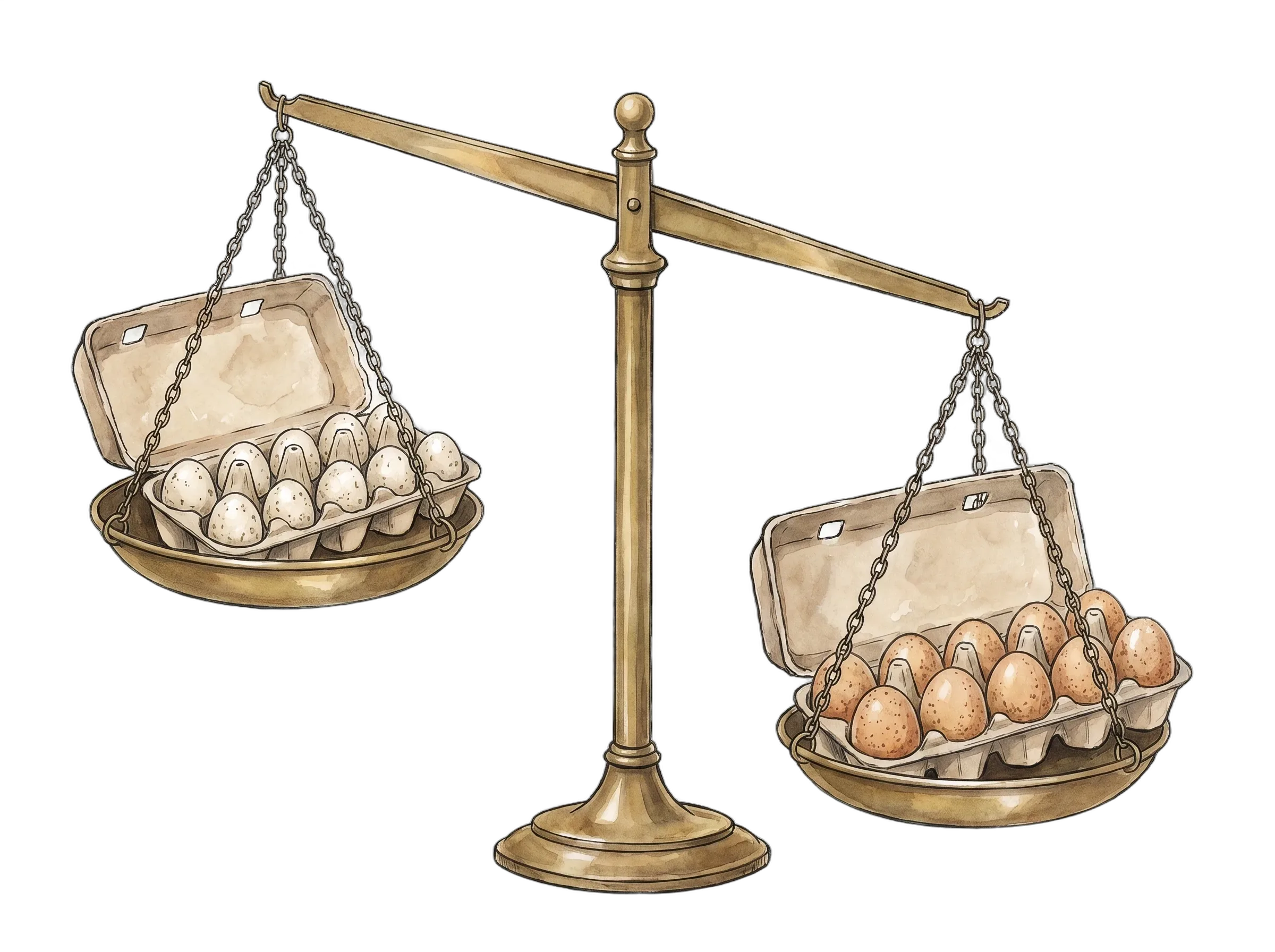
Weigh a mole
Same count, different weight
Predict first
One mole of hydrogen on the left, one mole of oxygen on the right. Which side drops?
Put one mole of each element on a scale and they never balance. A mole of hydrogen weighs about 1 gram; a mole of oxygen, about 16. The same number of atoms every time. Oxygen's are just heavier.
That weight-of-one-mole has a name: molar mass. And you already have it. It's the atomic weight printed on every square of the periodic table, measured in grams.
| Element | One mole weighs |
|---|---|
| Hydrogen (H) | 1 g |
| Carbon (C) | 12 g |
| Oxygen (O) | 16 g |
| Lead (Pb) | 207 g |
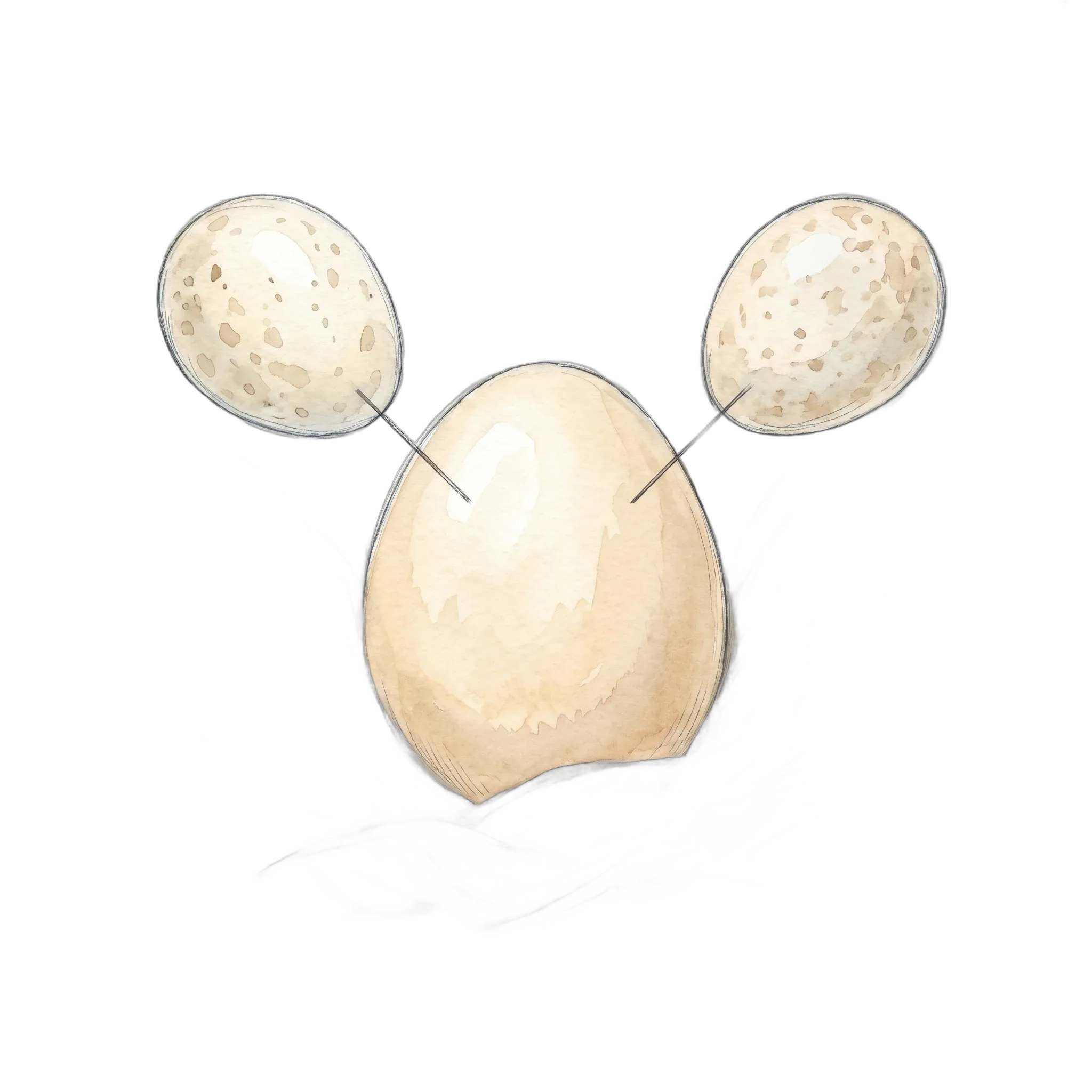
Now build something
Two cartons of hydrogen and one of oxygen make water
Water is H₂O: two hydrogen atoms bonded to one oxygen atom. So one mole of water is built from two moles of hydrogen and one mole of oxygen.
2 H
2 × 1 g
O
16 g
H₂O
18 g
Pour the cartons together and nothing vanishes. The atoms only rearrange, and the grams add up: a mole of water weighs 18 grams. Chemists call that conservation of mass.
The whole idea, in one line
A mole counts particles. It doesn't weigh them.
Same count, different weight. That difference is molar mass, the number already waiting on the periodic table.
- Count
- A mole = 6.022 × 10²³ particles. Like a dozen, only vast.
- Weight
- Molar mass = the atomic weight on the table, in grams.
- Build
- Formulas add up: 2 g + 16 g = 18 g of water.
Common questions
- How many is a mole?
- One mole is 6.022 × 10²³ particles, a number nicknamed Avogadro's number. It is the same kind of counting word as a dozen, only vastly bigger: a dozen is 12, a mole is about 602 sextillion. Chemists count atoms in moles because atoms are far too small, and far too many, to count one at a time.
- Why doesn't a mole of every element weigh the same?
- Because atoms of different elements have different masses. A mole is a fixed count, not a fixed weight, so a mole of light hydrogen atoms weighs about 1 gram while a mole of heavier oxygen atoms weighs about 16 grams. That weight of one mole is the element's molar mass, the number printed on its square of the periodic table.
- How do you find the molar mass of a compound?
- Add up the atomic weights of every atom in the formula. Water is H₂O, so two hydrogen atoms (about 1 gram each) plus one oxygen atom (about 16 grams) give a molar mass of about 18 grams per mole. The grams of the parts add up to the grams of the whole.
- Is a mole the same as a molecule?
- No. A molecule is a group of atoms bonded together, like one H₂O. A mole is a count of particles, 6.022 × 10²³ of them. You can have a mole of molecules, a mole of atoms, or a mole of anything. Mole answers how many; molecule answers what.
Now put a number on it. The mole calculator takes a mass and a formula — or just a formula — and shows the conversion with the units cancelling.
Open the mole calculatorThe mole is one idea. Chemistry is a few dozen like it.
Periodic Mole drills the periodic table and the other facts that crowd working memory down to automatic recall, then turns the practice into games. Bond Forge is free to play with a starter set of elements, no account needed. Full access is every game and all 118 elements, with your progress saved, for $59.
Teachers: there's a printable 11×17 version for the classroom wall. One sheet, no logins.
Get the 11×17 poster (PDF)A note for teachers
To keep the picture clean, one egg stands for one atom throughout. So "a mole of hydrogen" means a mole of hydrogen atoms (about 1 g), not H₂ gas (about 2 g), and "a mole of oxygen" means O atoms (about 16 g), not O₂ (about 32 g). Atomic weights are rounded and are weighted averages across isotopes (hydrogen is 1.008, oxygen is 15.999). The explainer maps to NGSS HS-PS1-7 (conservation of mass) and AP Chemistry Topics 1.1–1.2 (the mole, Avogadro's number, and molar mass).
This reference is free for teachers and students to use and share under the CC BY-NC-ND 4.0 license. Licensing details