
Master the Periodic Table, Earn Real Money
5 min read
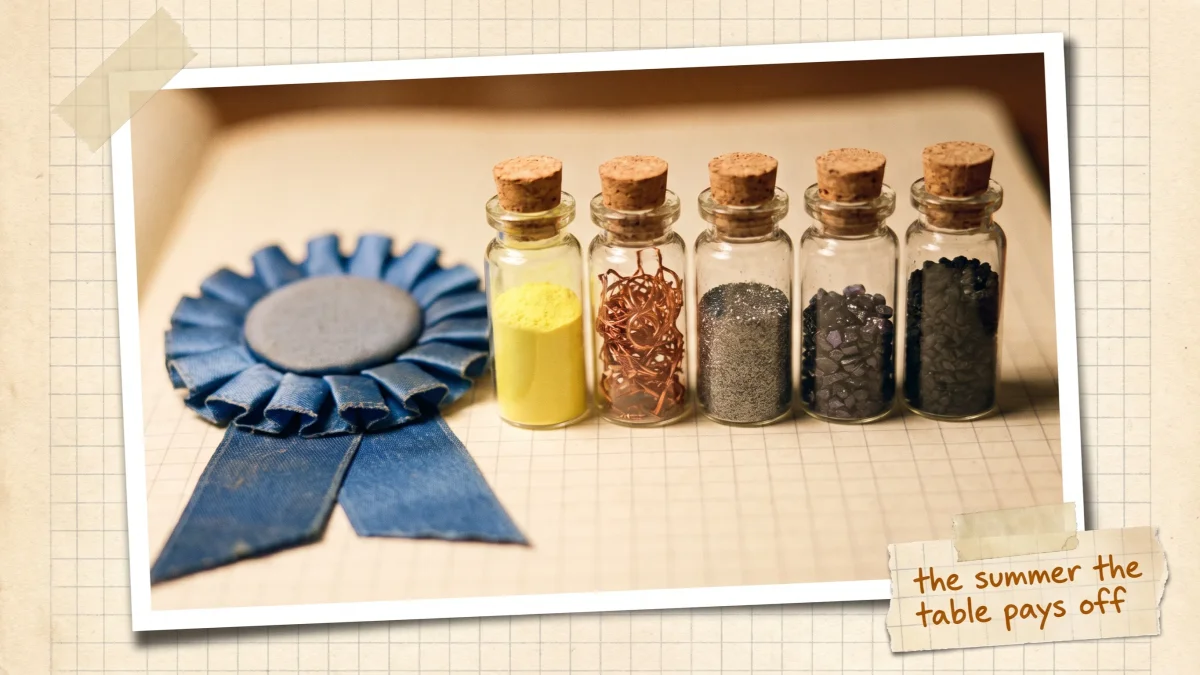
Short answer: Periodic Mole, a chemistry-learning game, is running the Element Mastery Prize from June 12 to September 15, 2026. Any kid who masters all 118 elements earns money: at least $25 for everyone who finishes, and $250 for the fastest. Full access is $59, with a 30-day money-back guarantee.
The real win is that your kid walks into chemistry this fall already knowing the periodic table cold. The prize money is just what gets a teenager to do it over the summer.
What is the Element Mastery Prize?
The Element Mastery Prize is a summer contest that rewards kids for learning the periodic table. It runs from June 12 to September 15, 2026. To finish, your kid masters every element, all 118, by symbol and by name, and completes each of the four contest games at least twice: Bond Forge, Pt Paddle, Capture the Nucleus, and Molecule Hunter.
Every kid who finishes earns at least $25 back. The fastest finishers win the biggest prizes, up to $250, plus a few smaller side prizes along the way like being first through the noble gases. The full rules, every prize, and the live standings are on the contest page, including the handful of states we aren't able to include.
It is not too late to start
Starting in August is fine, because the prize rewards speed of mastery, not who signed up first. The clock on each kid runs from their first mastery answer to the answer that masters their last element. A kid who starts in late August and learns fast competes on identical footing with one who started in June. So "we missed the beginning" is not a reason to skip it.
What does matter is the close. The contest ends September 15, and every element has to be mastered before then. Starting earlier won't shorten the speed clock, but it leaves more room to finish, and more of the summer to learn before class starts.
For a sense of pace: Cobalt, the in-game opponent, ran the whole course in 31 days before the contest opened. That is the bar to beat, and plenty of kids will beat it.
Why the contest makes the $59 nearly free
Full access to Periodic Mole is $59, one time, for a year. The contest needs full access, because it runs on all 118 elements and two of the four games are part of the paid set. Here's the math.
If your kid plays and it is not a fit, you have 30 days to get a refund, no questions and no exit survey. If your kid finishes the contest, they earn at least $25 back, and the fastest earn $250. So the realistic worst case for a kid who sticks with it is a net of about $34 for a summer that taught them the periodic table. The realistic best case is they come out ahead and learned chemistry. There is no version where an engaged kid loses much.
Does getting ahead in chemistry actually help?
Getting ahead helps because knowing the elements is the foundation the entire chemistry course is built on. The skill is recognizing that "Fe" is iron and that iron is "Fe", fast, without stopping to think. Every formula, equation, and reaction in the class is written in these symbols, so a student who has them automatic reads chemistry the way a fluent reader reads a sentence, instead of decoding it letter by letter.
This is the most established idea in learning research. "The most important single factor influencing learning is what the learner already knows," wrote David Ausubel in the textbook that founded the field (Ausubel, 1968). New chemistry sticks when it has something to attach to, and the elements are what the rest of the course attaches to.
Does spaced repetition work for chemistry?
Yes. It is one of the most reliable findings in memory research. Recalling an answer to win a round, rather than re-reading it, is retrieval practice (Roediger and Karpicke, 2006). A little every day instead of one long cram is spaced practice, which beat cramming across more than a hundred studies (Cepeda et al., 2006). Periodic Mole only counts an element as mastered after your kid recalls it correctly across several spaced sessions, so a finish means the elements are in long-term memory, not held for a day and gone.
Does a head start make chemistry class easier?
Yes, because it frees up working memory. A kid who walks into chemistry already fluent in the elements spends class following the chemistry instead of decoding symbols under pressure. Working memory holds only about four things at once (Cowan, 2001). The kid who still has to stop and think "wait, what's Fe again?" burns those slots on the symbols; the kid who knows the table cold has them free for the actual reasoning the class is testing. Same as the kid who knew 7 times 8 without counting got to spend long division doing long division.
That is the part the prize money is really buying: a kid who starts the hardest science class of the year already a step ahead, and a little proud of it.
Try it free. Bond Forge is free to play with a starter set of elements, no account needed. One payment of $59 unlocks every game and all 118 elements, with progress saved. No subscription.
When your kid is ready to enter, the contest page has the sign-up and the full rules.
FAQ
Is it too late to enter the contest? No. The prize rewards how fast your kid masters the elements, measured from their first answer to their last, not the calendar date they started. A kid who starts in August and learns quickly competes evenly with one who started in June.
How much does my kid actually have to do to win? Master all 118 elements, by symbol and name, and complete each of the four contest games at least twice. Most kids do this in short daily sessions rather than long ones, because the games are set at their level and only count a correct chemistry answer.
What does my kid need to enter? Full access to Periodic Mole, which is $59 for a year and carries a 30-day money-back guarantee. A few states are excluded for contest-law reasons; the contest page lists them and the full rules.
What if my kid doesn't finish? There is no penalty, and they keep everything they learned. If the whole thing turns out not to be for you, the 30-day money-back guarantee covers the cost.
How long does it take to learn the periodic table? With short daily sessions, a summer is plenty. There is no fixed number, because Periodic Mole spaces the reviews and sets each question at your kid's level. For a benchmark, Cobalt, the in-game opponent, learned all 118 in 31 days, and most kids who stick with it beat that.
Related
- Get Ahead in Chemistry Before Class Starts
- Periodic Table Games: What to Play
- How to Memorize the Periodic Table Fast
Sources
- Ausubel, D. P. (1968). Educational Psychology: A Cognitive View. Holt, Rinehart and Winston.
- Cowan, N. (2001). The magical number 4 in short-term memory: A reconsideration of mental storage capacity. Behavioral and Brain Sciences, 24, 87–114.
- Roediger, H. L., and Karpicke, J. D. (2006). Test-enhanced learning. Psychological Science.
- Cepeda, N. J., et al. (2006). Distributed practice in verbal recall tasks: A review and quantitative synthesis. Psychological Bulletin.