
How to Pass the Chemistry Regents in 2027
6 min read
Short answer: To pass the Chemistry Regents, make the foundation automatic (element symbols, ion charges, polyatomic ions), practice on real past exams instead of re-reading notes, and use the Reference Tables until finding any table is muscle memory. The exam is 85 points; a scaled score of 65 passes.
Almost half the points are multiple choice, so a student who can recall the basics without stopping to think has working memory left over for the questions that actually require chemistry.
What is the Chemistry Regents, exactly?
The Regents Examination in Physical Setting/Chemistry is New York State's course-ending chemistry exam: 3 hours, 85 points, four parts. Part A is 30 multiple-choice questions on core knowledge, Part B-1 is 15 multiple-choice questions that lean on application, and Parts B-2 and C are constructed-response questions, the ones where you write answers, show calculations, and explain reasoning, worth the remaining 40 points. A scaled score of 65 passes.
Since 45 of 85 points are multiple choice, fluent recall of facts and vocabulary pays off on more than half the exam before you write a single sentence. The constructed-response parts reward the same fluency a different way: a student who isn't burning a minute on "wait, what's the charge on sulfate?" has time to show the full setup.
As of this writing, the next administration is January 26, 2027 — both the legacy Physical Setting/Chemistry exam and the new Physical Science: Chemistry exam sit that date (per the NYSED exam schedule) — followed by the June 2027 period, the legacy exam's last. The plan below works for either, and for getting ahead of next year's exam.
One more date matters: New York began replacing this exam in June 2026 with the new Physical Science: Chemistry Regents, and the legacy exam retires after June 2027. If your course follows the new standards, read the new Chemistry Regents, explained — the study method below transfers, but the format you will sit for differs.
Start with the Reference Tables, not the review book
Every student gets the official Reference Tables for Physical Setting/Chemistry at the exam. They contain the periodic table, the polyatomic ion list, the solubility guidelines, Table J's activity series, and more. Many questions are answerable straight from the tables, if you know where to look without hunting.
The Reference Tables reward familiarity, not possession. A student who has used Table F fifty times finds the solubility answer in seconds; a student seeing it fresh under time pressure reads the header three times. So the highest-leverage early move is unglamorous: do every practice question with the tables open, and make yourself find the relevant table even when you remember the fact. By exam day, navigation should be muscle memory.
Make the foundation automatic before you practice the hard parts
The Chemistry Regents rewards automatic recall because working memory holds only a few things at once. A student who still decodes "Fe" or reconstructs the charge on nitrate is spending those slots on the alphabet instead of the chemistry, on every single question. This is why students who "know the material" still run out of time.
The fix is recall practice, not re-reading. In Dunlosky and colleagues' review of ten study techniques (2013), practice testing and distributed practice were the two rated highest utility, while re-reading and highlighting, the two things most students actually do, rated lowest. Concretely: drill element symbols and names, common ion charges, and the polyatomic ions until answering is instant. Short daily sessions beat weekend marathons; spacing the practice out is the single most reliable finding in memory research (Cepeda et al., 2006).
Then practice on the real thing
Every past Chemistry Regents exam and its scoring key is published free at nysedregents.org. Past exams beat any review sheet because the question styles repeat: the exam asks about the same core ideas, in recognizably similar ways, administration after administration.
Use them as practice tests, not reading material. Take a full Part A + B-1 under time, score it with the key, and let the wrong answers set tomorrow's drill list. That loop, test, score, drill the misses, is retrieval practice doing its job (Roediger and Karpicke, 2006), and it tells you exactly where the gaps are instead of leaving you to guess.
A two-week plan vs. a head-start plan
| If the exam is... | Two weeks away | Next year |
|---|---|---|
| Foundation drills | 15 min daily: symbols, ions, polyatomics | 10 min daily over the summer, the table is automatic by September |
| Reference Tables | Every practice question with tables open | Learn each table as the course reaches it |
| Past exams | One timed Part A + B-1 every other day, drill the misses | One full past exam per marking period as a checkup |
| Constructed response | Write out Part C answers for 2–3 past exams, check the key | Practice explaining answers out loud as the course goes |
| The night before | Sleep. Cramming trades tomorrow's recall for tonight's comfort | Nothing to cram, that's the point |
Where games fit in
If your exam is this month, timed past exams are the best use of your remaining hours, and no app changes that. The games fit the longer runways: the January exam, where a fall of steady drilling has time to pay, and next year's exam, where a head start makes the course easier from week one.
For those runways, the drilling is the part most students skip, because flashcard decks are a chore. That's the part we built games for. In Periodic Mole, you can't take a turn until you answer a chemistry question right, set at your level: the algorithm tracks your recall on all 118 elements and brings each one back right before you'd forget it. Ten minutes of Bond Forge, where every bond you draw costs a correct answer, is a recall session that doesn't feel like one. The exam's foundation, symbols, names, ions, formulas, is exactly the recall the games drill.
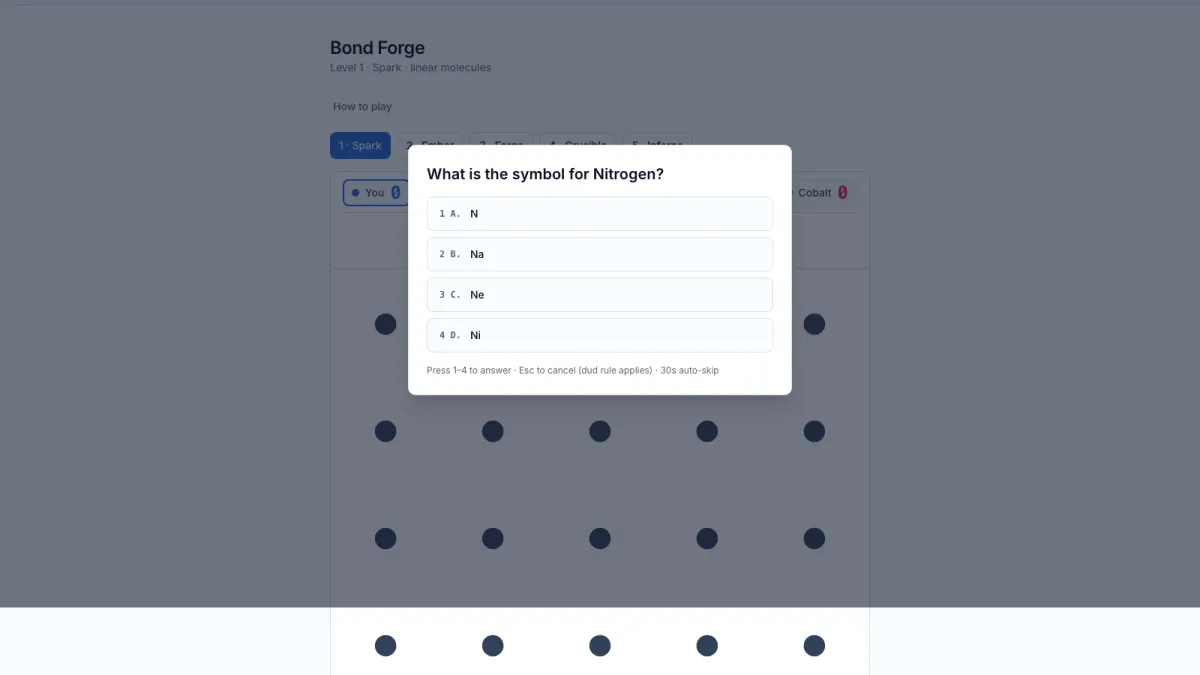
Try it free. Bond Forge is free to play with a starter set of elements, no account needed. One payment of $59 unlocks every game and all 118 elements, with progress saved. No subscription.
FAQ
What score do I need to pass the Chemistry Regents? A scaled score of 65. The exam is out of 85 raw points, and the conversion from raw to scaled score changes each administration, so the raw points needed vary; the scoring key for each exam at nysedregents.org includes its conversion chart.
Is the Chemistry Regents hard? It's demanding but predictable. The question styles repeat across years, the Reference Tables are provided, and 45 of 85 points are multiple choice. Most students who struggle went in without automatic recall of the foundation, and spaced practice fixes that.
What's the best way to study for the Chemistry Regents in the last two weeks? Timed past exams from nysedregents.org, scored against the official key, with the misses turned into short daily recall drills. Skip re-reading notes; in head-to-head research, practice testing beats re-reading decisively.
Do I get a periodic table on the Chemistry Regents? Yes. The Reference Tables booklet provided at the exam includes the periodic table, polyatomic ion list, solubility guidelines, and more. The advantage goes to students who can navigate it fast, so always practice with it open.
Related
Sources
- New York State Education Department. Regents Examination in Physical Setting/Chemistry, past exams and scoring keys. nysedregents.org/chemistry.
- New York State Education Department. Regents Examination Schedules. nysed.gov/state-assessment.
- Dunlosky, J., et al. (2013). Improving students' learning with effective learning techniques. Psychological Science in the Public Interest.
- Roediger, H. L., and Karpicke, J. D. (2006). Test-enhanced learning. Psychological Science.
- Cepeda, N. J., et al. (2006). Distributed practice in verbal recall tasks: A review and quantitative synthesis. Psychological Bulletin.