
Fireworks Chemistry: Every Color in the Sky
8 min read
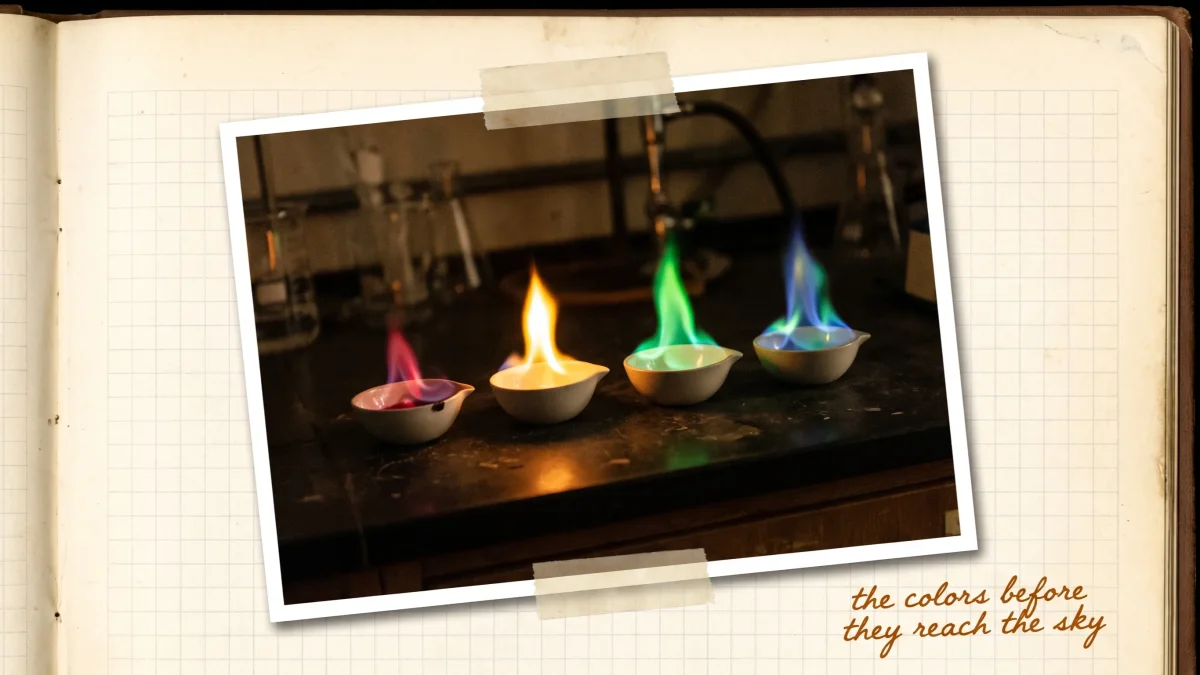
Short answer: A firework is a flame test at festival scale. Metal salts packed into the shell burn hot enough that their electrons jump to excited states, then fall back and release the difference as light: strontium red, barium green, sodium yellow, copper blue. The first fireworks had no color at all.
If your class has ever dipped a splint in salt solution and held it in a Bunsen flame, you have already run the core experiment. A firework does the same thing 200 meters up, in front of a few thousand people, with the chemicals chosen centuries in advance. Knowing which element makes which color turns a fireworks show into something you can read.
Who invented fireworks?
Fireworks started in China, and they started as a sound. More than 2,000 years ago, people threw bamboo stalks into fires; the air pockets sealed inside the hollow stems burst with a bang that was said to scare off evil spirits (American Pyrotechnics Association). No gunpowder yet. Just heat and trapped air.
Gunpowder arrived by accident. In the 800s, Tang-dynasty alchemists hunting for an elixir of immortality mixed saltpeter (potassium nitrate), sulfur, and charcoal, and got roughly the opposite of eternal life. A Taoist text from around 850 CE warns fellow experimenters that the mixture had burned hands and faces, "and even the whole house." The Chinese name for gunpowder, huoyao, still translates as "fire medicine." A military manual recorded working formulas in 1044, Song-dynasty vendors sold paper-tube firecrackers in the markets, and a court display entertained Emperor Huizong in 1110.
Tradition credits the firecracker itself to a monk named Li Tian around 621, and Liuyang, the Chinese city that honors him every April, is still the fireworks manufacturing capital of the world. That story is legend rather than documented history, but the city's status is very real.
Gunpowder moved west in the 1200s, most likely with the Mongol expansion along the Silk Road; Roger Bacon was describing firecrackers in Europe by 1267. Italians were making fireworks by the 1300s and spent the next five centuries as Europe's pyrotechnics school, developing the aerial shell along the way.
Color is the recent part. Until the 1800s, a fireworks display was mostly gold and orange: the broad glow of hot particles, called incandescence, the same light an old light-bulb filament makes. Two changes brought the modern palette. Claude Louis Berthollet discovered potassium chlorate in 1786, an oxidizer that burns hot and fast enough to excite metal salts. Then, in the 1830s, Italian pyrotechnicians began adding those salts on purpose (Royal Society of Chemistry). By 1865, London's Crystal Palace shows had made saturated color the standard the whole industry chased.
What chemicals make each firework color?
Inside every shell are "stars," packed pellets of fuel, oxidizer, a metal colorant, a chlorine donor, and a binder. When the burst charge fires, the stars ignite and scatter, and each metal announces itself.
| Color | Element responsible | Usually packed as | What actually glows |
|---|---|---|---|
| Red | Strontium (Sr) | Strontium carbonate | SrCl vapor, 635–673 nm |
| Orange | Calcium (Ca) | Calcium chloride | CaCl vapor, 594–621 nm |
| Yellow | Sodium (Na) | Sodium nitrate | Sodium atoms, 589 nm |
| Green | Barium (Ba) | Barium nitrate | BaCl vapor, 514–525 nm |
| Blue | Copper (Cu) | Copper carbonate | CuCl vapor, 430–490 nm |
| Purple | Sr + Cu together | A mix of both | SrCl and CuCl at once |
| Silver-white | Mg, Al, Ti | Metal powder | White-hot metal particles |
The light usually comes from a short-lived molecule, the metal monochloride, that exists only inside the flame (Journal of Pyrotechnics). Strontium chloride and copper chloride absorb water so aggressively that packing them directly would leave the star damp and unstable, so manufacturers ship the metal and the chlorine in separate, stable compounds and let them combine in the vapor mid-explosion. The chlorine typically comes from PVC, the same plastic as plumbing pipe.
Sodium is the bully of the table. Its 589-nanometer yellow is so intense that trace sodium contamination can wash out whatever color a star was supposed to be, which is why firework chemists treat it the way bakers treat salt: essential in its place, ruinous everywhere else.
Why is blue the hardest firework color?
Andy Brunning, the chemistry teacher behind the graphics site Compound Interest, puts it plainly: "you can judge the quality of a fireworks display on the quality of the blue fireworks!" The blue emitter, copper(I) chloride, is fragile: heat it much past roughly 1,200 °C and it breaks apart, yet a color star wants to burn at 1,700 to 2,000 °C to stay lit and bright. Every blue firework is a compromise inside that narrow temperature window, and nobody has fully escaped it since the 1800s. Blue light also sits near the edge of what human eyes detect well in the dark, so even a well-made blue reads dimmer than an equally powerful red. A deep, saturated blue against a night sky is the closest thing pyrotechnics has to a signature move.
Which chemicals are no longer used in fireworks?
Fireworks chemistry keeps a retired list. The list of chemicals banned in fireworks, or dropped by the industry, reads like the periodic table's usual suspects.
| Retired chemical | Old job | Why it left | Replaced by |
|---|---|---|---|
| Paris green (copper acetoarsenite) | Blue and green flames | An arsenic compound; arsenic is banned in US consumer fireworks | Copper carbonate |
| Calomel (mercury(I) chloride) | Chlorine donor for blues/greens | Mercury toxicity; mercury salts are banned | PVC |
| Red lead (lead tetroxide) | The crackle in "dragon eggs" | Lead poisoning risk | Bismuth trioxide |
| Potassium chlorate | Oxidizer | Dangerously friction-sensitive with sulfur; factory explosions | Potassium perchlorate |
| Hexachlorobenzene | Chlorine donor | Persistent organic pollutant under the Stockholm Convention | PVC, chlorinated rubber |
US consumer-fireworks rules (16 CFR 1507.2) name arsenic compounds, mercury salts, and chlorates outright, and the UK banned mixing chlorate with sulfur back in the late 1800s after too many factory disasters. Calomel is the strange one in hindsight: a mercury compound stayed in color recipes for roughly 250 years before cheaper and safer chlorine donors pushed it out. The crackle swap is the most satisfying chemistry. The pop-pop-pop of a "dragon egg" effect comes from granules that burn and then burst, and the lead oxide that once drove them was swapped for bismuth trioxide, lead's famously low-toxicity neighbor on the periodic table.
Two ingredients are still in the shells and still argued about. Perchlorate, the workhorse oxidizer, turns up in water: a USGS study traced elevated perchlorate in groundwater at Mount Rushmore to years of Independence Day shows, with one stream reading 54 micrograms per liter where sites outside the memorial read below 0.2. The EPA proposed its first federal drinking-water limit for perchlorate in January 2026, with a final rule due in 2027. Barium, the green, is toxic enough that researchers keep testing replacements, including a boron carbide green developed with the US Army in 2011. Quality control leaks too: a 2020 NYU Langone study found harmful levels of lead in 2 of the 12 consumer fireworks it tested.
The cleaner-fireworks work is further along than most people know: Disney began launching fireworks with compressed air at Disneyland in 2004, cutting the black-powder lift charge and its smoke, then donated the patents for industry-wide use, and Los Alamos chemists built nitrogen-rich compounds that need far less oxidizer and far less smoke, now used for indoor pyrotechnics at events like the Super Bowl.
What else is going on inside a firework?
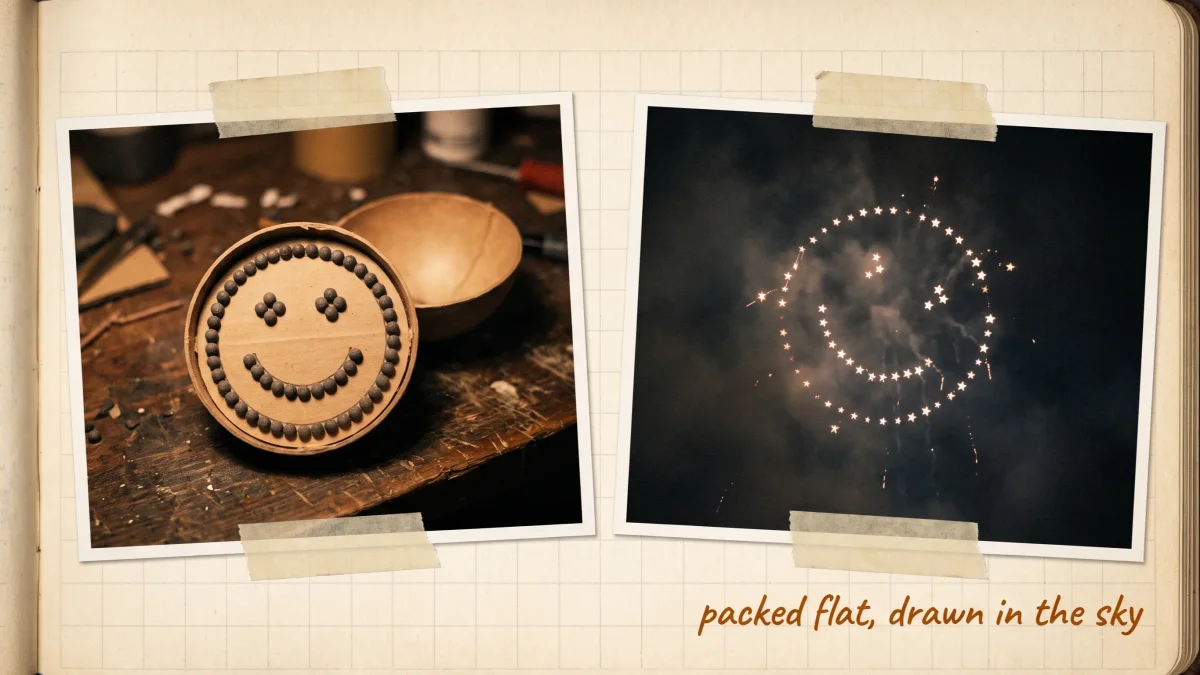
The burst pattern is glued in by hand. Stars are arranged on a cardboard insert in the shape of the effect, a ring, a heart, a smiley, and fly outward in that arrangement. The pattern only reads from angles facing the cardboard, so crews fire several shaped shells at once and let probability sort out your view. Even a well-aimed one arrives a little crooked, the ring squashed and the smile sagging, which is part of the charm.
The biggest shell on record weighed 2,797 pounds. Fired February 8, 2020, over Steamboat Springs, Colorado, from a steel mortar sunk 26 feet into a hillside; the shell was nearly five feet across and left the tube at about 300 mph (Guinness World Records).
Americans burn about 275 million pounds of fireworks a year, most of it around July 4 (American Pyrotechnics Association). The habit is as old as the country: Philadelphia's first Independence Day celebration in 1777 ended with fireworks.
The whistle is chemistry, not a whistle. Compounds like sodium salicylate burn in rapid pulses inside the tube, and the pulse rate is the pitch you hear.
You see the burst before you hear it because light outruns sound. Sound covers about a mile in five seconds, so counting the gap tells you how far you are from the shell, the same trick as counting after lightning.
The show is better when you can read it
Once you know strontium from barium, a fireworks finale stops being random pretty lights. You can call the elements from a lawn chair. That is the same knowledge chemistry class asks for in September. Copper, strontium, barium, and sodium each have their own page in our interactive periodic table, and you can see what they look like outside a flame in the elements in real life gallery.
Try it free. Bond Forge is free to play with a starter set of elements, no account needed. Full access is $59 for a year: every game and all 118 elements, with progress saved. No subscription.
FAQ
What gives fireworks their colors? Metal salts. Strontium compounds burn red, calcium orange, sodium yellow, barium green, and copper blue; strontium and copper together make purple. Magnesium, aluminum, and titanium powders burn white-hot for silver and white effects. The heat excites electrons in each metal, and the light released as they fall back has a wavelength characteristic of that element.
Why are blue fireworks so rare? The blue emitter, copper(I) chloride, breaks apart above roughly 1,200 °C, while firework stars burn at 1,700 to 2,000 °C. Blue therefore has the narrowest workable temperature window of any firework color, and pyrotechnicians often judge a show by the quality of its blues.
What color were fireworks before modern chemistry? Mostly gold and orange. For centuries the light came from incandescence, the broad glow of hot particles, rather than from selected elements. Vivid reds, greens, and blues only became possible after potassium chlorate was discovered in 1786 and Italian pyrotechnicians began adding metal salts in the 1830s.
Which chemicals are banned in fireworks? US consumer-fireworks regulations prohibit arsenic compounds, mercury salts, and chlorates (with narrow exceptions). Lead compounds were phased out of crackle effects in favor of bismuth, and hexachlorobenzene was banned internationally as a persistent organic pollutant. Perchlorate and barium remain legal but are under environmental scrutiny.
What toxic chemicals are in fireworks today? Consumer fireworks still contain barium compounds, which are toxic, and perchlorate oxidizers, which can contaminate water and interfere with the thyroid’s iodide uptake. A 2020 NYU Langone study also found harmful lead levels in 2 of 12 consumer fireworks tested. Most exposure comes through the smoke, so watch from upwind and stay out of the plume.
Is borax used in fireworks? No. Borax is not a firework ingredient, and boron is on the US prohibited list for consumer fireworks (16 CFR 1507.2). Boron compounds do burn green, which is why boric acid shows up in classroom flame demonstrations, and boron carbide has been studied as a barium-free green emitter for future fireworks.
Related
- How the Hunt Brothers Cornered Silver
- Helium Was Discovered on the Sun First
- When Aluminum Was Worth More Than Gold
- What Every Element Looks Like
- The Mole, Explained With a Carton of Eggs
- Periodic Table Games: What to Play
- Get Ahead in Chemistry Before Class Starts
Sources
- Compound Interest (2013). The Chemistry of Fireworks. Color palette and emitter overview (compoundchem.com).
- Ingram, B. (2003). Color Purity Measurements of Traditional Pyrotechnic Star Formulas. Journal of Pyrotechnics, Issue 17. Emitter species and emission wavelengths.
- Royal Society of Chemistry Education (2020). Fire and light in the sky. History of gunpowder, potassium chlorate, and colored fireworks.
- Smithsonian Magazine. 14 Fun Facts About Fireworks. Aerial shells and 1830s Italian color chemistry.
- US Consumer Product Safety Commission. 16 CFR 1507.2, prohibited chemicals in consumer fireworks.
- US Geological Survey (2016). Firework displays as a source of perchlorate in Mount Rushmore National Memorial groundwater.
- US EPA (2026). Proposed National Primary Drinking Water Regulation for perchlorate.
- Guinness World Records. Largest aerial firework shell (Steamboat Springs, 2020).
- American Pyrotechnics Association. Industry facts and figures; history of fireworks.
- NYU Langone Health (2020). Common fireworks release lead, copper, and other toxic metals into the air. Study published in Particle and Fibre Toxicology.