
Printable Periodic Table PDFs for Class
5 min read
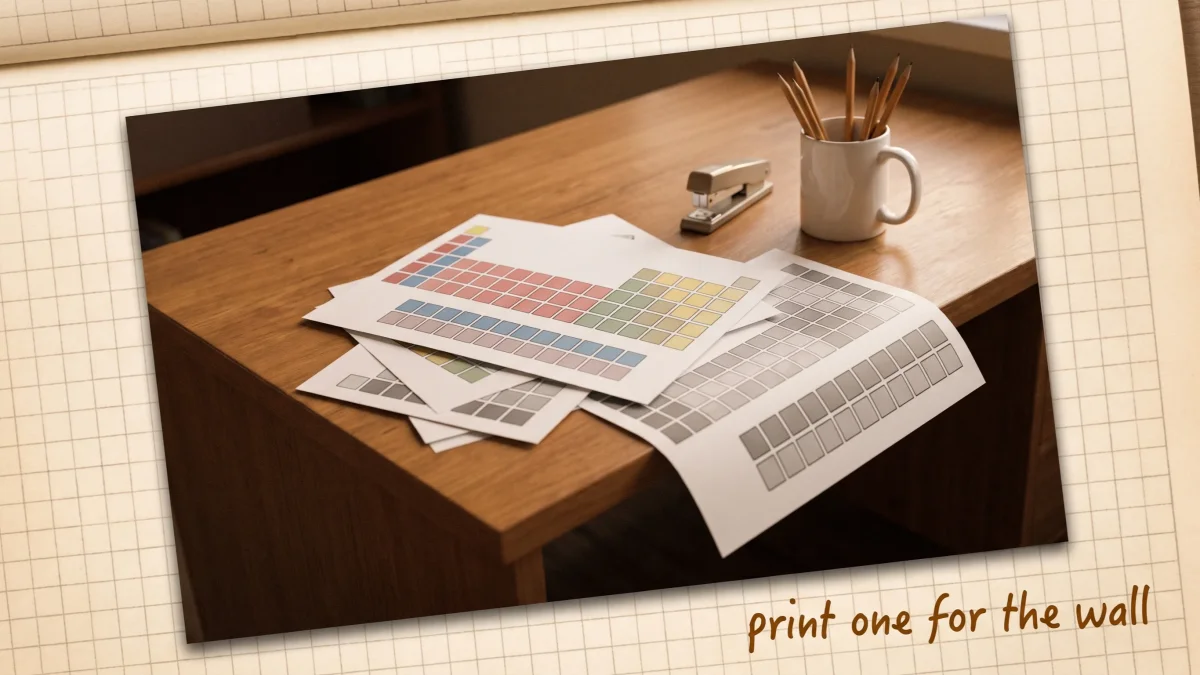
For chemistry homework, choose a printable periodic table PDF with atomic masses. Periodic Mole’s free tables come in Letter, A4, and 11×17, with names-only and blank versions for practice. Download the basic charts without an account, then print one copy to check before making a class set.
A chart can look fine on your laptop and turn out too small to read beside a worksheet. Before you send thirty copies to the printer, choose the information your class needs and match the file to the paper in the tray.
Which periodic table PDF should I download?
For homework involving molar mass, choose a printable periodic table with atomic masses. For learning symbols and names, the simpler names chart gives you fewer numbers to sort through. These links open our Letter-size PDFs:
| What you need | PDF to download | What is on the page |
|---|---|---|
| A reference for calculations | Atomic masses, black and white | Atomic number, symbol, name, and mass |
| A color chart for your binder | Atomic masses, color | The same information, with colored element families |
| A simple names reference | Names, black and white | Atomic number, symbol, and name |
| Electron configurations | Full chart, black and white | Names and masses, plus electron configurations |
| A worksheet to fill in | Blank periodic table | Atomic numbers, with space for symbols and names |
For A4, 11×17, or the minimal design, use the full printable periodic table collection. The basic tables are free to download without signing up. The separate 118-element poster pack has a teacher request form.
What works on a black-and-white printer?
Our black-and-white periodic table uses small icons to identify element families. A legend explains the icons, so a student can distinguish a halogen from a noble gas without relying on colored ink. The minimal edition is another option if you prefer less decoration around the element names.
Print a sample and look at the smallest text, especially the atomic masses. If you will distribute photocopies, check one of those too. Thin lines and small numbers can be harder to read on a copy.
For a table you can customize, Ptable’s printable PDFs have layers that let you hide names, symbols, or other information before printing. You need a PDF reader that supports layers. Ptable also uses letters in the tile corners to identify categories on black-and-white copies.
How do I print the table without cutting off the edges?
Download the periodic table PDF in the size your printer holds: Letter is 8.5×11 inches, A4 is 210×297 mm, and Tabloid is 11×17 inches. Our charts use landscape orientation.
- Open the PDF and select the matching paper size.
- Start with “Actual size” or 100% scale.
- Check the preview for all four edges, the bottom two rows, and the footer.
- If part of a single-page chart falls outside the printable area, choose “Fit” or “Shrink oversized pages,” then check the preview again.
Adobe’s printing guide explains these scaling options. “Actual size” preserves the file’s dimensions; it does not guarantee that every printer can print to the same margins.
For a larger display, our four-page periodic table poster is already divided across four Letter sheets. Print single-sided, keep the scale the same on every page, and join the inner edges. At full size, the assembled chart is about 21×16 inches. Check the lettering from where students will sit before choosing a place to hang it.
Why do atomic masses differ between tables?
Periodic tables may use different rounding or different editions of the atomic-weight data. Our PDF footer identifies the data as IUPAC 2021 abridged atomic weights. For calculations assigned in class, use the values on your teacher’s reference table so your rounding matches the worked examples.
IUPAC’s periodic table page identifies the release and data behind its downloadable reference chart. Check that information when comparing files; a recent download date does not tell you when the numbers were revised.
A whole number in square brackets is the mass number of a particular isotope: the number of protons plus neutrons in that atom. IUPAC’s page explains how the isotope is chosen. It is a different kind of value from an average atomic weight such as carbon’s 12.011.
How can I use a blank periodic table for practice?
The blank periodic table keeps the atomic numbers and leaves the symbols and names for you to supply. Print a completed names chart alongside it as an answer key, then put the key out of sight.
Start with the elements your class is using. If sodium, chlorine, and calcium are in this week’s work, fill those in first. Check your answers, correct any mistakes, and try those cells again on another day. You can also check a symbol on the interactive periodic table.
If you would like to practice on screen, try a chemistry game:
Try it free. Bond Forge is free to play with a starter set of elements, no account needed. One payment of $59 unlocks every game and all 118 elements, with progress saved. No subscription.
Can I copy the PDFs for my class?
Periodic Mole’s printable tables use the CC BY-NC-ND 4.0 license. You can share unmodified copies for noncommercial use with attribution. Keep the credit and license notice on the file. The license does not permit you to distribute adapted versions; the full terms are linked on our licenses page.
FAQ
Can I download a periodic table PDF without signing up? Yes. Periodic Mole’s basic periodic table PDFs, including the color charts, black-and-white charts, and blank worksheets, need no signup. The separate pack of 118 element posters has a teacher request form.
Which printable periodic table includes atomic masses? Choose the “With atomic masses” edition for atomic numbers, symbols, names, and masses. The minimal chart also includes masses. The “With all information” edition adds electron configurations.
Is there a blank periodic table with an answer key? Periodic Mole’s blank worksheet keeps the atomic numbers and leaves the symbols and names for you to fill in. Download a completed names chart in the same paper size to use as the answer key.
Can I print a periodic table poster on Letter paper? Yes. Periodic Mole’s wall-poster PDF contains four Letter pages. Print them single-sided at the same scale, then trim and join the inner edges. The assembled chart is about 21 by 16 inches at full size.
Related
- Free Chemistry Printables for Teachers
- The Best Interactive Periodic Table
- How to Memorize the Periodic Table Fast
- Periodic Table Games: What to Play
Sources
- Periodic Mole’s printable periodic table collection, including the downloadable files and their data and license notices.
- Ptable’s printable PDFs, for PDF layers and black-and-white category labels.
- IUPAC’s Periodic Table of Elements, for release information and bracketed mass numbers.
- Adobe’s PDF page-size guide, for print scaling.
- Creative Commons CC BY-NC-ND 4.0, for the license terms.