
Chemistry tool
Mole calculator
Type an amount and a formula, like 25 g H2SO4, or just a formula. Choose “Show me how” to see the work step by step, with the units that cancel crossed out.
Use grams or moles, or just type a formula. Lowercase works too.
Answer
1.39 mol
H2O has a molar mass of 18.015 g/mol. Your 25.0 g has 3 significant figures and 18.015 has 5, so the answer has 3, the smaller of the two.
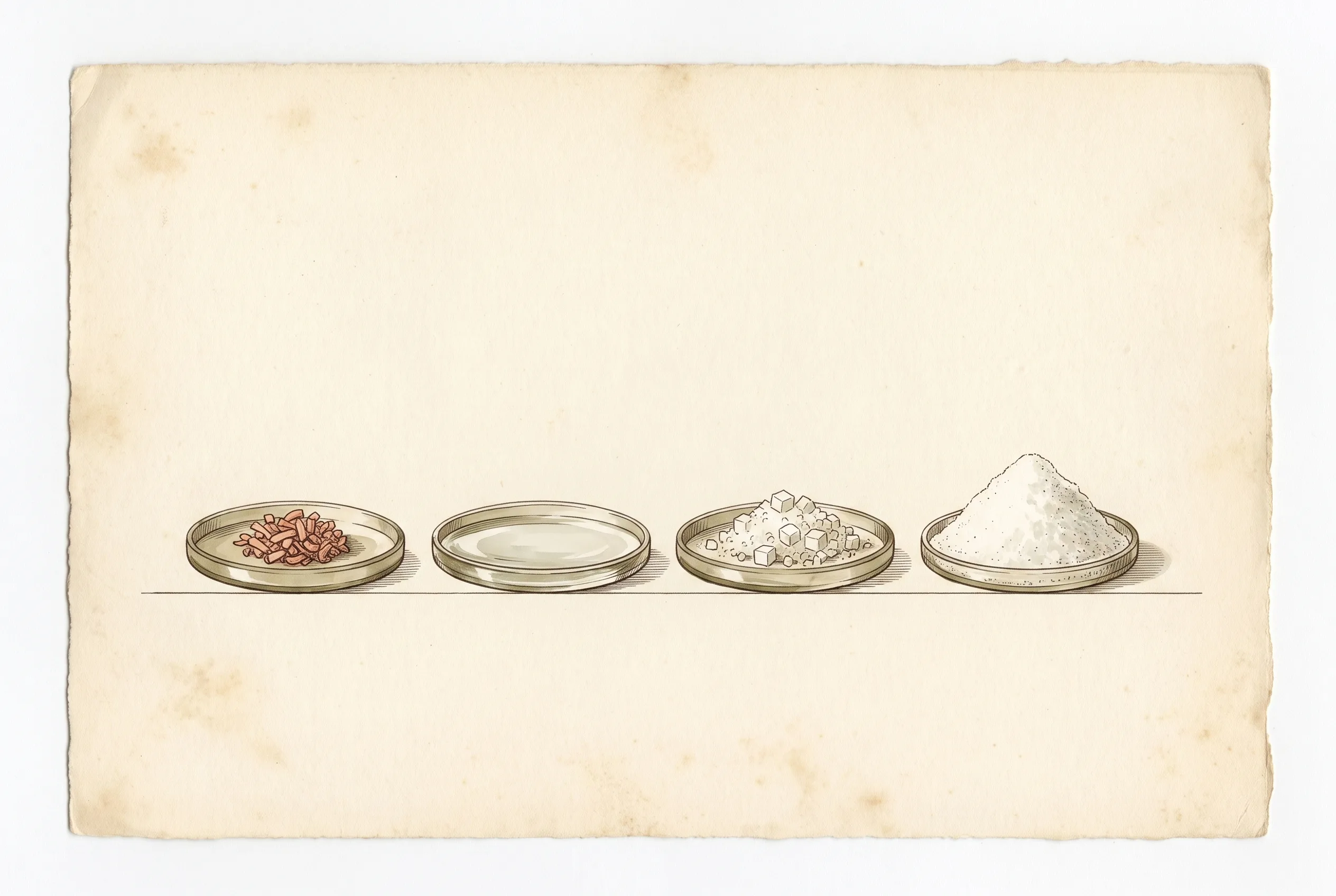
- Mass
- 25.0 g
- what you'd weigh on a balance
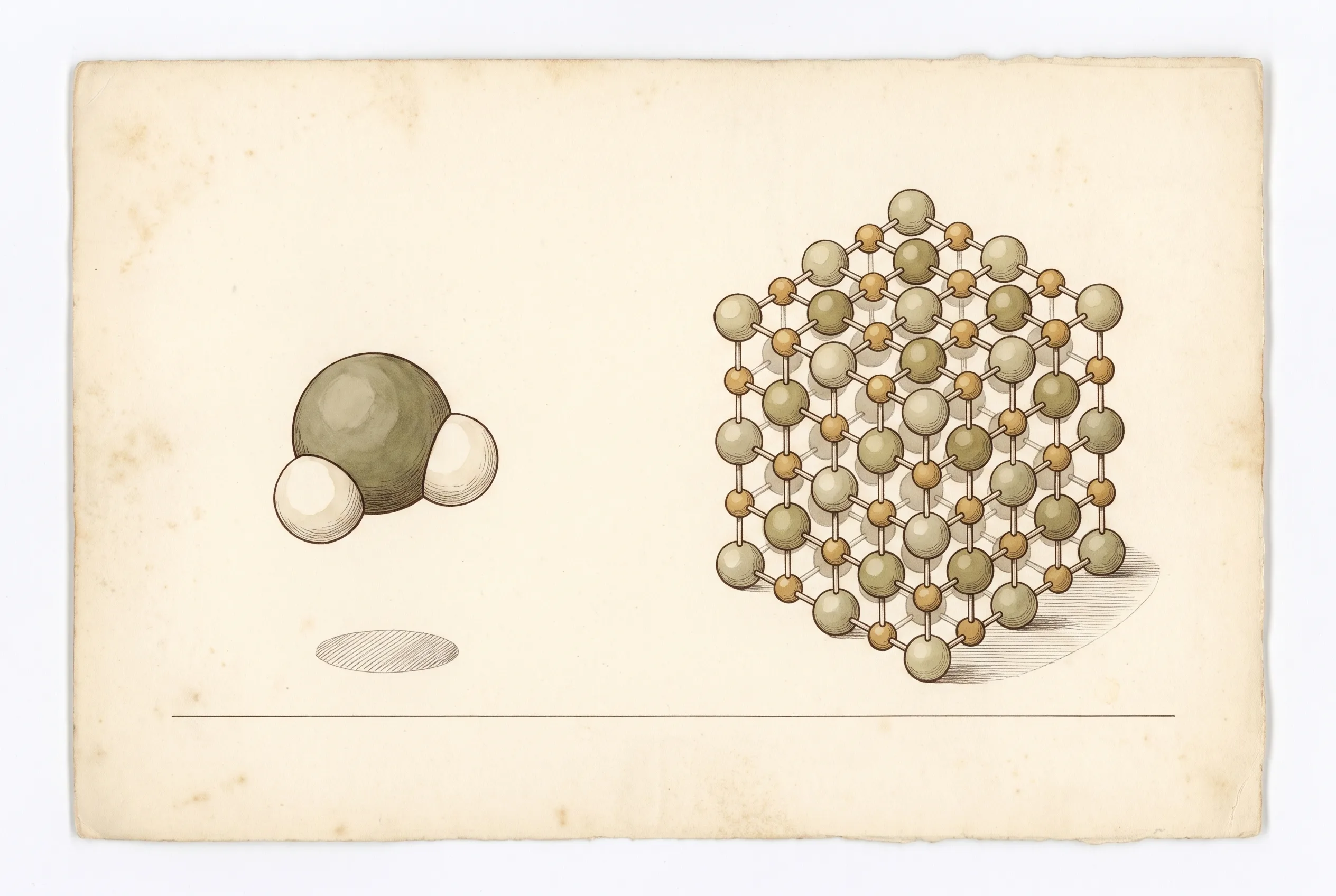
- Amount of substance
- 1.39 mol
- written n, measured in moles
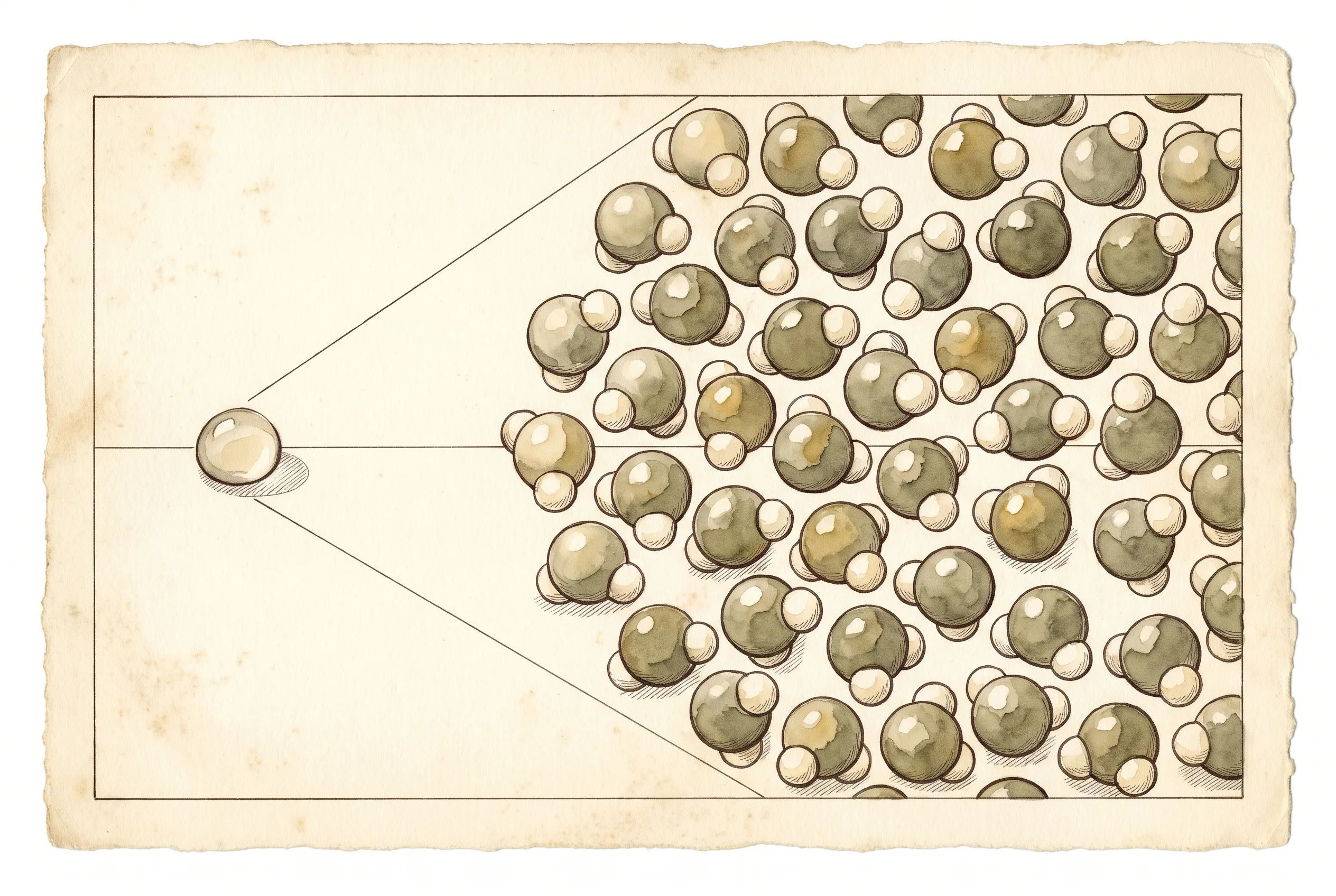
- Particles
- 8.36 × 10²³
- molecules
What these numbers look like
How to calculate moles from grams
What you have and what you want
Write down three things: the formula of the substance, the amount the question gives you, and the unit it asks for. Grams to moles and moles to grams use the same molar mass. To go from grams to moles, divide by it. To go from moles to grams, multiply by it.
Find the molar mass
Add up the atomic weight of every atom in the formula, which you find on the periodic table. A subscript outside parentheses multiplies everything inside them. Calcium nitrate, Ca(NO3)2, has one calcium atom at 40.078 and two nitrate groups (NO3) at 62.004 each, so its molar mass is 40.078 + 2 × 62.004 = 164.086 g/mol.
Turn grams into moles
Multiply the mass by a conversion factor with grams on the bottom, so the grams cancel: 25.0 g H2O × (1 mol H2O / 18.015 g H2O) = 1.39 mol H2O. Multiplying by this factor is the same as dividing by the molar mass. Then check the unit that's left. If it's moles, you set the factor up the right way.
Questions
- How do you calculate moles from grams?
- Divide the mass in grams by the molar mass in grams per mole. For 25.0 g of water, that's 25.0 g ÷ 18.015 g/mol = 1.39 mol. As a conversion factor, it's 25.0 g H2O × (1 mol H2O / 18.015 g H2O). The grams cancel, and moles are left.
- How do you find the molar mass of a compound?
- Add up the atomic weight of every atom in the formula, and multiply anything in parentheses by the subscript outside them. Calcium nitrate, Ca(NO3)2, has one calcium atom at 40.078 and two nitrate groups (NO3) at 62.004 each, for a molar mass of 164.086 g/mol.
- Is the molar mass of oxygen 16 or 32?
- It depends on whether you mean one oxygen atom or oxygen gas. An oxygen atom has a molar mass of 15.999 g/mol. Oxygen gas is made of O2 molecules, two atoms each, so its molar mass is 31.998 g/mol. If the question says "oxygen gas" or writes O2, use 32. If it means a single atom, or the oxygen inside a compound, use 16.
- How many significant figures should the answer have?
- As many as the less precise of the two numbers you divide or multiply: your measurement and the molar mass. Usually that's your measurement. 25.0 g has three significant figures and 18.015 g/mol has five, so 25.0 g of water is 1.39 mol, not 1.38773 mol. Sodium's molar mass, 22.99 g/mol, has only four, so 25.000 g of sodium is 1.087 mol.
- What is the difference between molar mass and molecular weight?
- They give the same number in different units. Molar mass is the mass of one mole of a substance, in grams per mole: 18.015 g/mol for water. "Molecular weight" is an older name for relative molecular mass, which compares the mass of one molecule with the atomic mass unit, so it has no units: 18.015 for water. People also use it for molecular mass, the mass of one molecule in atomic mass units: 18.015 u. Because the numbers match, the atomic weights on the periodic table work as molar masses in grams per mole.
Every formula on this page is written in element symbols. If you have to stop and work out what a symbol stands for, that’s attention you can’t spend on the math. In Bond Forge, you draw a bond by answering a chemistry question correctly, and most questions come from what you’re still learning. It’s free to play with a starter set of elements, no account needed.
We use the atomic weights in the CRC Handbook of Chemistry and Physics, 104th edition (2023), for all 118 elements. We round each molar mass to three decimal places and calculate every conversion with the rounded number you see, so you can check each step with your own calculator.
This reference is free for teachers and students to use and share under the CC BY-NC-ND 4.0 license. Licensing details