
Why Your Kid Has Gaps in Chemistry
7 min read
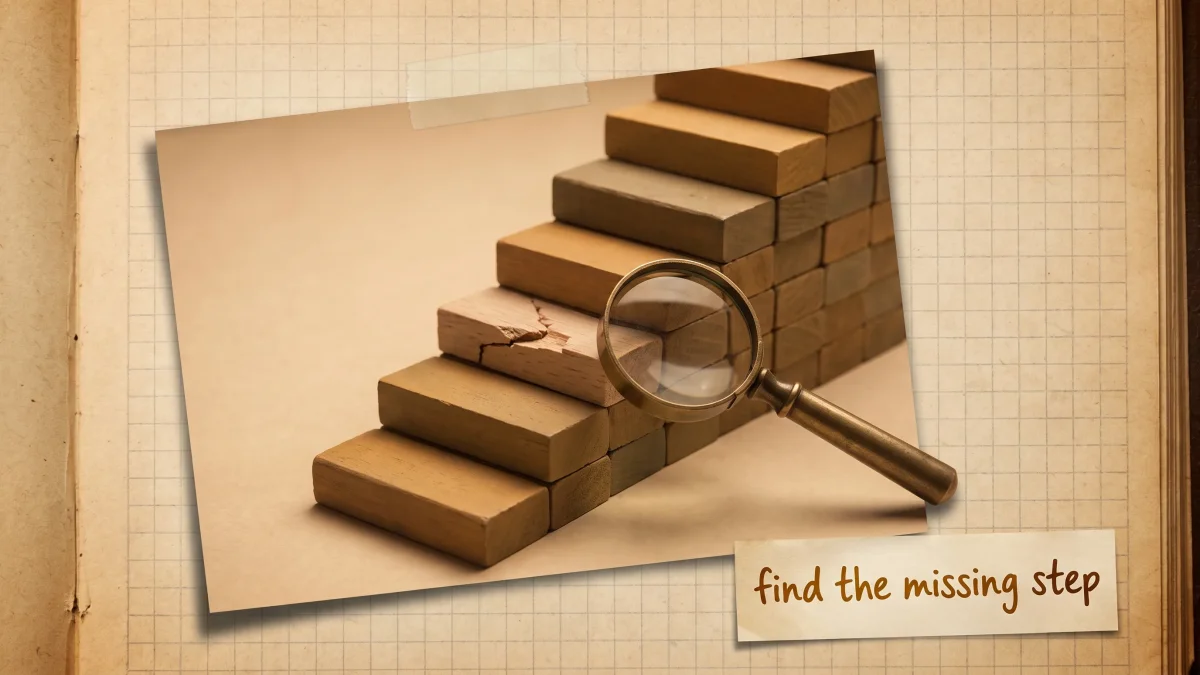
Short answer: A class moves at one pace, but each student is missing different pieces, one never solidified atom-counting, another shaky on ionic charge, and a teacher can't pause the calendar for all of them at once. Mastery-based learning flips that: you don't move on until the current piece is solid, so the gap gets found and filled.
Why does my kid have gaps if they're keeping up with the class?
Because "keeping up" means showing up to the next lecture on schedule, not having actually learned the last one. A time-paced class assumes each unit landed before it moves to the next, and it moves whether or not that's true. One student never fully locked down how to count atoms in a formula. Another got the idea of ionic charge for about a day and then lost it. Neither one raises a hand, because neither one knows they're the only one who's shaky on that particular piece, and chemistry builds in layers, so a soft spot from three weeks ago becomes the reason this week's problem set doesn't make sense. The gap is real. It's also invisible from the outside, including to the kid who has it.
What is mastery-based learning?
It's the older, well-studied idea that a student moves to the next skill only after demonstrating they've actually got the current one. Benjamin Bloom described the model in 1968 ("Learning for Mastery"): teach a unit, check whether students have mastered it, give the ones who haven't a different kind of practice until they do, then move everyone forward together. Learning sets the pace, and the calendar follows it. It's a simple swap in principle and a hard one to run for thirty students with one teacher and one clock.
Why can't a teacher just go back and fix each gap?
Because the gaps aren't the same gap. In a room of thirty students, you might have ten different missing pieces scattered across ten different kids, and re-teaching ionic charge to the whole class wastes the time of the twenty who already have it while still not reaching the two who needed something else entirely. A teacher juggling a full curriculum and a fixed number of class days can't run thirty individualized lesson plans at once. It comes down to arithmetic: one instructor, one pace, many different missing pieces, and a syllabus that has to move forward regardless. The teacher stays stretched thin inside that structure no matter what. It's the exact constraint mastery-based software exists to route around.
What is the "2 Sigma Problem," and does it apply here?
In 1984, Bloom published a follow-up asking how far one-to-one tutoring could push learning outcomes. His finding: students who got individual tutoring, working at their own pace with corrective feedback until each step was mastered, scored about two standard deviations higher than students in a conventional classroom. Put plainly, the average tutored student outscored roughly 98 percent of the untutored group. Bloom called the size of that gap "the 2 sigma problem," because no school system can afford a personal tutor for every kid, and forty years later, that's still true. What software brings within reach isn't the exact tutoring effect, one-to-one human attention has ingredients no app fully replicates, but the underlying principle behind it: don't advance the student until the current piece is solid. That principle is available at the price of a game, even where a personal tutor isn't.
How does Periodic Mole find and fill the gap automatically?
Periodic Mole is built as a game where you answer a chemistry question to make your move, and the questions are mastery-gated: the system deals you the next one a small step above what you've already mastered, tracking your actual recall rather than a grade level or a unit number. Get something wrong and it doesn't wave you past it. It drills that exact piece until it's solid, then lets you climb. The ladder starts with the basics, element symbols and names, and climbs into reading chemical formulas, bonding, the mole, and stoichiometry. If your kid's gap is early, the ladder halts there and works it. If the gap is further along, everything before it clears fast because it's already solid. Either way, the system finds the actual stopping point without anyone having to diagnose it by hand. For more on supporting this from the parent side, see Help your teen with chemistry.
Do I need to know chemistry myself to help with this?
No. You don't have to check the work or spot the gap yourself. The game does that by design: your teen plays, the questions adjust to what they've actually got down, and the mastery ladder is the diagnosis. Your job is mostly making room for a little daily play, the same way you'd make room for practicing an instrument.
Will this guarantee a better grade?
No, and treat anyone who promises that with suspicion. What mastery-based practice does is target the actual mechanism grades depend on: whether the foundational pieces are solid before the next thing gets built on them. Bond Forge and Pt Paddle are free to try with no account and cover the first 12 elements, and the full interactive periodic table (all 118) is free to browse. Acid Boy & Base Girl also offers two free missions about pH. Full access includes every game and all the content for $59 for one year or $79 for two, paid upfront.
Try it free. Bond Forge is free to play with a starter set of elements, no account needed. Full access is $59 for a year: every game and all 118 elements, with progress saved. No subscription.
FAQ
What are "chemistry gaps" and why does every student have different ones? A chemistry gap is a piece that never fully solidified, atom-counting, naming compounds, balancing an equation, whatever it was. Every student's gap is different because everyone's attention, background, and bad day landed on a different lesson. A time-paced class can't rewind individually for thirty different gaps, so they stay invisible until the next unit depends on them.
Is mastery-based learning the same as one-to-one tutoring? No. One-to-one tutoring is a person adapting in real time to exactly one student, and it's the gold standard the research is built on. Mastery-based software borrows the underlying rule, don't advance until the current piece is mastered, and applies it at the price and scale of a game.
What is the 2 Sigma Problem? It's a 1984 finding from Benjamin Bloom that students given one-to-one tutoring scored about two standard deviations higher than students taught conventionally, meaning the average tutored student outscored roughly 98 percent of the untutored group. Bloom named it a "problem" because that effect is large and, forty years later, still isn't affordable for every student.
How does Periodic Mole know where my kid's gap is? Every question in the game is mastery-gated: the system serves the next question a small step above what's already mastered. Miss it, and the ladder halts there and drills that exact piece until it's solid before moving on, climbing from element symbols up into formulas, bonding, the mole, and stoichiometry.
Do I need to know chemistry myself to use this with my teen? No. The game evaluates what your teen has mastered and adjusts the questions accordingly. You don't need to check the work or spot the gap yourself.
Related
Sources
- Bloom, B. S. (1984). The 2 Sigma Problem: The Search for Methods of Group Instruction as Effective as One-to-One Tutoring. Educational Researcher.
- Bloom, B. S. (1968). Learning for Mastery. Evaluation Comment.
- Guskey, T. R. (2007/2010). Research on mastery learning and formative assessment.