
Acids, Bases, and pH: A High School Guide
10 min read
Short answer: An acid gives up a proton, a hydrogen ion (H⁺), and a base takes one. pH is the number for how acidic a water solution is: below 7 is acidic, 7 is neutral at 25 °C, and above 7 is basic. Each pH step is tenfold.
In water, an acid gives its proton to a water molecule, and the water molecule becomes a hydronium ion (H₃O⁺). That's why chemists define pH by the concentration of hydronium, and why you'll also see the ion written as H⁺, a common shorthand for H₃O⁺ in water. We wrote this for students meeting acids and bases for the first time and for anyone reviewing before a test.
What is an acid, and what is a base?
An acid is a substance that donates a proton to another substance, and a base is a substance that accepts one. This is the Brønsted–Lowry definition, which Johannes Brønsted and Thomas Lowry proposed in 1923. OpenStax's free textbook Chemistry 2e has it in one sentence: "A compound that donates a proton to another compound is called a Brønsted-Lowry acid." A proton here is a hydrogen ion, a hydrogen atom without its electron. Lowry called them "hydrogen nuclei."
Here are two reactions with water, one for each side:
- HCl + H₂O → H₃O⁺ + Cl⁻
- NH₃ + H₂O ⇌ NH₄⁺ + OH⁻
In the first, hydrogen chloride (HCl) gives its proton to a water molecule. The water becomes a hydronium ion (H₃O⁺), and the rest of the acid is a chloride ion (Cl⁻). In the second, ammonia (NH₃) takes a proton from a water molecule, and the products are an ammonium ion (NH₄⁺) and a hydroxide ion (OH⁻). The double arrow (⇌) means the reaction goes both ways, and at any moment only a small share of the ammonia has taken a proton. Lowry wrote this ammonia equation in his paper of January 1923, with water as HOH, and said: "The real function of a base is that of an acceptor of hydrogen nuclei."
Water is the base in the first reaction and the acid in the second. Chemists call a substance that can do both amphiprotic.
Ammonia has three hydrogen atoms and is still a base, so you can't tell an acid by the H's in its formula. In one study, Demircioğlu, Ayas, and Demircioğlu tested 88 tenth graders at one school in Turkey before their acids and bases unit. In one group, 41% said an H in a formula means the substance is an acid, and in the other, 48%.
What is an Arrhenius acid?
An Arrhenius acid is a substance that produces hydrogen ions (H⁺) when it dissolves in water, and an Arrhenius base is one that produces hydroxide ions (OH⁻). That wording is a later textbook summary of the work of Svante Arrhenius, who didn't define an acid that way in his 1887 paper on ions in water.
In that paper, Arrhenius sorted dissolved substances into four groups: non-conductors, bases, acids, and salts. In his Nobel lecture of December 1903, he put the ion picture plainly. Strong acids and bases "are in extreme dilution almost completely dissociated into their ions, i.e. HCl into H+ and Cl-, NaOH into Na+ and OH-." In that list, NaOH is sodium hydroxide, H⁺ a hydrogen ion, Cl⁻ a chloride ion, Na⁺ a sodium ion, and OH⁻ a hydroxide ion. He wrote neutralization, the reaction of an acid with a base, as "H+ + OH- = HOH."
The Arrhenius definition is about water solutions only, and its bases are substances that make hydroxide ions. Ammonia was in Arrhenius's 1887 table of bases, but NH₃ has no hydroxide in it. It makes OH⁻ by taking a proton from water, the step Brønsted and Lowry built their definition on. Lowry called the hydroxide view of bases "a narrow view, based on the fact that most of our chemical work is done in presence of water."
G. N. Lewis published a wider definition in a book in 1923, the same year as Brønsted and Lowry. In it, he wrote that "the basic substance furnishes a pair of electrons for a chemical bond, the acid substance accepts such a pair." Boron trichloride (BCl₃) has no hydrogen to give and is an acid under that definition. Lewis called the proton definition "more general" than the water one, but "not universal."
| Definition | An acid… | A base… |
|---|---|---|
| Arrhenius (textbook summary) | makes H⁺ in water (HCl) | makes OH⁻ in water (NaOH) |
| Brønsted–Lowry (1923) | gives up a proton (HCl) | takes a proton (NH₃) |
| Lewis (1923) | accepts an electron pair (BCl₃) | donates an electron pair (NH₃) |
Every Arrhenius acid is also a Brønsted–Lowry acid, every Brønsted–Lowry base is also a Lewis base, and Lewis counted the hydrogen ion itself as an acid.
What does pH mean?
pH is a number for the concentration of hydronium ions in a water solution, on a scale of powers of ten. The definition is pH = −log[H₃O⁺], where the square brackets mean concentration in moles per liter (mol/L). In plain terms, pH is the power of ten in the hydronium concentration with its sign flipped: a solution with 1 × 10⁻³ mol/L of hydronium has a pH of 3. The minus sign is why more hydronium means a lower pH.
S. P. L. Sørensen, a Danish biochemist, introduced pH in two papers in 1909, one in German and one in French. According to the U.S. Geological Survey, the p is from the German Potenz and the French puissance, both meaning power, as in the power of ten.
| Hydronium (mol/L) | pH | Compared with pure water at 25 °C |
|---|---|---|
| 1 × 10⁻² | 2 | 100,000 times the hydronium |
| 1 × 10⁻⁴ | 4 | 1,000 times the hydronium |
| 1 × 10⁻⁷ | 7 | the same, neutral |
| 1 × 10⁻¹⁰ | 10 | a thousandth of the hydronium |
Each step of 1 is a factor of 10, so a solution at pH 3 has ten times the hydronium of one at pH 4 and a hundred times the hydronium of one at pH 5. In one study, Sheppard interviewed 16 American students in grades 10 and 11 at one school after their acids and bases unit and found that "for most students pH was a linear scale." Two of the 16 defined pH as −log[H⁺], and one explained the hundredfold gap between pH 3 and pH 5.
A solution is neutral when it has equal amounts of hydronium and hydroxide, and that is pH 7 only at 25 °C. At 80 °C, a neutral solution has a pH of 6.31.
Only a solution with water in it has a pH. The U.S. Geological Survey gives vegetable oil and pure alcohol as liquids with no pH, and it puts the range at 0 to 14. In another study, Hoe and Subramaniam tested 92 ninth graders in Singapore at least two months after they studied acids and bases, and 65% said pH values can only be between 1 and 14. The authors note that a textbook's pH chart is an illustration and that pH values outside it are possible.
What is the pH of everyday things?
Everyday substances have pH values from about 2 for lemon juice to 14 for lye. These are typical values from the U.S. Food and Drug Administration, the Environmental Protection Agency, the U.S. Geological Survey, and a 2016 study of drinks in the Journal of the American Dental Association. A real bottle at home can differ.
| Substance | pH, about | Side of 7 |
|---|---|---|
| Lemon juice | 2.0–2.6 | acidic |
| Cola | 2.4 | acidic |
| Vinegar | 2.4–3.4 | acidic |
| Orange juice | 3.3–4.2 | acidic |
| Black coffee | 5 | acidic |
| Rain, unpolluted | 5.6 | acidic |
| Milk | 6.4–6.8 | acidic |
| Pure water at 25 °C | 7 | neutral |
| Seawater | 8 | basic |
| Baking soda in water | 8–9 | basic |
| Soap solution | 10 | basic |
| Ammonia solution | 11 | basic |
| Bleach | 12–13 | basic |
| Lye (sodium hydroxide) | 14 | basic |
Students in the Singapore study held wrong values for cola and rain, both with high confidence. In the dental study, Reddy and colleagues measured classic colas at about 2.4, but 55% of the Singapore students said colas are about pH 5, and only 3% answered that question right with the right reason. On a separate question, 52% called unpolluted rain neutral. Rain is about 5.6, slightly acidic, because carbon dioxide from the air dissolves in it.
Is a strong acid the same as a concentrated acid?
A strong acid and a concentrated acid are different things. Strength is how completely an acid ionizes, or splits into ions, in water, and concentration is how much acid is in each liter. In Chemistry 2e: "If the ionization reaction is essentially complete, the acid or base is termed strong; if relatively little ionization occurs, the acid or base is weak." Arrhenius had numbers for the difference in 1887: for the fraction split into ions, he gave 0.90 for hydrochloric acid and 0.01 for acetic acid.
OpenStax lists six strong acids: perchloric (HClO₄), hydrochloric (HCl), hydrobromic (HBr), hydroiodic (HI), nitric (HNO₃), and sulfuric (H₂SO₄, for its first proton). Acetic acid (CH₃COOH), the acid in vinegar, is weak. Its acid ionization constant, Ka, a number for how far an acid ionizes, is 1.8 × 10⁻⁵.
The pH of a solution depends on both. A very dilute strong acid, hydrochloric acid at 1.0 × 10⁻⁵ mol/L, has a pH of 5.0. A weak acid at a far higher concentration, acetic acid at 1.0 mol/L, has a pH of about 2.4, with over 400 times the hydronium, though only about 0.4% of its molecules ionize. In the Turkish study, 18% and 23% of the two groups said a strong acid is always concentrated. In the American interviews, 6 of 16 students described pH as a measure of "strength."
What happens when an acid and a base react?
An acid and a base react when a proton moves from the acid to the base. OpenStax defines it the same way: "An acid-base reaction is one in which a hydrogen ion, H+, is transferred from one chemical species to another."
Hydrochloric acid and sodium hydroxide are the classic pair, and their reaction is HCl + NaOH → NaCl + H₂O. The products are water and sodium chloride (NaCl), a salt: an ionic compound made of the base's positive ion, Na⁺, and the ion the acid leaves behind, Cl⁻. Arrhenius wrote the core of it in 1903 as "H+ + OH- = HOH." With hydronium, the same reaction is H₃O⁺ + OH⁻ → 2 H₂O: a hydronium ion and a hydroxide ion become two water molecules.
The pH after a neutralization isn't always 7, because salt solutions, in OpenStax's words, "may be acidic, basic, or neutral." Ammonium chloride (NH₄Cl) dissolves to an acidic solution. Sodium acetate (CH₃COONa) dissolves to a basic one, and baking soda, sodium hydrogen carbonate (NaHCO₃), is about 8 to 9 in water. In a titration, a chemist adds a base to an acid a little at a time and follows the pH. In OpenStax's titration of 0.100 mol/L acetic acid with 0.100 mol/L sodium hydroxide, the pH at the equivalence point, where the moles of base added equal the moles of acid, is 8.72. In the Turkish study, "all salts are neutral" was the most common wrong idea before the unit, held by 84% and 95% of the two groups.
A neutral solution still has both ions in it. Water's ion product, Kw = [H₃O⁺][OH⁻], is 1.0 × 10⁻¹⁴ at 25 °C, so pure water has 1.0 × 10⁻⁷ mol/L of hydronium and the same of hydroxide. In the Singapore study, 41% of students said that after a complete neutralization, neither H⁺ nor OH⁻ is left.
Acids react with carbonates too. Limestone is calcium carbonate (CaCO₃), and hydrochloric acid on limestone makes calcium chloride (CaCl₂), a salt, with carbon dioxide gas (CO₂) and water: CaCO₃ + 2 HCl → CaCl₂ + CO₂ + H₂O. The carbon dioxide is the fizz.
How do you read pH with an indicator?
An acid-base indicator is a dye whose color depends on pH, and each indicator changes color over its own range. Robert Boyle sorted substances this way in 1664: "almost any Acid Salt will turn Syrrup of Violets Red," he wrote, and alkaline (basic) salts turned the syrup green. The ranges below, with each indicator's color below its range and above it, are from the University of British Columbia's chemistry department.
| Indicator | pH range | Color as pH rises |
|---|---|---|
| Methyl orange | 3.2–4.4 | red to yellow |
| Bromcresol green | 3.8–5.4 | yellow to blue |
| Bromthymol blue | 6.0–7.6 | yellow to blue |
| Phenolphthalein | 8.2–10.0 | colorless to pink |
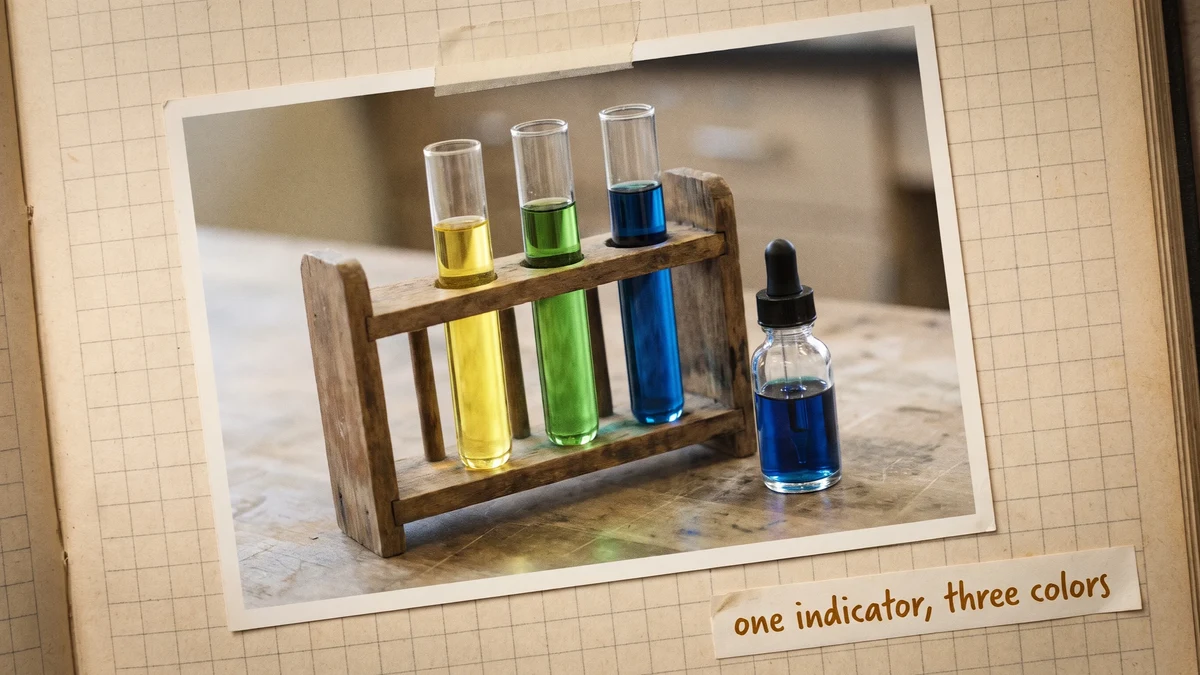
Inside its range, an indicator is a mix of its two colors. Bromthymol blue is green near the middle of its 6.0–7.6 range, as in the middle tube of the image at the top of this page. From one color you learn which side of a range the pH is on, not the number. If bromthymol blue is yellow, the pH is below 6.0, and it could be 5.9 or 2.
With two indicators, you can narrow it down. If methyl orange is yellow (above 4.4) and bromthymol blue is yellow (below 6.0) in the same solution, the pH is between 4.4 and 6.0.
In the American interview study, 14 of the 16 students said an indicator changes color at pH 7. For a titration, chemists choose an indicator that changes color near the equivalence point. Phenolphthalein is colorless until 8.2, so it is a good fit for the acetic acid titration above: 8.72 is inside phenolphthalein's range and above bromthymol blue's.
What do you need for the New York Chemistry Regents?
On New York's new Chemistry Regents, NYSED, the state education department, put acids, bases, and pH in 10 of the 98 questions on the June and August 2026 papers. The 2025 Reference Tables for the new exam have no acid, base, or indicator table and no pH formula, so you need to know what pH means without looking it up. On the papers it has released, NYSED printed an indicator chart beside every question about indicators.
Students taking the older Physical Setting/Chemistry exam, whose last sitting is June 23, 2027, still have Tables K, L, and M in the 2011 edition: common acids, common bases, and indicators. We compare the two editions table by table in Chemistry Regents Reference Tables 2011/2025.
We teach this unit from the first idea in our free pH module, with no account needed. We start the first lesson with what an acid is, and when you finish the module, we send you to missions 1 and 2 of Acid Boy & Base Girl.
Is there a game for acids, bases, and pH?
Acid Boy & Base Girl is our 3D puzzle platformer about acids and bases, and the first two missions are free in a browser. You guide two heroes through a lab where most platforms are everyday substances with a real pH. Acid Boy is safe below 7, Base Girl above 7, and both at 7. In mission 1, you clear a limestone wall with an acid. We tell the whole story in Acid Boy & Base Girl: The pH Game.
Try it free. Bond Forge is free to play with a starter set of elements, no account needed. Full access is $59 for a year: every game and all 118 elements, with progress saved. No subscription.
FAQ
Is water an acid or a base?
Water is both. It accepts a proton from hydrogen chloride and gives one to ammonia, and chemists call a substance that can do both amphiprotic. Pure water at 25 °C has equal amounts of hydronium and hydroxide ions, 1.0 × 10⁻⁷ mol/L of each, so its pH is 7.
Is pH 7 always neutral?
No. A solution is neutral when it has equal amounts of hydronium and hydroxide ions, and that is pH 7 only at 25 °C. At 80 °C, a neutral solution has a pH of 6.31, according to OpenStax's Chemistry 2e.
What is the difference between an Arrhenius acid and a Brønsted–Lowry acid?
An Arrhenius acid makes hydrogen ions (H⁺) in water. A Brønsted–Lowry acid gives a proton to any substance that accepts one. Every Arrhenius acid is a Brønsted–Lowry acid. Under the Brønsted–Lowry definition, ammonia (NH₃) is a base because it takes a proton from a water molecule, which leaves a hydroxide ion (OH⁻).
What are the strong acids?
OpenStax's Chemistry 2e lists six: perchloric acid (HClO₄), hydrochloric acid (HCl), hydrobromic acid (HBr), hydroiodic acid (HI), nitric acid (HNO₃), and sulfuric acid (H₂SO₄). A strong acid ionizes almost completely in water (for sulfuric acid, its first proton). Strength is a different property from concentration, so a very dilute strong acid can have a higher pH than a weak acid at a much higher concentration.
Related
Sources
- Flowers, P., Theopold, K., Langley, R., & Robinson, W. R. (2019). Chemistry 2e. OpenStax. Sections 4.2, 14.1, 14.2, 14.3, 14.4, 14.7, and 18.6.
- Arrhenius, S. (1887). Über die Dissociation der in Wasser gelösten Stoffe. Zeitschrift für physikalische Chemie 1, 631–648. English translation in H. C. Jones (ed.), The Modern Theory of Solution (1899), pp. 45–66, archive.org.
- Arrhenius, S. (1903). Development of the theory of electrolytic dissociation. Nobel Lecture, 11 December 1903, nobelprize.org.
- Lowry, T. M. (1923). The uniqueness of hydrogen. Journal of the Society of Chemical Industry 42, 43–47, doi:10.1002/jctb.5000420302.
- Lewis, G. N. (1923). Valence and the Structure of Atoms and Molecules. Chemical Catalog Company, pp. 137–143, archive.org.
- Boyle, R. (1664). Experiments and Considerations Touching Colours. London, p. 246, Project Gutenberg.
- U.S. Geological Survey, Water Science School. pH and Water.
- U.S. Food and Drug Administration, CFSAN (2007). Approximate pH of Foods and Food Products.
- U.S. Environmental Protection Agency (2006). Volunteer Estuary Monitoring Manual, 2nd ed., chapter 11, "pH and Alkalinity" (EPA-842-B-06-003).
- Reddy, A., Norris, D. F., Momeni, S. S., Waldo, B., & Ruby, J. D. (2016). The pH of beverages available to the American consumer. Journal of the American Dental Association 147(4), 255–263, doi:10.1016/j.adaj.2015.10.019.
- University of British Columbia, Department of Chemistry. Acid-Base Indicators.
- Hoe, K. Y., & Subramaniam, R. (2016). On the prevalence of alternative conceptions on acid–base chemistry among secondary students. Chemistry Education Research and Practice 17(2), 263–282, doi:10.1039/C5RP00146C.
- Sheppard, K. (2006). High school students' understanding of titrations and related acid-base phenomena. Chemistry Education Research and Practice 7(1), 32–45, doi:10.1039/B5RP90014J.
- Demircioğlu, G., Ayas, A., & Demircioğlu, H. (2005). Conceptual change achieved through a new teaching program on acids and bases. Chemistry Education Research and Practice 6(1), 36–51, doi:10.1039/B4RP90003K.
- New York State Education Department. Reference Tables for Physical Science: Chemistry, 2025 Edition and Reference Tables for Physical Setting/Chemistry, 2011 Edition, and the June and August 2026 Physical Science: Chemistry exams, nysedregents.org/ps-chemistry.