
Acid Boy & Base Girl: The pH Game
7 min read
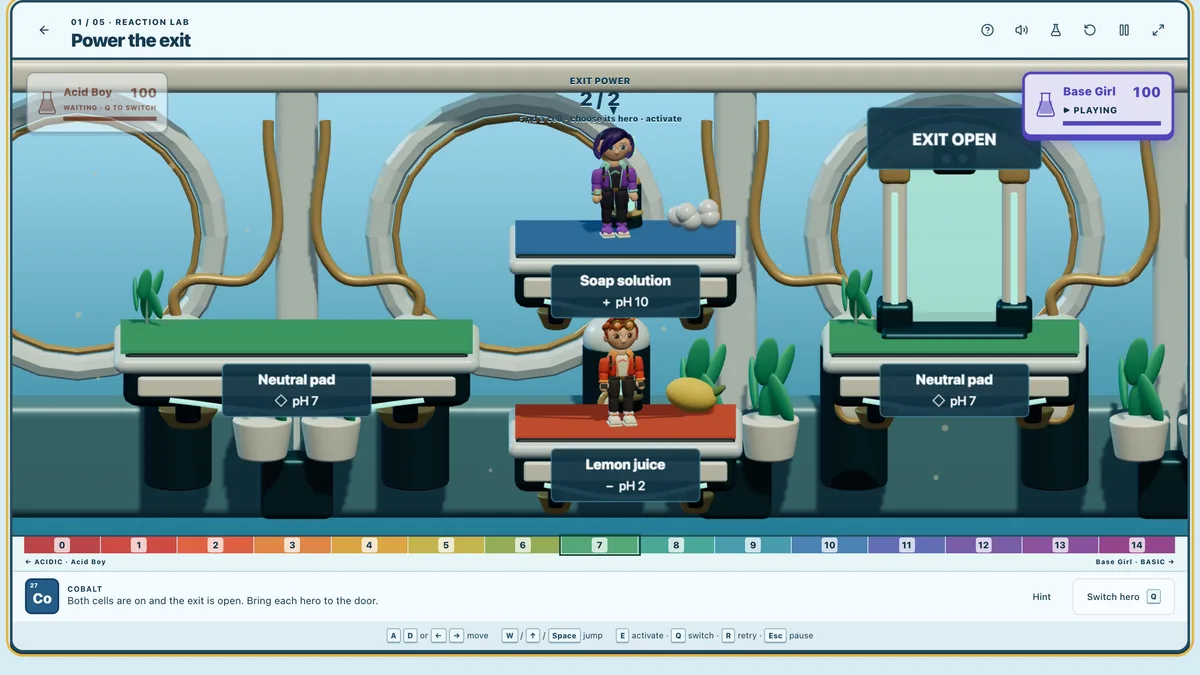
Acid Boy can stand in lemon juice. Put Base Girl on it and she starts to dissolve.
Short answer: Acid Boy & Base Girl is our 3D puzzle platformer about acids and bases. You guide two heroes through a laboratory where most platforms are everyday substances with a real pH. Acid Boy is safe below 7, Base Girl above 7, both at 7. The first two missions are free in a browser.
To get through a room, you read the pH of each substance and send the hero who can stand on it.
How does the pH game work?
Acid Boy & Base Girl runs on one rule from real chemistry. The pH scale runs from 0 to 14, and it sits along the bottom of the screen the whole time. Everything below 7 is acidic, everything above 7 is basic, and 7 is neutral. Acid Boy is safe on acidic ground and neutral pads. Base Girl is safe on basic ground and neutral pads.
You control both heroes and switch between them with Q. Each room has power cells sitting in solutions, and a cell can only be activated by the hero who can survive standing in it. In the first mission that means Acid Boy takes the lemon juice (pH 2) and Base Girl takes the soap solution (pH 10). Power both cells and the exit opens.
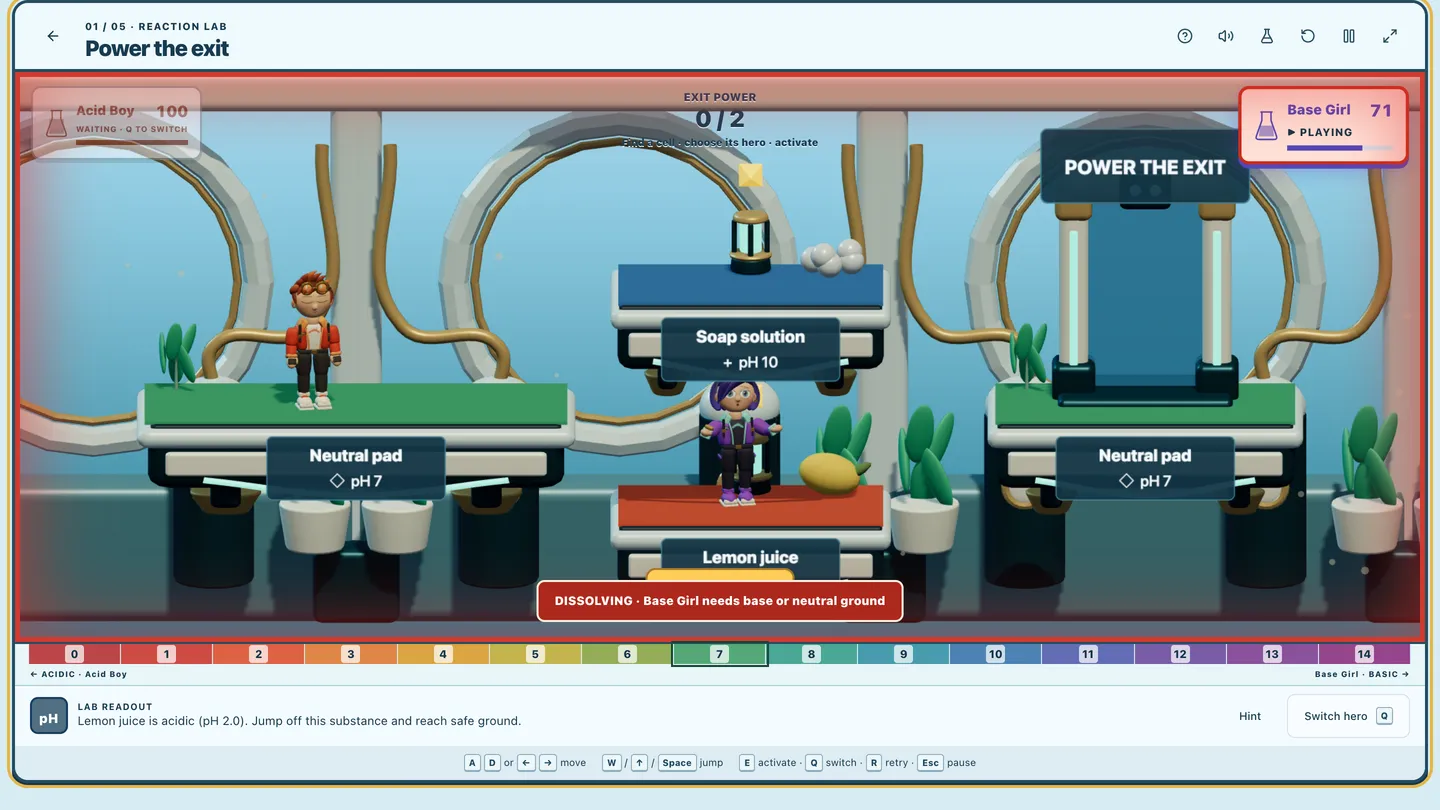
Send the wrong hero and their health starts to fade. Fast. The screen flushes red, and the lab readout names the substance and its pH: "Lemon juice is acidic (pH 2.0). Jump off this substance and reach safe ground." You retry from the last checkpoint, so a wrong guess costs a few seconds.
What does each mission teach?
Each of the five missions in Acid Boy & Base Girl adds one idea about acids and bases, and each builds on the one before it. Missions 3 to 5 add taller rooms with lifts and pressure plates. The chemistry stays at the level of a first-year high school course.
| Mission | Room | What you learn by playing | Access |
|---|---|---|---|
| 1. Power the exit | Reaction Lab | Acids sit below 7 on the pH scale, bases above 7, neutral at 7 | Free |
| 2. Crossed wires | Reaction Lab | Choose routes by pH, then pair equal amounts of H⁺ and OH⁻ to make water | Free |
| 3. Just enough | The Titration Terrace | Partial neutralization, balance, and excess are three different results | Full access |
| 4. Read without color | The Unlabeled Gallery | Classify substances by name with the sensors offline and no indicator color to lean on | Full access |
| 5. Pack more into a dose | Concentration Falls | Concentration is amount per volume, so equal volumes can carry different amounts | Full access |
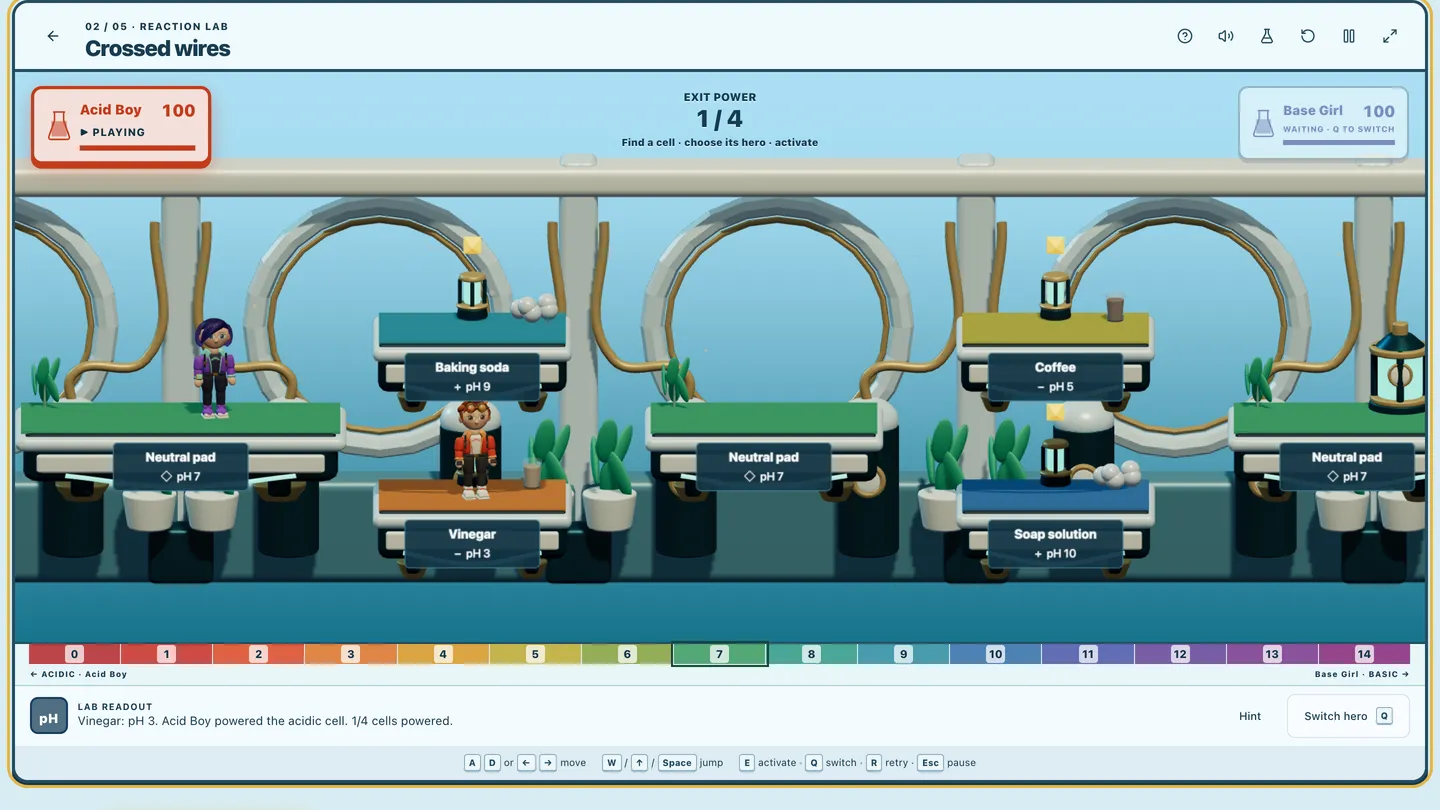
Mission 2 adds forks to the route. There are two, and the high road switches sides: at the first fork baking soda (pH 9) sits above vinegar (pH 3), and at the second coffee (pH 5) sits above soap (pH 10).
At the end of that room sits a reactor holding a model hydrochloric acid solution. Before you touch it, a short lesson walks you through one example of H⁺ and OH⁻ pairing into water, asks you to predict which ion will be left over in a second case, and then flips the problem around. Then you dose the real reactor yourself. When the amounts match, the solution reads pH 7 and the bridge extends.
Is it like Fireboy and Watergirl?
Acid Boy & Base Girl shares one idea with Fireboy and Watergirl, the browser platformer Oslo Albet released in 2009 with The Forest Temple: two heroes, each safe on a different kind of ground, who have to help each other through a level. Acids and bases split the same way, and our art direction lists Fireboy and Watergirl as a reference.
Two things are different. First, the hazards are real substances with real pH values, and you need to know them to finish a room. Second, the puzzles are about amounts as well as colors: by mission 5 you are comparing two bottles of the same volume and different concentration.
If you came here looking for games like Fireboy and Watergirl, this one keeps the two-hero coordination. The hazards are lemon juice, vinegar, soap, and lye instead of fire and water.
Why build a chemistry video game this carefully?
Students compare Acid Boy & Base Girl with the games on their phones and consoles, so those are the games we measure it against. Our design standard names Team Asobi's Astro Bot for character appeal and animation, and the lab, the heroes, and the machinery are original 3D models made for this game. Cobalt, element 27 and our in-house guide, opens each mission with a short briefing you can skip and gives hints when you ask for them. We hold every game on Periodic Mole, from Bond Forge to Storm the Castle, to that same written standard.
There's a teaching reason for that effort. In many learning games, including our own Bond Forge, the chemistry lives in a question card and the game is the reward for answering it. That design works well for facts like element symbols, which is why Bond Forge uses it. Acids and bases are a different kind of knowledge: a relationship between numbers, substances, and amounts. In this game the pH values set the level layout, so you use them every time you choose a route.
The reactor lesson in mission 2 (a worked example, a prediction, then your own attempt) follows the U.S. Institute of Education Sciences practice guide on organizing instruction (Pashler and colleagues, 2007), which recommends pairing graphics with explanation and alternating worked examples with attempts.
We think it's the best-looking chemistry game you can play in a browser, and we're still improving it. The first two missions are free, so start mission 1 and judge that for yourself in about five minutes.
Is the chemistry in the game accurate?
Acid Boy & Base Girl models dilute aqueous solutions at 25 °C, and the game keeps a field notebook that lists which parts are real chemistry and which are game fiction. Open it from the flask icon in any room. A few lines from it:
- "Strong and weak describe ionization. Concentrated and dilute describe amount per volume. A pH reading alone does not tell you acid strength."
- "pH values do not average when solutions mix."
- "Other acid–base reactions can finish above or below pH 7 at equivalence."
- "Character immunity, dissolving, healing, bubbles, and solid bridges are game fiction."
Household pH values in the game are representative samples. Real lemon juice and real soap vary by brand and concentration, and the notebook says so. The mixing stations use only model hydrochloric acid (HCl) and sodium hydroxide (NaOH), a strong acid and a strong base, which is the case where equal amounts land at exactly pH 7.
The game pairs well with a simulation. PhET's pH Scale from the University of Colorado Boulder lets you dip a probe into coffee, soap, and spit and watch the reading change as you dilute. Use the simulation to experiment freely and the game to practice the same ideas against a goal.
Who is Acid Boy & Base Girl for?
Acid Boy & Base Girl is built for high school students meeting acids and bases for the first time, including students who haven't learned ions or moles yet. The game introduces each term beside its symbol the first time it matters.
- Students: play mission 1 before the acids and bases unit starts. You'll start the unit already knowing where lemon juice, vinegar, and soap sit on the pH scale.
- Parents: the free missions need no account and no card. A mission takes a few minutes, and the par time for the first one is 60 seconds.
- Teachers: the game plays in a browser on a Chromebook or laptop, with touch controls on tablets. It works as a warm-up before a pH lab or as a check afterward: mission 4 asks students to classify lye, ammonia, cola, and vinegar by name alone.
Try it free. Bond Forge is free to play with a starter set of elements, no account needed. One payment of $59 unlocks every game and all 118 elements, with progress saved. No subscription.
The rest of the collection, from element games to a chemistry siege game, is on the games page.
FAQ
Is Acid Boy & Base Girl free? The first two missions are free to play in a browser, with no account needed; progress from free play lasts only for that visit. Missions 3 to 5, and saved progress, come with full access: $59 for one year or $79 for two, with a 30-day refund.
Can two people play Acid Boy & Base Girl together? Not yet. One player currently controls both heroes and switches between them with Q. Multiplayer is planned for the next few days.
Do I need to know chemistry to play? No. The first mission teaches the pH scale as you play, and the reactor in mission 2 comes with a short lesson you can replay any time. The game is built for students before or during their first chemistry course.
What device do I need? A browser. Acid Boy & Base Girl runs on laptops and Chromebooks with a keyboard, and on tablets and phones with touch controls. There's nothing to install.
Is there an acid base game for high school? Acid Boy & Base Girl is an acid base game built for high school: five missions covering the pH scale, neutralization, excess, reading substances without an indicator, and concentration. For free-form experimenting, PhET's pH Scale simulation pairs well with it.
Sources
- Fireboy and Watergirl, Wikipedia: Oslo Albet, The Forest Temple, 2009.
- PhET Interactive Simulations, University of Colorado Boulder, pH Scale.
- Pashler, H., et al. (2007). Organizing Instruction and Study to Improve Student Learning. Institute of Education Sciences, U.S. Department of Education.