
Bond Forge: Chemistry Dots and Boxes
5 min read
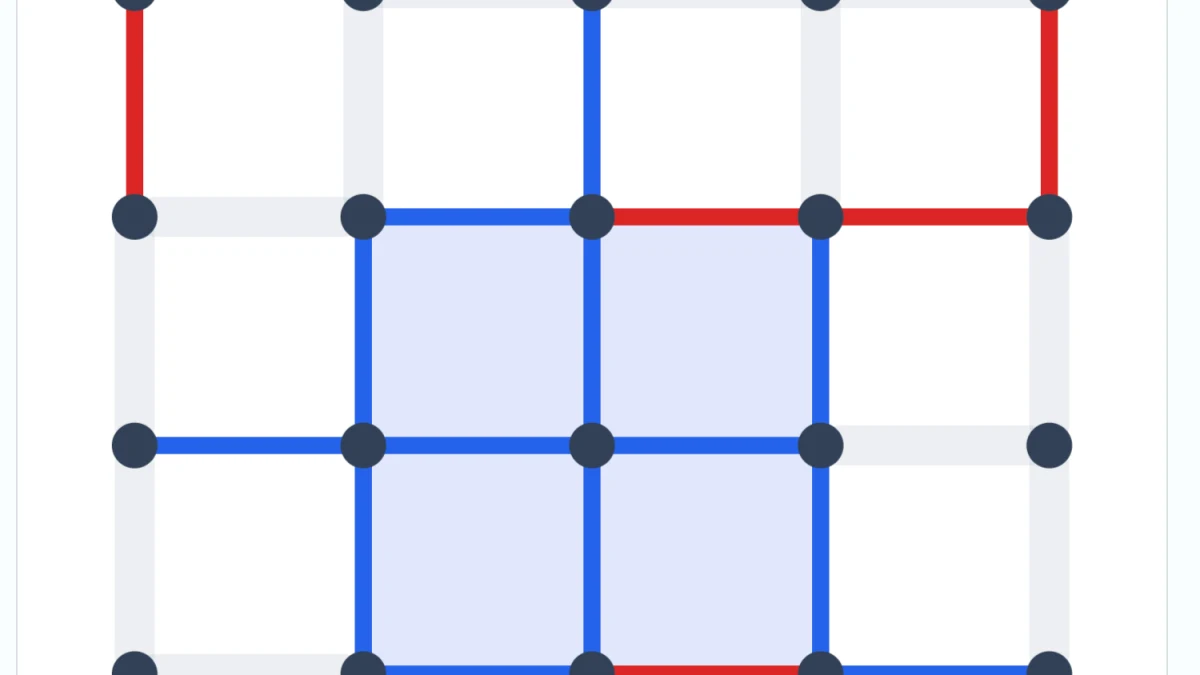
You may have played dots and boxes on the back of a worksheet. Bond Forge is that game with one new rule: nobody draws a line for free.
Short answer: Bond Forge is our free chemistry game. The board is classic dots and boxes; the twist is that you earn every move by answering a chemistry question set at your level. Play solo against the AI or head-to-head with a friend; the starter set of elements is free.
How does a game of Bond Forge work?
A match of Bond Forge runs on four rules. Answer a chemistry question right and you draw your line (the game calls it a bond). Miss and you lose the turn entirely, and it stings: your opponent picks any open line as a free bonus, no question asked, then takes their normal turn, two lines in a row. Close a box and you score a point and go again, the classic chain rule, and chains fire on bonus draws too. On the higher levels, the shape of what you build starts to matter: levels four and five pay extra for closing the level's geometric signature, on top of the point per box.
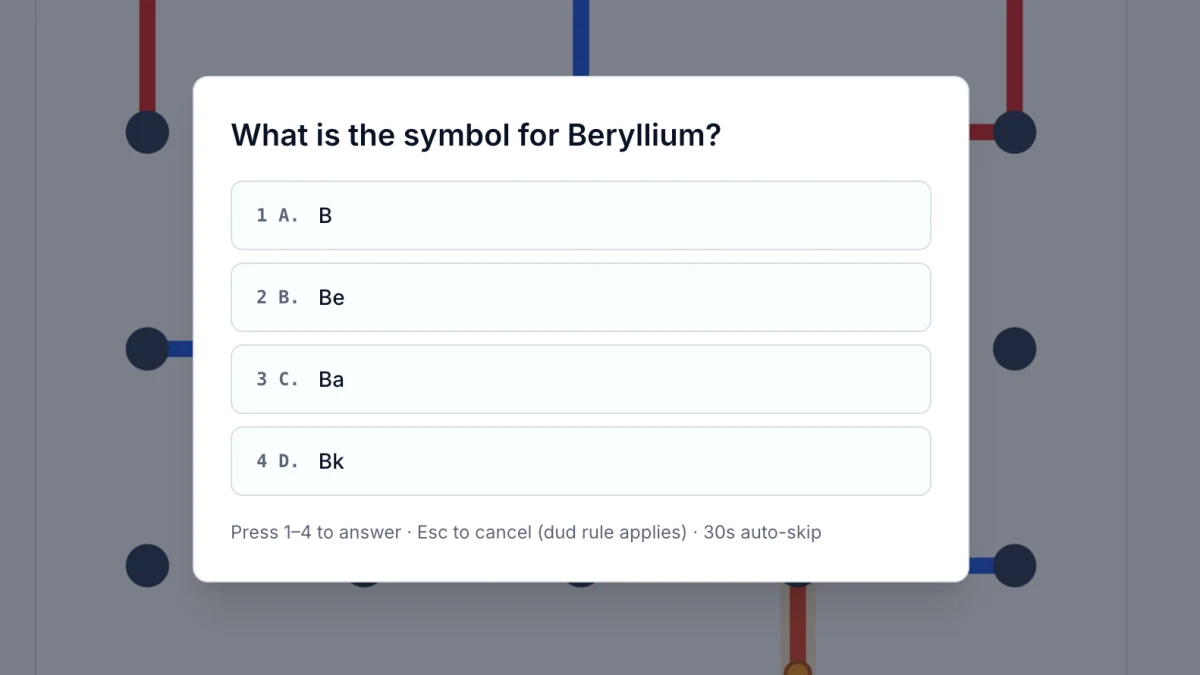
Those stakes are doing deliberate work. The question gate means a turn is earned by producing an answer from memory, and the miss penalty makes each retrieval matter without ever making it a public performance. The question is always set at your own level, whoever you're playing. The distractors aren't random, either: Beryllium's wrong answers are B, Ba, and Bk, real symbols students actually confuse with it.
Where's the chemistry in it?
The chemistry in Bond Forge lives in the questions. The board is plain dots and boxes; what makes it a chemistry game is that a match demands dozens of accurate answers. The questions come from the fact layer a chemistry student has to make automatic anyway, element symbols and names first, the material we call the times tables of chemistry. The five levels borrow their names and shapes from molecular geometry, Spark (linear) up through Inferno (rings), with the board growing at every level; that's theme and progression, and the learning stays in the question gate. Every answer also feeds the review scheduler behind all our games: the elements you miss come back sooner, and the ones you've learned reappear only at widening intervals to cement them, the way spaced repetition is supposed to work.
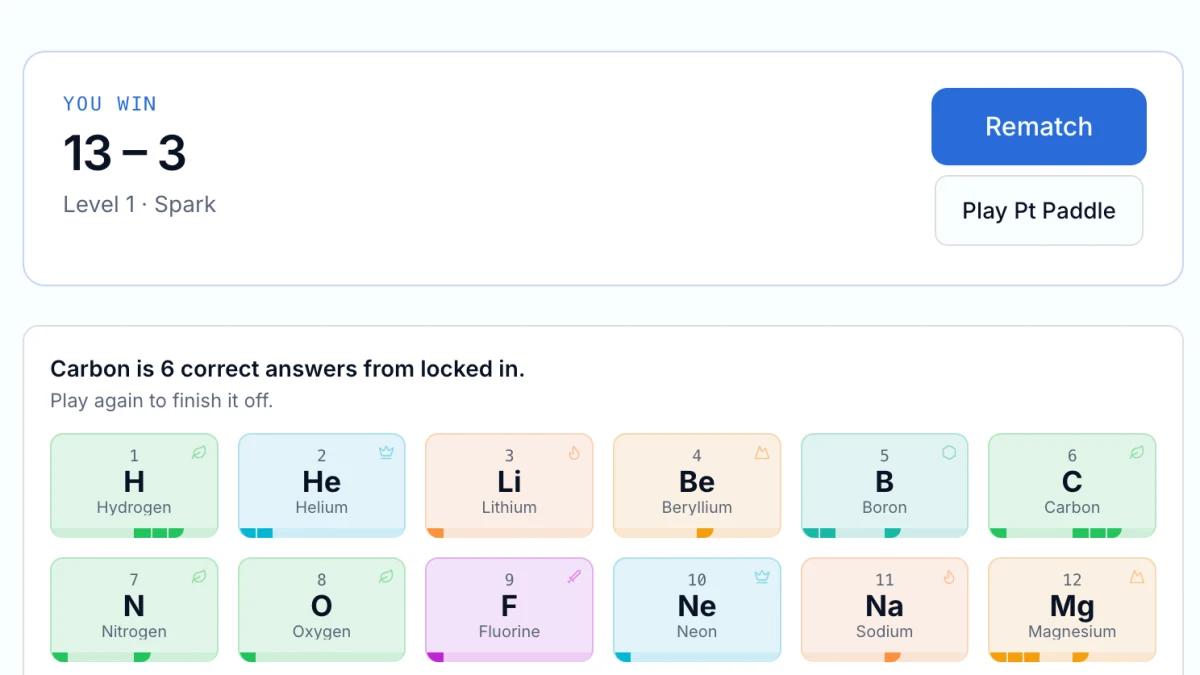
That scheduler is visible the moment a match ends. The screen above says it plainly: Carbon is six correct answers from locked in, play again to finish it off. Win or lose, the match moved real elements toward mastery, and the next match starts where the evidence says you need it.
Which learning principles is it built on?
Each mechanic maps to a finding from the research series this post closes:
| The research said | Bond Forge does |
|---|---|
| Producing answers beats recognizing them | No move happens until you produce one |
| Practice must return on a schedule | Every answer updates the per-element scheduler |
| Hard facts need bigger doses | Missed elements come back sooner, at your level |
| Competition motivates; it doesn't teach | The contest brings you back; the questions do the teaching |
| Fluency frees working memory | The content is the symbol-and-name layer courses assume |
| Fun alone teaches nothing | The fun is the delivery; the retrieval is the medicine |
The competition row deserves a word, because it's where the design took its clearest position. A match is between people, never between a student and material above their level: each player's questions come from their own mastery ladder, so a first-week player and a table-master can play a real game. Losing costs a turn, not standing. That is the self-paced-spine, optional-contest design the classroom research argues for, running live.
Try it free. Bond Forge is free to play with a starter set of elements, no account needed. One payment of $59 unlocks every game and all 118 elements, with progress saved. No subscription.
FAQ
Is Bond Forge free to play? Yes. Bond Forge is free to play with a starter set of elements, no account needed, and progress is not saved on the free tier. One payment of $59 unlocks every game and all 118 elements with progress saved.
Can I play Bond Forge with a friend? Yes. Bond Forge runs solo against the AI or head-to-head with a friend from a shared lobby, and each player's questions are set at their own level, so a mixed pair can play a fair match.
What grade level is Bond Forge for? It's built for high school chemistry students, and the on-ramp is gentle: early levels gate bonds on element symbols and names, the facts a first-year course assumes.
What do I need to run Bond Forge? A browser. It plays on a laptop, Chromebook, tablet, or phone, with nothing to install.