
Why Students Forget Chemistry So Fast
5 min read
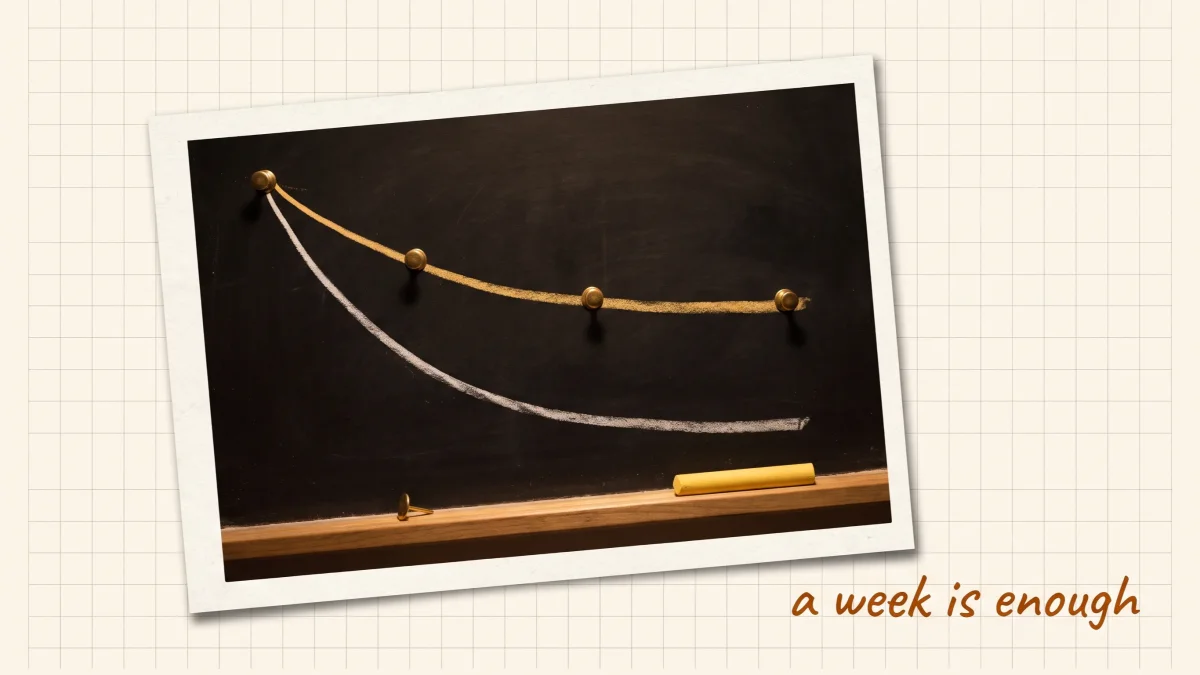
The unit test went fine. Two weeks later, a quiz on the same material goes badly, and everyone involved wonders where the knowledge went. Nothing went wrong with the student. Something predictable went wrong with the schedule.
Short answer: Memory for new chemistry decays fast once practice stops, and one strong test performance doesn't prevent it. Memory research is consistent that the steepest losses come in the first days after practice stops, well inside the week after a unit ends. The reliable fix is spaced retrieval: short practice sessions that return to old material on a schedule, sized to each fact.
How fast does chemistry knowledge actually fade?
Fastest at the start. That is the shape every memory lab since Ebbinghaus has drawn: a steep drop in the first days, then a flattening, with most of the loss happening before the week is out.
Putting a single number on it is where the evidence gets thinner than the internet suggests. Individual classroom studies produce dramatic percentages, but they run in one school with a few dozen students and no control for what else differed, so the number tells you about that classroom rather than about chemistry. The pooled picture is the sturdier claim: across 34 studies covering more than four thousand students, learners who met chemistry through games outperformed their peers both on tests taken immediately and on tests taken after a delay (Hu et al., 2022). The direction is consistent. The size varies enough between studies that quoting one figure would oversell it.
The long-horizon version is bleaker. Baker and Cuevas (2018) stopwatch-tested multiplication facts across grade levels in a study of 24 students and found 8th graders scoring below the 5th graders, five years after the multiplication unit. Small, and pointed in the same direction as everything else here: fluency that nothing maintains doesn't hold still. It slides.
Doesn't learning it well the first time prevent forgetting?
Learning it well helps and doesn't finish the job. A 2022 meta-analysis of 34 chemistry studies (Hu et al., Journal of Research in Science Teaching) found students who learned through games still ahead of lecture-taught peers on delayed tests, so how material goes in matters. But even the winning groups in these studies kept losing ground once practice stopped: ahead of the comparison classes, and still sliding. Encoding buys a slower leak, and only re-encounter patches it. That re-encounter also can't be left to good intentions: in a preregistered Kent State experiment (Badali et al., 2022), students who controlled their own flashcard practice dropped items after about one correct recall regardless of difficulty, even after writing plans to do otherwise.
What actually flattens the forgetting curve?
Returning to material on a schedule, in short retrieval sessions. The evidence is unusually consistent:
| Practice pattern | What the research finds |
|---|---|
| Cram once, stop after the test | Steep losses within days (the default outcome) |
| Same practice, spread across sessions | Substantially better retention (Latimier et al., 2021 meta-analysis) |
| Student-managed flashcards | Stops too early on hard items (Badali et al., 2022) |
| Schedule adapted to each fact | The direction the evidence points; hard facts need more (Vaughn et al., 2013) |
Two details from that table earn emphasis. First, spacing the same amount of practice out over time beat bunching it, across 39 experimental comparisons, after correcting for publication bias (Latimier et al., 2021). It held up in real chemistry classrooms too: a nine-course field experiment found its clearest spacing benefits in chemistry and calculus courses (Bego et al., 2024). Second, facts differ. Equating practice on easy and hard items still left the hard ones remembered worse a week later (Vaughn et al., 2013), which is why a schedule that treats sodium and oxygen the same wastes effort on one and underserves the other. Our games feed a review system built around exactly that: every answer updates a per-element memory model, and the next re-encounter lands before the predicted cliff, not after. The element miss list shows which facts need the most returns.
Try it free. Bond Forge is free to play with a starter set of elements, no account needed. One payment of $59 unlocks every game and all 118 elements, with progress saved. No subscription.
FAQ
How long does it take to forget chemistry after a test? Measurable losses show up within a week once practice stops, and the drop is steepest in the first few days. The rate depends on how the material was learned and whether anything schedules a return to it.
Does cramming work for chemistry tests? Cramming can rescue tomorrow's test, and the spacing research is blunt about the cost: the same hours spread across days produce far better retention weeks later. In a cumulative course, that difference compounds across every later unit.
What is spaced repetition, in plain terms? Spaced repetition is practice that returns to a fact after a delay, ideally just before you'd forget it, instead of repeating it while it's still fresh. Spreading retrieval out is one of the most consistently supported findings in learning research.
Can students run a spaced schedule themselves? Most don't manage it, even with good intentions. In controlled research, self-directed students stopped practicing each item after about one correct answer, hard or easy, and their retention on hard items suffered for it. A system that decides what comes back when removes that failure point.
Related
- Element Symbols: Chemistry's Times Tables
- How to Study for a Chemistry Test
- Do Learning Games Actually Work? 34 Studies
- Should Students Memorize the Periodic Table?
Sources
- Latimier, A., Peyre, H., & Ramus, F. (2021). A meta-analytic review of the benefit of spacing out retrieval practice episodes on retention. Educational Psychology Review, 33.
- Hu, Y., et al. (2022). Game-based learning has good chemistry with chemistry education: A three-level meta-analysis. Journal of Research in Science Teaching, 59(9).
- Bego, C. R., et al. (2024). Single-paper meta-analyses of the effects of spaced retrieval practice in nine introductory STEM courses. International Journal of STEM Education, 11:9.
- Badali, S., Rawson, K. A., & Dunlosky, J. (2022). Do students effectively regulate their use of self-testing as a function of item difficulty? Educational Psychology Review, 34.
- Vaughn, K. E., Rawson, K. A., & Pyc, M. A. (2013). Repeated retrieval practice and item difficulty. Psychonomic Bulletin & Review, 20.
- Baker, A. T., & Cuevas, J. (2018). The importance of automaticity development in mathematics. Georgia Educational Researcher, 14(2).