
Should Students Memorize the Periodic Table?
5 min read
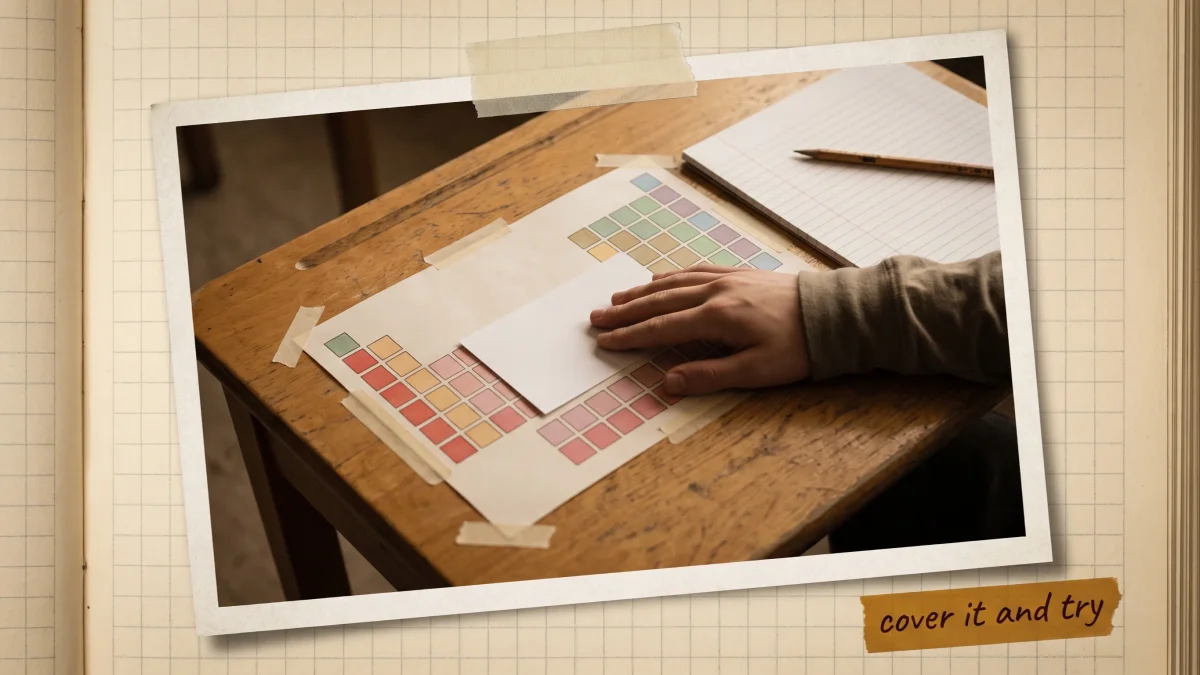
Ask this question in a teachers' forum and you'll collect both certainties: "memorization is obsolete, the exam provides the table" and "my students who know their symbols cold are the ones who thrive." The research has a more useful answer than either camp.
Short answer: Memorize the part you use constantly: symbols, names, and common ions. Look up the part designed for looking up: masses, electronegativities, and trends. The provided chart is a reference, and a reference can't make reading formulas effortless. Recent classroom research says the drilling half deserves more respect than it gets.
What does the chart on the wall actually do for a student?
The provided periodic table does exactly what a multiplication chart does: it supplies correct answers to a student who has time to fetch them. A 2025 case study of an Indonesian fifth-grade class shows where that leads when the fetching never stops. Students who relied on printed times-table charts answered slowly, needed every word problem decomposed for them, hesitated on anything unfamiliar, and stalled when they got to fractions, because each new topic re-billed them for the facts they never owned. Their teacher had them copy the chart before every lesson; it didn't close the gap. The chart is a scaffold while a fact is being learned and a crutch afterward, and the difference is whether the student is working toward not needing it.
Chemistry's version of that chart hangs at the front of the classroom. It's excellent at what it's for. Fluency was never what it's for.
Isn't drilling facts bad teaching now?
The largest relevant experiment says no, with numbers. Researchers in Sweden assigned 877 second graders across 20 schools to timed memorization practice, untimed conceptual practice with manipulatives, or ordinary lessons (Östergren et al., 2024, Scandinavian Journal of Educational Research). Both practice styles beat ordinary lessons. But timed memorization beat the conceptual condition across ability levels, and for the struggling learners the gap was decisive: memorization practice clearly outperformed the control group for low achievers, while conceptual-only practice did not. The authors note the case against memorization has been argued mostly from theory, and their data points the other way, especially for the students already behind. The one group that gained nothing from drill: high achievers whose facts were already automatic. Practice belongs where fluency isn't yet.
So what should a chemistry student memorize?
| Worth owning cold | Fine to look up |
|---|---|
| Element symbols and names (~first 40) | Atomic masses |
| Common ion charges (Na⁺, Cl⁻, SO₄²⁻) | Electronegativity values |
| Formula-reading conventions | Melting points, densities |
| Diatomic elements (H₂, O₂, N₂…) | Full electron configurations |
| Polyatomic ion names | Periodic trends (the chart shows them) |
The left column is the fact layer we call the times tables of chemistry: items a student reads or writes constantly, where a two-second lookup costs more than the fact is worth. The right column is genuine reference material, and memorizing it is a poor use of anyone's week.
One caution the research adds: memorizing and understanding are partners. The Swedish study's conceptual practice also beat ordinary teaching, and a student who knows why sodium is Na (Latin natrium) holds the symbol better than one who brute-forced it. Drill the facts, gloss the stories, and check that understanding keeps pace.
Try it free. Bond Forge is free to play with a starter set of elements, no account needed. One payment of $59 unlocks every game and all 118 elements, with progress saved. No subscription.
FAQ
Do students get a periodic table on chemistry exams? Nearly always, including the AP Chemistry exam and state exams like the New York Regents. The provided table carries masses, symbols, and trends. It does not make a slow reader of formulas fast, which is the skill timed sections actually price.
Is memorizing the periodic table a waste of time? Memorizing all 118 masses would be. Owning the symbols, names, and common ions is different: those run through two years of equations, and fluency in them frees working memory for the actual problem.
How long does it take to memorize the element symbols? With short daily retrieval practice, most students can make the common 40 symbols automatic in a few weeks. The stubborn ones are the Latin-root symbols like Na, Sn, Fe, and Pb, which reliably need more repetitions than the obvious ones.
Does timed practice stress kids out? The Swedish study measured achievement, not anxiety, so it can't settle the stress question. What it did show is that brief, game-length timed practice was the most effective format for nearly every learner, including the ones who struggled most. Pacing and tone are the teacher's levers either way.
Related
- Element Symbols: Chemistry's Times Tables
- Why Students Forget Chemistry So Fast
- How to Memorize the Periodic Table Fast
- Why Your Kid Has Gaps in Chemistry
Sources
- Östergren, R., Träff, U., Elofsson, J., Hesser, H., & Samuelsson, J. (2024). Memorization versus conceptual practice with number combinations. Scandinavian Journal of Educational Research, 68(6).
- Kristesia, E., et al. (2025). The mastery of basic multiplication and division skills and its impact on students' mathematics achievement. AMPLITUDO, 4(1).
- Vaughn, K. E., Rawson, K. A., & Pyc, M. A. (2013). Repeated retrieval practice and item difficulty. Psychonomic Bulletin & Review, 20.