
Element Symbols: Chemistry's Times Tables
5 min read
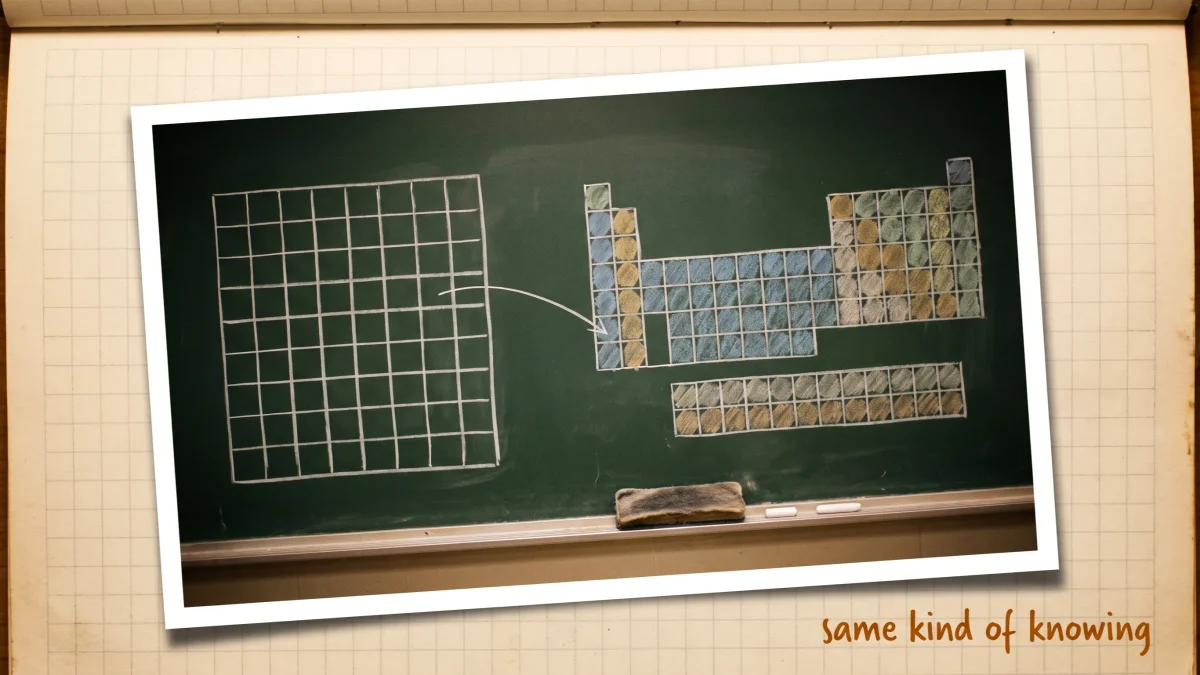
Every parent knows what happens to a kid who never masters times tables: fractions hurt, algebra hurts more, and the kid starts to believe math isn't for them. Chemistry has the same layer. It just doesn't have a name yet.
Short answer: Element symbols, common ions, and formula conventions are chemistry's foundational fact layer, the same role times tables play in math. A student who can't produce them instantly pays a working-memory tax on every equation and every bonding diagram. Fluency in that layer is learnable in weeks, and it changes how hard the whole course feels.
What are the times tables of chemistry?
The times tables of chemistry are the facts a student uses constantly, on nearly any line of work: the 118 element symbols and names, the common ions, and the conventions for reading a formula. Reading researchers have long argued that sight-word recognition works this way for reading comprehension, and a 2018 study in the Georgia Educational Researcher extended the argument to math facts: automaticity below, reasoning above. Chemistry is the third leg of the same stool. A student who reads NaCl as "sodium chloride" without stopping has attention left over for the actual chemistry. A student who stops to decode Na is doing two hard things at once, all class long.
Chemistry education researchers describe the subject as a constant shuffle between three levels: the stuff you can see, the atoms underneath, and the symbols on the board. The symbols are the level a student can make automatic in advance.
How fast is "knowing it," exactly?
Knowing a symbol means producing the name in under about three seconds, without a workaround. That operational bar comes from Baker and Cuevas (2018), who stopwatch-tested students on multiplication facts and counted an answer as automatic only under that line. It transfers directly, and any parent can run it at the dinner table: say "Fe," count to three. "Iron" inside the count is fluency. A pause, a guess, or "wait, I know this" is a fact that still costs working memory. Their study found something else worth knowing: 8th graders, five years past the multiplication unit, scored below the 5th graders who had just finished it. Fluency that nothing maintains slides backward. That result shapes how we schedule review, and it's why cramming symbols once in September doesn't settle anything.
Which symbols do students actually miss?
The symbols students miss are rarely the famous ones. Across the thousands of answers students have typed into our games and the free element quiz, gold (Au) almost never gets missed. Sodium (Na) gets missed at more than twice the rate of iron (Fe), and tin (Sn) at nearly three times iron's rate. The pattern is old Latin hiding inside the symbol:
| Symbol | Name | Why it trips students |
|---|---|---|
| Na | Sodium | From Latin natrium; students reach for "N" |
| Sn | Tin | From Latin stannum; nothing in "tin" says Sn |
| P | Phosphorus | Students expect P to be potassium (which is K) |
| Au | Gold | From aurum, yet famous enough that it sticks |
The full ranking, updated as students play, lives on our element miss list. The takeaway for a parent: when a student says "I'm bad at chemistry," what's often underneath is a fact-fluency gap: a fixed set of symbols and ions, with a hard middle we can name element by element. A few weeks of the right practice closes a gap like that.
Why not just use the periodic table on the wall?
The chart answers a different question than fluency does. It's a superb reference for trends and data, and students taking major exams, from the AP to New York's Regents, are given one for reference during the test. What it can't do is make reading a formula effortless, for the same reason a multiplication chart taped to a desk builds no fluency in sevens. A 2025 case study of an Indonesian fifth-grade class documented the pattern math teachers know well: students who leaned on printed times-table charts solved everything slowly, dodged hard problems, and stalled when they got to fractions. The chart is a scaffold for what you're still learning and a crutch for what you should already own. We go deeper on that line in Should Students Memorize the Periodic Table?
Try it free. Bond Forge is free to play with a starter set of elements, no account needed. One payment of $59 unlocks every game and all 118 elements, with progress saved. No subscription.
FAQ
How many element symbols does a high school chemistry student need to know? All 118 exist, but a first-year course leans on roughly 40 heavily. The elements in the first four rows, plus common metals like silver, gold, tin, lead, and mercury, cover nearly everything a student will read or write.
What is the fastest way to learn element symbols? Short, frequent retrieval beats one long session. Practice producing the name from the symbol (not just recognizing it), let a game or app schedule which symbols come back and when, and expect the Latin-root symbols to need noticeably more practice than the obvious ones.
Why does my kid know the material but work so slowly in chemistry? Slow, correct work is the signature of missing fact fluency. Each symbol that has to be reasoned out costs seconds and working memory, and those costs stack across a 20-line problem set. Speed on the basics is what frees attention for the new material.
Are element symbols worth memorizing when the exam includes a periodic table? Yes. The provided table supplies data, not fluency. A student who must look up every symbol spends test time and attention on lookups; a student who reads formulas at a glance spends both on the question being asked.
Related
- Why Chemistry Homework Takes So Long
- Should Students Memorize the Periodic Table?
- Why Students Forget Chemistry So Fast
- How to Memorize the Periodic Table Fast
- Is High School Chemistry Hard?
Sources
- Baker, A. T., & Cuevas, J. (2018). The importance of automaticity development in mathematics. Georgia Educational Researcher, 14(2).
- Kristesia, E., et al. (2025). The mastery of basic multiplication and division skills and its impact on students' mathematics achievement. AMPLITUDO, 4(1).
- Hu, Y., et al. (2022). Game-based learning has good chemistry with chemistry education: A three-level meta-analysis. Journal of Research in Science Teaching, 59(9).
- Periodic Mole element miss list — our live ranking of the most-missed elements, with methodology.