
Why Chemistry Homework Takes So Long
4 min read
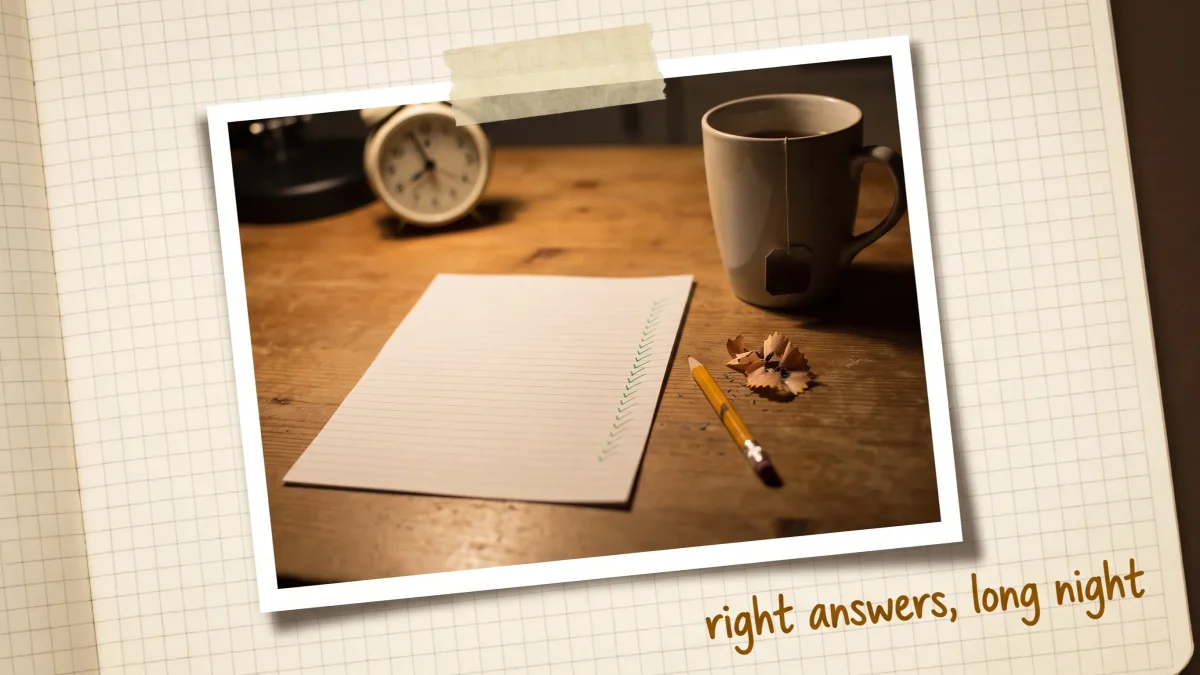
The homework comes back right. It also comes back at 10:40 p.m., after two hours at the kitchen table. Most parents read that scene as diligence, or as a hard class. It's usually neither.
Short answer: A student who gets chemistry right but takes forever is telling you something specific: the answers are being reasoned out, fact by fact, instead of recalled. That's a fluency gap, not an ability problem. It has a test you can run at the dinner table and a fix measured in weeks of short practice.
What does slow-but-correct actually mean?
Slow, correct work means the knowledge is there and the retrieval isn't. A student who decodes Na from a chart, reconstructs an ion charge from the group number, and re-derives a formula convention on every line can absolutely get the right answer. Each derivation just costs seconds and a slice of working memory, and a problem set bills those costs twenty times per page. The result is exactly what you see at the kitchen table: right answers, long nights, and a student who ends the evening drained by work a fluent classmate finished before dinner.
The reverse reading matters just as much. Slow-but-correct is good news in disguise: the hard part, understanding, is done. What's missing is the automatic layer underneath it, and that layer is the trainable part.
How can a parent check for a fluency gap?
The check takes ten seconds and no chemistry knowledge. Say one of these symbols out loud and count to three: Na (sodium), K (potassium), Fe (iron), Sn (tin), Pb (lead), Hg (mercury). The answers are in the parentheses, so you don't need to know any chemistry to grade it. A fluent student answers inside the count, the way you’d answer 5 × 4. A pause, a "wait, I know this," or a correct answer at second six is the gap. Researchers use the same bar: Baker and Cuevas (2018) counted a math fact as automatic only when the answer landed in under about three seconds, and found students five years past the multiplication unit scoring below students fresh out of it. Fluency that nothing maintains slides. The same three-second test works on any fact your student's course leans on, from symbols to common ion charges.
Why isn't this an ability problem?
Nothing about the pattern points at ability, and the evidence points away from it. In a university study we cover in the equalizer research, students who started courses behind finished level with their prepared classmates once short retrieval practice entered the routine; the gap tracked practice. And the slow-but-correct student has already demonstrated the genuinely hard skill, which is understanding the chemistry. What remains is repetition, scheduled well. We wrote the full argument in Element symbols are chemistry's times tables: the fact layer is a fixed set with a hard middle we can name element by element.
What actually closes the gap?
| What families usually try | What the research supports |
|---|---|
| More hours at the table | Shorter sessions, more days |
| Re-reading notes and the chart | Producing answers from memory |
| One big weekend review | A schedule that returns to each fact before it fades |
| General encouragement | A named, finite list to master |
Ten minutes a day of answer-from-memory practice, with something deciding which facts return when, beats another long night in the comparisons researchers have run; the spacing research behind that sentence is in why students forget chemistry. The practice also has to be something a teenager will actually repeat, which is why ours ships as games: the match brings them back tomorrow, and the question gate does the work.
Try it free. Bond Forge is free to play with a starter set of elements, no account needed. One payment of $59 unlocks every game and all 118 elements, with progress saved. No subscription.
FAQ
Why does my kid take so long on chemistry homework? When the answers come back right, slow work usually means facts are being re-derived instead of recalled. Every symbol or ion charge that has to be reasoned out costs seconds and working memory, and those costs stack across a full problem set.
Is slow schoolwork a sign of a learning problem? Slow work with wrong answers is worth a conversation with the teacher. Slow work with right answers more often signals a fluency gap in the subject's basic facts, which short daily retrieval practice can close. When in doubt, ask the teacher what they see in class.
How long does it take to fix a fact-fluency gap in chemistry? Weeks. The core symbol-and-name layer of a first chemistry course is a bounded set, and short daily practice with scheduled review makes most of it automatic within a few weeks.
Does timed practice help or just add pressure? The largest classroom trial of timed fact practice found it the most effective format for nearly every learner, including the students furthest behind. Pace and framing matter; practice that races a friend is optional, and practice against your own record does the same work.
Related
- Element Symbols: Chemistry's Times Tables
- Why Students Forget Chemistry So Fast
- How to Help a Teen Struggling in Chemistry
- Do Learning Games Actually Work? 34 Studies
Sources
- Baker, A. T., & Cuevas, J. (2018). The importance of automaticity development in mathematics. Georgia Educational Researcher, 14(2).
- Muzsnay, A., et al. (2025). Retrieval practice — a tool to narrow the achievement gap in learning higher mathematics. International Journal of Science and Mathematics Education, 23.
- Östergren, R., et al. (2024). Memorization versus conceptual practice with number combinations. Scandinavian Journal of Educational Research, 68(6).