
Online Chemistry Games: The 3D Rebuild
7 min read
Seven chemistry games run in the browser at Periodic Mole, and this month three of them were rebuilt from the board up. Here is what you will see when you open each one, what changed under the hood, and which ones cost nothing to play. For a class that needs games sorted by lesson topic, see Chemistry Games for High School; this post covers how each game looks and plays now.
Short answer: Three of our online chemistry games, Bond Forge, Pt Paddle, and Molecule Hunter, now play on 3D boards. Two-player matches deal a question every turn, and any match can run on element questions only. Bond Forge and Pt Paddle are free for the first 12 elements; Acid Boy & Base Girl's first two missions are free.
What changed in the online chemistry games in October 2026?
The October 2026 update touched every game on the games page. Three boards were rebuilt in 3D. Pt Paddle gained a question on every two-player turn, while Bond Forge began dealing those questions from each player's mastery record. Four games gained a per-match switch to element questions only (the Elements level, explained below), and two had their content widened. The table says which is which. Cobalt is the sparring partner you play when no friend is around.
| Game | What changed | Play with | Free? |
|---|---|---|---|
| Bond Forge | 3D forge table; two-player turns dealt from your mastery record; Elements level | Cobalt or a friend | First 12 elements |
| Pt Paddle | The Platinum Arena court, a new soundtrack, questions in two-player rallies; Elements level | Cobalt or a friend | First 12 elements |
| Molecule Hunter | 3D scanning observatory, sonar and ambience, a roster of what is left to sink; Elements level | Cobalt or a friend | Full access |
| Capture the Nucleus | Elements level | Cobalt or a friend | Full access |
| Storm the Castle | Levels 2 and 3 now draw from all 315 questions; answer choices shuffled | Cobalt | Full access |
| Acid Boy & Base Girl | Rebuilt rooms, a text-adventure narrator, online co-op, the Six Bottles case board | Solo or co-op | First 2 missions |
| Run the Table | Unchanged this month | Solo | Full access |
Every one of these is built for browser play, with layouts for laptops, Chromebooks, tablets, and phones. On a device without WebGL, the browser's 3D drawing layer, each 3D board falls back to a flat board with the same rules.
What does the new Bond Forge board look like?
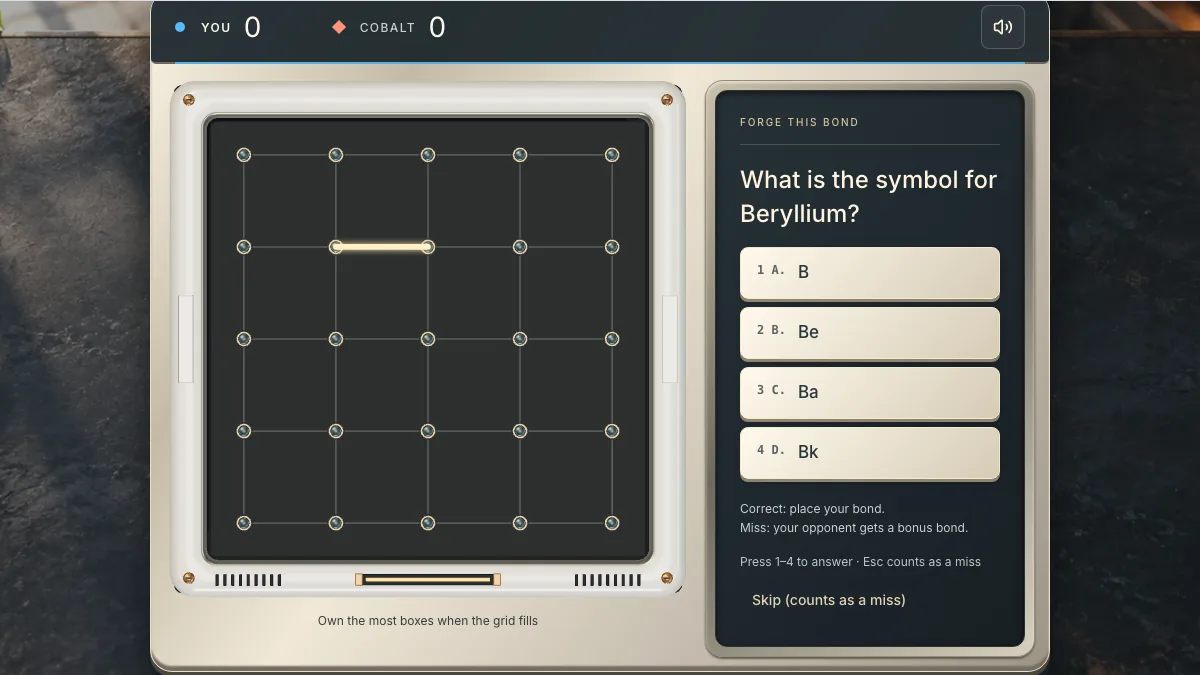
Bond Forge now plays on a forge table instead of a flat grid. The table is an ivory enamel chassis with platinum bevels and copper fasteners, and the board sits in a dark graphite recess at its center. Open moves are narrow gray channels; a bond you draw is a blue metal inlay, and Cobalt's are coral. A box you claim gets inset depth and a dot, so ownership reads without color.
Cobalt, your sparring partner, watches from a portrait beside the board. The chemistry question appears in a console built into the table's right side.
The rules did not change. You pick an edge, a question appears, and a right answer forges the bond. A miss costs the turn and gives your opponent a free bonus bond before their own move. Closing a box scores and keeps your turn. The camera is fixed straight overhead, so every piece sits exactly on the edge you click, and the keyboard still answers with the 1 to 4 keys.
What is the Platinum Arena in Pt Paddle?
The Platinum Arena is Pt Paddle's new court. A porcelain chassis wraps a satin mineral playing surface, with graphite mechanics and platinum rails along the edges. Your side is cyan, the opponent's is coral, and the ball is a small amber projectile, the brightest moving thing on the deck. A match is first to five.
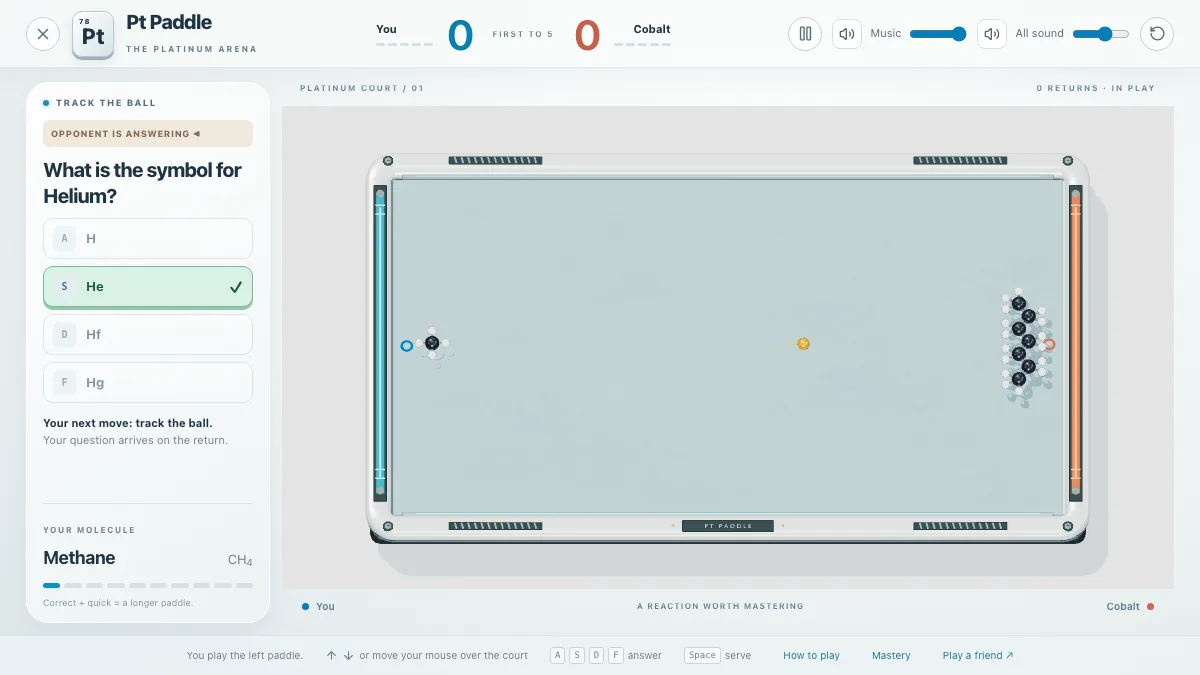
The loop is the same: answer the question on your side early and your paddle grows into a longer molecule, then put that molecule in the ball's path. The A, S, D, and F keys answer; Space serves. Voice answering, which was unreliable, is gone along with its help text. The soundtrack is new: one continuous loop whose volume and tone shift with the phase of play. Music has its own volume slider now, so you can mute the music and keep the hit and miss sounds.
What is Molecule Hunter's scanning observatory?
Molecule Hunter's scanning observatory is the new setting for its hidden-fleet game. You hide your molecules on a grid, then use chemistry answers to probe the opponent's grid. The instrument is ivory enamel set in a blue observatory. The scan tiles are a dark teal, the hardware is brass, and a detection glows amber. The molecules themselves are lit 3D models: hydrogen is pale porcelain, oxygen coral, carbon graphite, and every atom carries its element letter.
Selecting a target plays a sonar ping, and a low submarine ambience runs under the match and drops while a question is open. A roster of Cobalt's fleet lists every molecule as Hidden or Sunk, with a count of how many are still hidden. It answers the question we kept asking while playing: which molecules are left? Hits on an unsunk molecule stay anonymous, so the roster never gives away a partial find. Molecule Hunter needs full access.
Can two people play these chemistry games online together?
Two people can play Bond Forge, Pt Paddle, Molecule Hunter, and Capture the Nucleus against each other, and Acid Boy & Base Girl as a pair. For Bond Forge and Pt Paddle, one player opens the live lobby, sends a link, and the other joins in any browser. Neither player needs an account for the free tier.
The two-player games changed under the surface this month. Pt Paddle rallies now deal a chemistry question to the receiving player on the serve and after every paddle hit. Before the update, a two-player Pt Paddle match had no questions at all. Bond Forge deals each turn's question from the players' mastery records instead of a plain shuffle. When either player is not signed in, questions stay inside the first 12 elements, and the same element is not dealt twice in a row.
Acid Boy & Base Girl plays as co-op: the host presses Play with a friend, sends the link, and each player drives one hero on a separate device. The friend joins free, without an account; for missions 3 to 5 the host needs full access.
What is the Elements question level?
The Elements question level is a switch on Pt Paddle, Bond Forge, Molecule Hunter, and Capture the Nucleus that reads "Questions: Your level | Elements." Your level is the default: questions come from wherever your mastery record says you are. With full access, that includes the topic questions beyond the elements. Elements keeps the whole match on element symbols and names.
The reason it exists is a complaint from our own play. Once the elements are mastered, the pack questions get hard, and sometimes you want an easier question and to just play the game.
The switch only points down, never up, and it never lifts the free tier's cap. It lasts one match: nothing is saved, and the next match starts back at Your level. Pt Paddle offers it on the serve card before the first serve; the other three keep it visible during play. A match on Elements still counts toward the Climb and achievements.
What changed in Storm the Castle?
Storm the Castle is a turn-based siege against Cobalt: answer questions to muster an army, commit your line, and storm the keep. Its question supply was the problem. We have 315 written chemistry questions, and Storm was using 19 of them. Level 3, the hardest, dealt exactly 2 questions, so a player could memorize both answers and farm gold. Level 2 dealt 17.
The cause was a sorting rule that judged a question by its format, so every plain multiple-choice question counted as level 1 and was skipped. That included 33 questions written at depth-of-knowledge level 3, the strategic-thinking tier on Norman Webb's scale (Webb, 2002). Levels 2 and 3 now draw from the full bank. The hard items also had the correct answer at A for 56 of 64, and nothing shuffled the choices; they are shuffled now. Storm the Castle needs full access.
What's new in Acid Boy & Base Girl?
Acid Boy & Base Girl, our 3D platformer about the pH scale, had the longest month of any game. Two rooms were rebuilt. Room 1, "The limestone door," puts a limestone wall in front of the exit and two sealed bottles on the start pad: vinegar and soap solution. Vinegar poured on the wall fizzes and dissolves it. Soap runs off.
Room 4 is now "Six Bottles, No Labels." The room holds six unlabeled bottles, every sensor off, and three crates marked ACID, NEUTRAL, and BASE under the door. A lamp over the door lights when three bottles are placed right and seals them; six sealed bottles open the door.
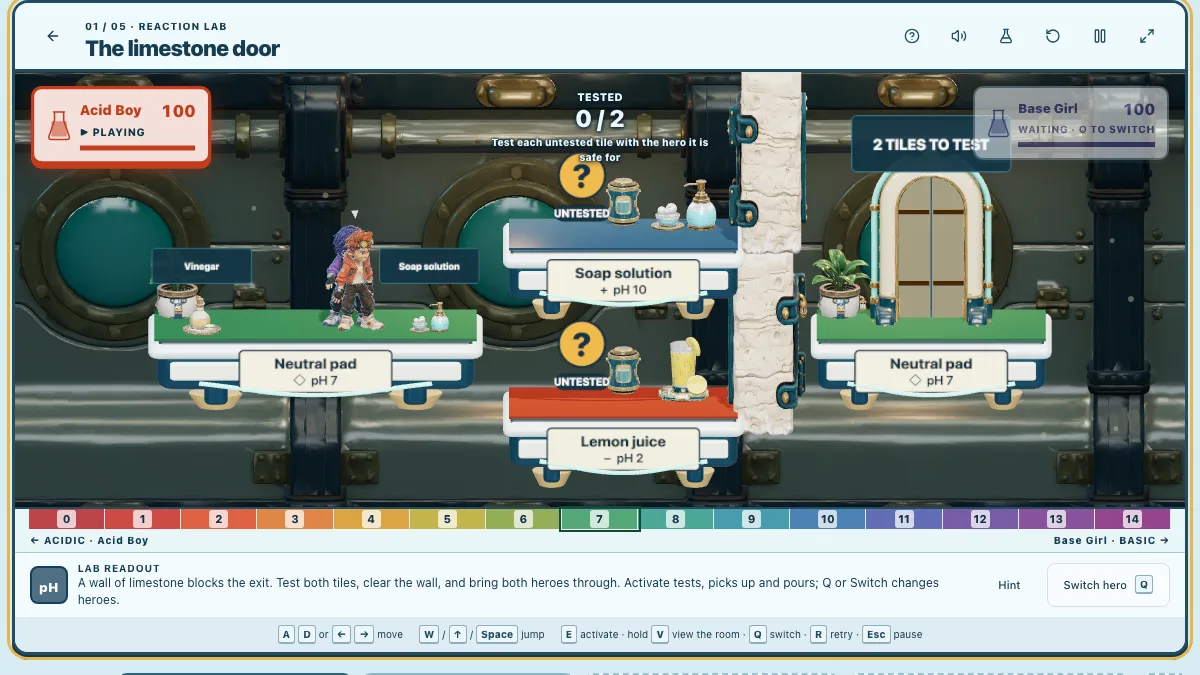
The lab now narrates like an early text adventure, in the present tense: "The lemon juice reads pH 2: below 7, so acidic." Heroes are named in the third person, so both co-op players read the same line. The heroes themselves are rigged to run, jump, and celebrate inside a generated night lab. Indicator colors round away from 7, so a pH 6.5 tile never reads as neutral. The full tour is in Acid Boy & Base Girl: The pH Game.
Which online chemistry games are free?
Three of the games are free to play with no account. Bond Forge and Pt Paddle cover the first 12 elements, hydrogen through magnesium, solo against Cobalt or live against a friend. Progress from free play lasts only for that visit. Acid Boy & Base Girl opens its first two missions free. Full access is $59 for one year or $79 for two, and it unlocks every game, all 118 elements, the topic packs, and saved progress.
The 3D boards are not a paid feature. The forge table and the Platinum Arena are what a free player sees on the first visit. A device without WebGL gets the flat board with the same rules.
MDN describes WebGL as "a JavaScript API for rendering high-performance interactive 3D and 2D graphics within any compatible web browser without the use of plug-ins," and adds that the device's own hardware has to support it. That hardware gap is why the flat board exists.
Try it free. Bond Forge is free to play with a starter set of elements, no account needed. One payment of $59 unlocks every game and all 118 elements, with progress saved. No subscription.
FAQ
Do I need to download anything to play these chemistry games online? No. Every game is built for browser play, with layouts for laptops, Chromebooks, tablets, and phones. The 3D boards draw in the browser, and a device without WebGL gets a flat board with the same rules.
Can I play a chemistry game online with a friend for free? Yes. Bond Forge and Pt Paddle both have a live two-player lobby. One player opens it and sends a link; the other joins in any browser. Free play covers the first 12 elements for both players, with no account needed.
Are the chemistry questions the same in every game? The element questions are. Bond Forge, Pt Paddle, Molecule Hunter, and Capture the Nucleus deal from one shared bank of element symbols and names, set to your level. With full access they go on to the topic packs. Storm the Castle draws from a separate bank of 315 written questions. Acid Boy & Base Girl asks you to read and test real pH values instead of answering multiple choice.
Does the 3D board change how the game is scored? No. Bond Forge, Pt Paddle, and Molecule Hunter keep their rules, scoring, and two-player match logic. The rebuild changed what you see and hear, and the chemistry still lives in the questions.
Which online chemistry game should I start with? Bond Forge. It is free for the first 12 elements, needs no account, and its questions are element symbols and names, the layer chemistry courses lean on. Pt Paddle drills the same elements at speed. For acids and bases, start with the free first mission of Acid Boy & Base Girl.
Sources
- Three.js, the library that renders the three 3D boards in the browser. MDN's WebGL page lists it as "an open-source, fully featured 3D WebGL library."
- Blender, where the forge table, the Platinum Arena, and the observatory's chamber tiles were modeled.
- WebGL at MDN, the source of the definition quoted above and of the note that the device's hardware must support it; without it, each game falls back to a flat board.
- Webb, N. L. (2002). Depth of Knowledge Levels for Four Content Areas. Wisconsin Center for Education Research. The scale behind the level-3 figure in the Storm the Castle section.