
Chemistry Games for High School
6 min read
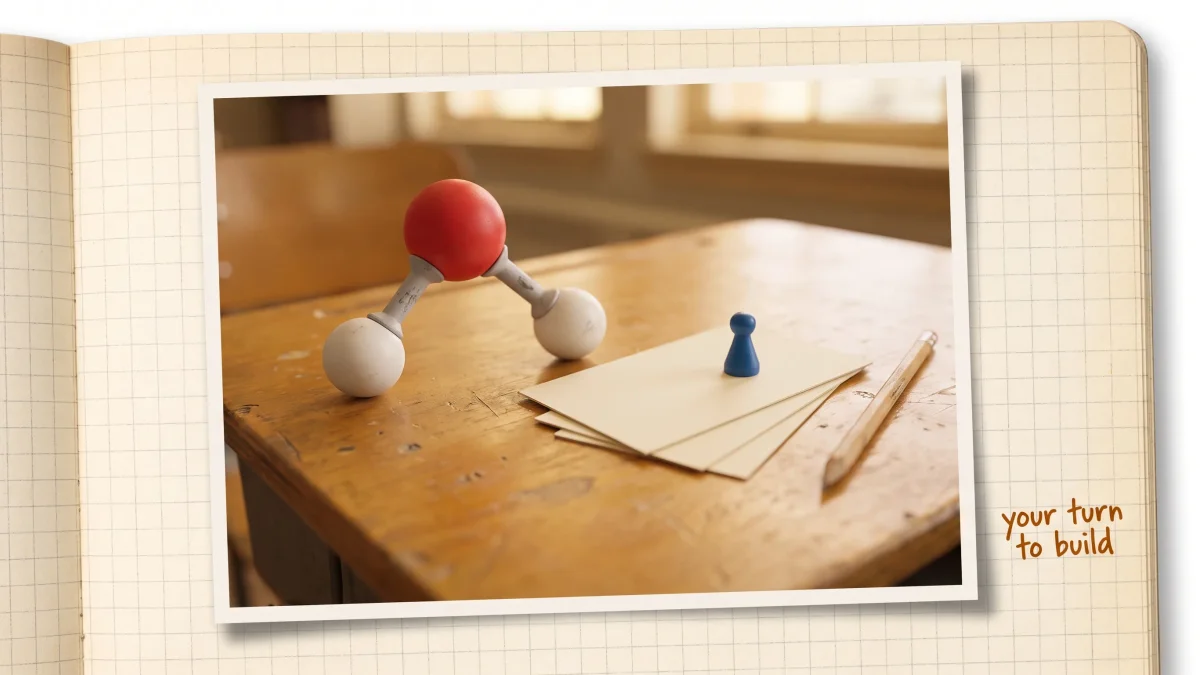
Choose chemistry games by the work students need to practice. Bond Forge is for element questions; in PhET’s Build a Molecule you connect atoms to formulas; in Molecule Shapes you predict shapes; and Balancing Chemical Equations has a game for coefficient practice. Add a short written check to see what students can explain afterward.
A student can name every element in H₂O and still count the atoms in 2H₂O incorrectly. More symbol practice is not the fix for that particular mistake. They need to work with two whole water molecules and count what’s there.
That’s where choosing the activity matters. Here are four options for different parts of a high-school course, followed by a review game you can run with paper. The PhET activities include both simulations and a scored game; the classroom challenges below are suggestions for using them.
Which game is right for today’s lesson?
| Lesson topic | Activity | What students practice |
|---|---|---|
| Element names and symbols | Bond Forge guide | Answering element questions between turns on a dots-and-boxes board |
| Molecular formulas | Build a Molecule | Assembling molecules and connecting formulas to atom counts |
| Molecular shapes | Molecule Shapes | Predicting shapes from bonds and lone pairs |
| Balancing equations | Balancing Chemical Equations | Changing coefficients while conserving atoms |
The three PhET simulations are free, and so is Bond Forge for the first 12 elements, with no account. For pH and neutralization, try Acid Boy & Base Girl, a 3D laboratory platformer with two free missions. For what you practice in each of our games and which ones are free, see Online Chemistry Games to Play in a Browser.
Open the activity on a school device before assigning it. A blocked site or a graphics problem is much easier to handle before thirty students are waiting. For a lesson with limited devices, let pairs share one and take turns explaining and entering answers.
How do students practice element names and symbols in Bond Forge?
Bond Forge is a good short warm-up when students keep pausing to look up symbols. With a correct chemistry answer, a student earns a line on a dots-and-boxes board. A student who closes a box scores a point and gets another turn; after a wrong answer, the opponent gets a bonus line before their normal turn.
The forge table has a graphite board, blue and coral bonds, and a question console beside it. You can play against our lovable robot Cobalt or with a friend.
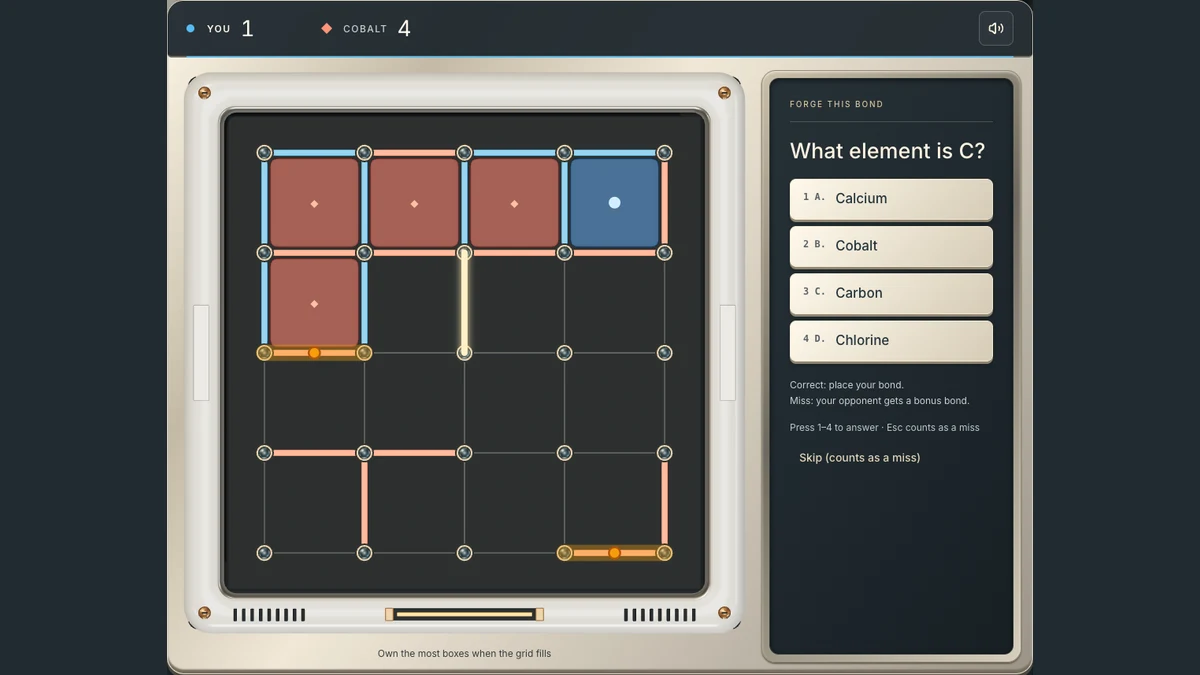
You can play the free version with no account, and it includes elements 1–12, hydrogen through magnesium. In our periodic table games guide we compare it with a typed quiz, arcade play, and timed grids if you need a different format or element set.
For a paired warm-up, ask the student answering to say the answer before looking through the choices. After the match, each partner writes one question they missed and its correction. Keep those slips for the next lesson: each one is a useful opening question.
Try it free. Bond Forge is free to play with a starter set of elements, no account needed. Full access is $59 for a year: every game and all 118 elements, with progress saved. No subscription.
Despite its name, Bond Forge’s board is not a model of chemical bonding. Use it for its questions. For molecular structure, move to a simulation where students can inspect the atoms and their arrangement.
How can students build molecular formulas?
Open Build a Molecule and try assembling a water molecule from the available atoms. Before checking its name, ask a partner to identify it and write its formula. Then take it apart and explain what the subscript in H₂O means.
A useful challenge is to sketch two copies of that water molecule on paper. How many hydrogen atoms are there? How many oxygen atoms? Write 2H₂O underneath and connect each part of the notation to the sketch.
Answer: one H₂O molecule has two hydrogen atoms and one oxygen atom. Two water molecules have four hydrogen atoms and two oxygen atoms. The coefficient is a multiplier for the entire formula. If you write H₄O₂ as the formula for one molecule, you have not written two separate water molecules.
Build a Molecule is a place to explore molecular formulas. It is no substitute for practice writing ionic formulas such as MgCl₂ from ion charges. If that’s the skill on tomorrow’s quiz, give students an ion-charge task instead.
How can students predict molecular shapes?
Use Molecule Shapes when students can draw a structure but struggle to picture it in space. The full simulation linked here has the lone-pair controls needed for this exercise; the Basics version doesn’t have them.
Start in the Model screen. Add bonds and lone pairs around the central atom, then rotate the model to inspect the arrangement.
Try this partner challenge: one student specifies two bonded atoms and no lone pairs on the central atom. The other predicts the molecular shape before building it. Repeat with two bonded atoms and two lone pairs. Each partner has to explain what changed.
Answer: the first arrangement is linear. The second has a bent molecular shape. Its four electron domains have a tetrahedral arrangement, but the molecular shape depends only on the positions of the atoms.
That distinction is the reason for the challenge. A student who calls the second molecule “tetrahedral” may be counting electron domains correctly while answering a different question. Ask them to point to the atoms as they name the shape.
How can students practice balancing equations?
In Balancing Chemical Equations, use Intro to work through the atom counts, then move to Game for practice. Students change the coefficients in front of formulas. The formulas themselves are fixed.
Before submitting an answer, have each partner count one side aloud. For example, try this on paper:
H₂ + O₂ → H₂O
Answer: 2H₂ + O₂ → 2H₂O. There are four hydrogen atoms and two oxygen atoms on each side. The smallest whole-number coefficients are 2, 1, 2.
If someone changes H₂O to H₂O₂ to make the oxygen count match, stop there. They’ve changed water into hydrogen peroxide. Have them draw the molecules so they can see why a coefficient is allowed and a new subscript means a different reaction.
How do you run a chemistry review game with paper cards?
A paper-card chemistry review game is good for mixed-topic practice. Write one question on each card and put students in pairs. Give them a minute to work separately before comparing answers. Award one point for the answer and one for an explanation that the other partner can follow. Swap who explains on the next card.
These three cards are for the activities above:
| Card | Prompt | Answer to keep covered |
|---|---|---|
| 1 | How many atoms of each element are represented by 3CO₂? | Three carbon atoms and six oxygen atoms |
| 2 | A central atom has two bonded atoms and two lone pairs. Name the molecular shape. | Bent; the electron-domain arrangement is tetrahedral |
| 3 | Balance N₂ + H₂ → NH₃ using the smallest whole-number coefficients. | N₂ + 3H₂ → 2NH₃; two nitrogen and six hydrogen atoms on each side |
For a final exam, add cards from the course’s other units. Stoichiometry, acids and bases, thermochemistry, and the rest of a year’s work are not in these examples. For the acids and bases unit, there’s our pH game Acid Boy & Base Girl, on the pH scale and neutralization. Build the pile from your teacher’s review sheet. Use our chemistry study guide to sort the questions you can answer from the ones you need to go over again.
Finish with one fresh question answered alone, without the game open. If the student can explain why 3CO₂ contains six oxygen atoms, keep that answer beside the earlier mistake. You learn more about their progress from it than from who won the round.
FAQ
Which chemistry games are free for high-school students? PhET’s Build a Molecule, Molecule Shapes, and Balancing Chemical Equations are free. Bond Forge has a free, no-account version with element content from hydrogen through magnesium, atomic numbers 1–12.
Which game is for balancing chemical equations? PhET’s Balancing Chemical Equations includes Intro for exploring atom counts and a Game screen for practice. Students change coefficients while keeping the chemical formulas fixed.
Can I use a chemistry simulation as a classroom game? Yes. Give pairs a prediction or building challenge, have them check it in the simulation, and award points for a correct answer and explanation. The suggested partner challenges here are teacher-led activities, not built-in multiplayer modes.
Are chemistry games enough for final exam review? Use them for selected skills, then answer new questions without the game. Build the rest of your review around the topics on your course review sheet, including units that aren’t in the games.
Related
- Online Chemistry Games to Play in a Browser
- Periodic Table Games: What to Play
- Chemistry Apps for Teachers
- How to Study for a Chemistry Test
- How To Use A Blank Periodic Table
Sources
- PhET: Build a Molecule, for molecule-building and formula activities.
- PhET: Molecule Shapes, for bonds, lone pairs, and molecular shape exploration.
- PhET: Balancing Chemical Equations, for coefficient practice and its Game screen.