
How To Use A Blank Periodic Table
6 min read
Use a blank periodic table to practice a small set of elements, then check it against a completed chart. Start with symbols and names, add questions about groups and periods, and correct mistakes in a second color. We kept the atomic numbers on our free worksheet as clues.
If a student writes S for sodium, ask them to find S on the completed chart, then look for sodium. Start with ten cells so there’s time to go over mistakes like this before the bell.
Which blank periodic table should I print?
Periodic Mole’s blank periodic table has numbered cells with room to write each element’s symbol and name. Group numbers are above the columns; period numbers are down the left. The completed names chart has the same layout and is a full answer key. Both PDFs are free, with no account required.
| Paper in your printer | Blank worksheet | Completed answer chart |
|---|---|---|
| Letter | Blank periodic table PDF | Symbols and names, Letter |
| A4 | Blank periodic table PDF, A4 | Symbols and names, A4 |
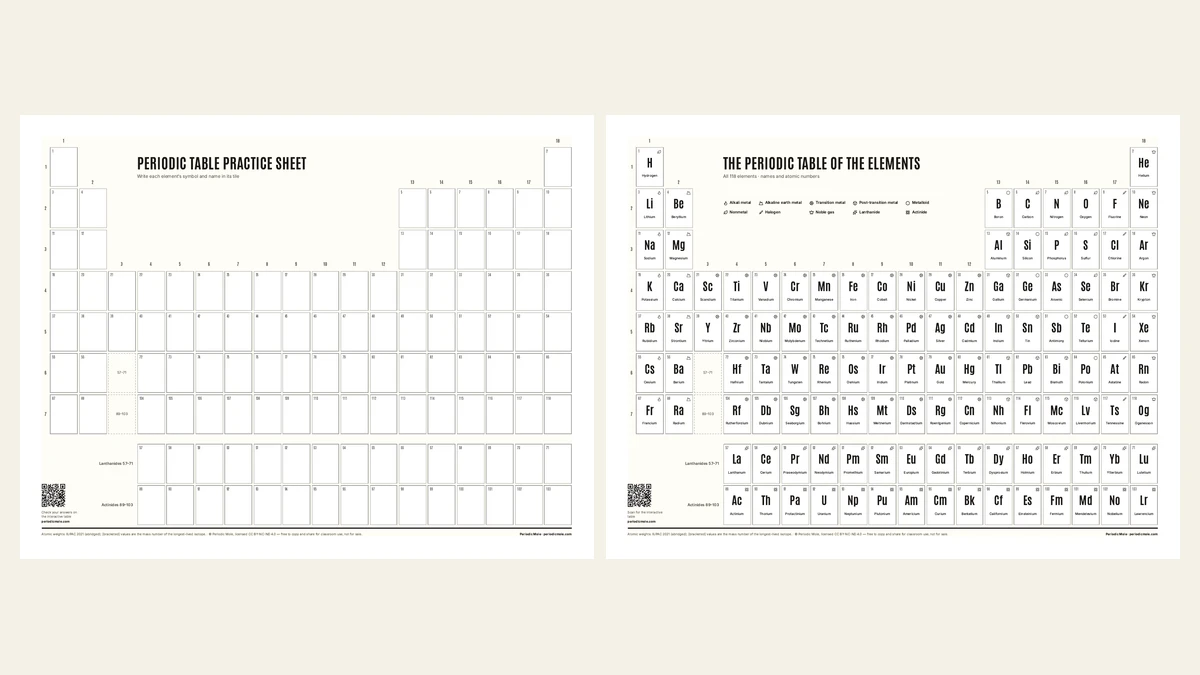
Print in landscape orientation. Check one copy before making a class set. There’s also an 11×17 version in the printable periodic table collection, and sizing and printer settings are in our PDF printing guide.
If students are new to the table, let them work with the completed chart beside them. When you want to check what they remember, ask them to put it away.
Which elements should students fill in first?
Start with the elements your class is using. If you need a short quiz, ask for the symbols and names in cells 1, 2, 6, 7, 8, 11, 12, 17, 19, and 20. Students can leave a question mark where they get stuck, then check the answer key below.
For a score out of twenty, give one point for each correct symbol and one for each correct name. Check capitalization: the first letter of a symbol is uppercase and the second, if there is one, is lowercase. Chlorine is Cl, with a lowercase L.
Have students make corrections in a second color without erasing their first answers. Next time, they can try the missed cells first. If someone knows a symbol but keeps putting it in the wrong cell, let them practice finding it with the completed chart open.
How can I teach groups and periods with the worksheet?
Leave the completed chart out for these questions. Students will need to follow a group down a column or a period across a row. IUPAC numbers the groups from 1 to 18; those numbers are along the top of the worksheet and the periods are down the left.
Ask students to write each element’s symbol and name in its cell, with answers to the questions on a separate sheet:
- Find group 1, period 3. What is the atomic number?
- Find group 17, period 3. Which element is directly above it?
- Find group 18, period 2. Does it share a group or a period with helium?
- Find magnesium. Does it share a group or a period with calcium?
If a student mixes up groups and periods, ask them to trace the row or column with a finger while explaining their answer.
The two rows below the main table belong to periods 6 and 7. On this worksheet, the dashed boxes marked 57–71 and 89–103 are where those rows fit. They are not periods 8 and 9.
Can students use a blank table to identify element families?
For this exercise, stop at calcium, element 20. Ask students to use the completed chart’s family legend to find the alkali metals, halogens, and noble gases among those first twenty elements. Mark their cells with these letters:
- A for an alkali metal.
- H for a halogen.
- N for a noble gas.
Add a small key beside the table. Colored pencils are optional; with letters, the answers are readable on a photocopy too.
Then ask: Does hydrogen get an A? It’s above lithium in group 1, but hydrogen is a nonmetal, so leave its cell unmarked. You can check its position in the Royal Society of Chemistry’s hydrogen entry and its classification in our completed chart’s legend.
What mistakes can students correct on a blank table?
Write these four wrong answers on the board. Ask students to correct each one on their worksheet and explain the mistake in a sentence:
- Cell 11: S, sodium.
- Cell 17: CL, chlorine.
- Cell 19: P, potassium.
- Cell 6: Ca, carbon.
S, P, and Ca all belong to other elements. Ask students to name those too. For “CL,” they only need to fix the capital L.
What fits into fifteen minutes?
Try five minutes for the ten-cell quiz, five for the group and period questions, and five to go over the answers. Leave the family markings and wrong-answer exercise for another lesson.
If the class needs longer to find the cells, give them that time. Finish with the questions they’ve reached.
Answer key
Symbols and names
| Atomic number | Symbol | Name |
|---|---|---|
| 1 | H | Hydrogen |
| 2 | He | Helium |
| 6 | C | Carbon |
| 7 | N | Nitrogen |
| 8 | O | Oxygen |
| 11 | Na | Sodium |
| 12 | Mg | Magnesium |
| 17 | Cl | Chlorine |
| 19 | K | Potassium |
| 20 | Ca | Calcium |
The completed PDF chart has the rest of the elements. For a quick lookup, use our interactive periodic table.
Groups and periods
- Na, sodium, atomic number 11. Group 1, period 3.
- Cl, chlorine. Fluorine (F) is directly above it in group 17.
- Ne, neon. Neon and helium share group 18. Helium is in period 1; neon is in period 2.
- Mg, magnesium. Magnesium and calcium share group 2. Magnesium is in period 3; calcium is in period 4.
Families among the first twenty elements
- Alkali metals: Li (3), Na (11), K (19).
- Halogens: F (9), Cl (17).
- Noble gases: He (2), Ne (10), Ar (18).
- Hydrogen has no family letter in this exercise.
Corrections
- Sodium is Na. S is sulfur, atomic number 16.
- Chlorine is Cl. Use a lowercase L as the second letter.
- Potassium is K. P is phosphorus, atomic number 15.
- Carbon is C. Ca is calcium, atomic number 20.
Have students keep their corrected sheets. Next lesson, they can cover three corrections and try those answers again. When they’re ready for a break from paper, they can practice chemistry questions in a game:
Try it free. Bond Forge is free to play with a starter set of elements, no account needed. Full access is $59 for a year: every game and all 118 elements, with progress saved. No subscription.
FAQ
Does this blank periodic table include atomic numbers? Yes. Each element cell includes its atomic number. We left the symbols and names blank, and the group and period numbers are along the edges.
Where is the answer key for the blank periodic table? Download the completed symbols-and-names chart linked near the top of this article. It has all 118 elements. The answer key in the article is for the exercises on this page.
Should students fill in all 118 elements? Use the elements assigned in class. The starter exercise here has ten elements; the family exercise has only the first twenty. Expand the assignment when those are familiar.
Can I use the worksheet without a color printer? Yes. The blank worksheet and the linked answer charts are black and white. For the family exercise, mark cells with letters and add a key so color is optional.
Related
- Printable Periodic Table PDFs for Class
- Free Chemistry Printables for Teachers
- How to Memorize the Periodic Table Fast
Sources
- Periodic Mole’s printable tables, for the numbered worksheet, completed answer chart, and family legend used in these exercises.
- IUPAC’s Periodic Table of Elements, for group numbering.
- Royal Society of Chemistry: Hydrogen, for hydrogen’s group and classification.