
Greenland Shark Lifespan: How Do We Know?
12 min read
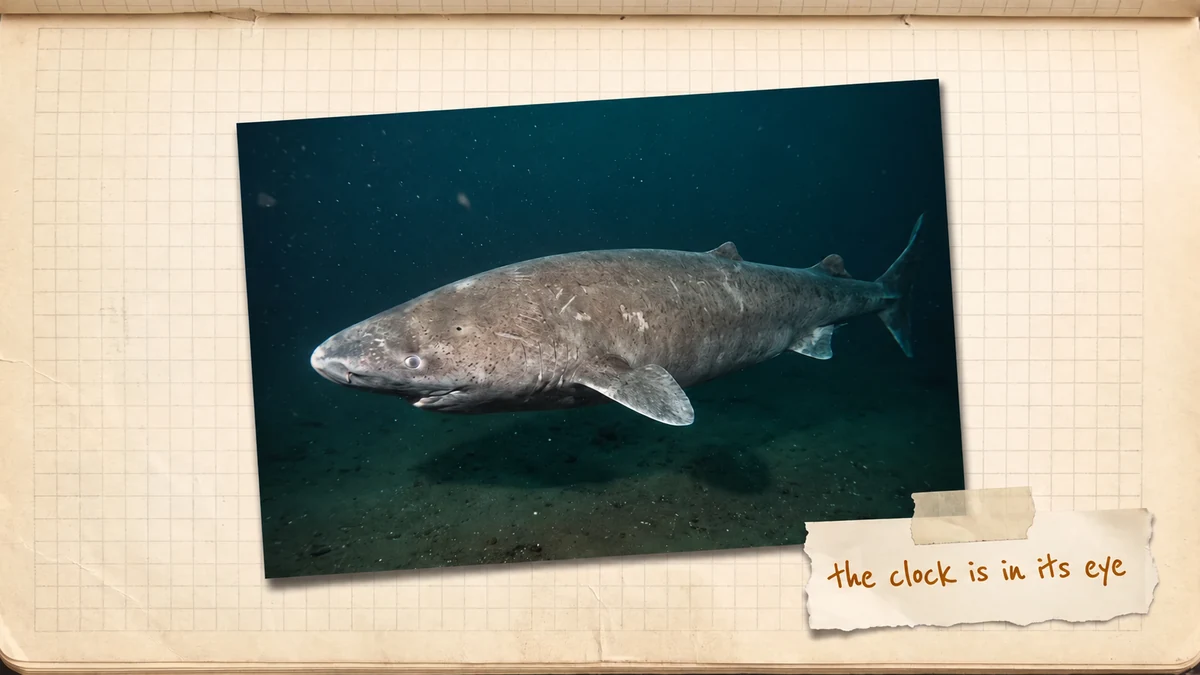
Short answer: Greenland sharks can live at least 272 years, according to a 2016 study that measured the eye lenses of 28 sharks. The biggest, a 502-centimeter female, came out between 272 and 512 years old, and the team called the Greenland shark the longest-lived vertebrate, or animal with a backbone, known to science.
Counted back from 2012, the team's main model puts her birth between 1500 and 1740, before the United States existed. The 392 years you see in headlines is the middle of her range. Scientists worked out her age from the carbon-14 in the center of her eye and from how fast sharks grow, anchored by one younger shark whose eye carried the first trace of carbon from nuclear bomb tests. The exact number is less settled than the headlines make it sound, and the scientists who measured it say so themselves.
How long do Greenland sharks live?
Greenland sharks live for centuries. In their 2016 paper in the journal Science, Nielsen and colleagues wrote that their results "seem to corroborate an estimated life span of at least 272 years for Greenland sharks attaining more than 500 cm in length." In other words, sharks over 5 meters long are probably 272 years old or more.
The team estimated each shark's age at capture, and the oldest age sets a floor for how long the species can live. The oldest shark came out at 392 ± 120 years (read "plus or minus 120"), a range from 272 to 512 with 392 in the middle. If the team's model and its assumptions hold, there's a 95% chance her true age falls in that range. The paper's "at least 272" is the bottom of it, and the "400 years" in headlines rounds the middle up.
| Animal | Oldest age reported | How it was measured |
|---|---|---|
| Ocean quahog (a clam) | 507 years | Counting growth lines in one shell |
| Greenland shark | 392 ± 120 years (272 to 512) | Carbon-14 in the eye lens, plus a growth model |
| Bowhead whale | 211 years (possibly 177 to 245) | A slow chemical change in the proteins of the eye lens |
| Human (Jeanne Calment) | 122 years, 164 days | Birth and death records |
The clam's 507 years beats the shark's middle estimate but sits inside the top of her range, so we can't tell which lived longer. A clam has no backbone, though, so the Greenland shark is the longest-lived vertebrate known (Nielsen and colleagues, 2016). The other figures come from Butler and colleagues (2013), George and colleagues (1999) and Guinness World Records.
How old is the oldest Greenland shark?
The oldest Greenland shark ever dated is shark no. 28 in the 2016 study, a female 502 centimeters long, about 16.5 feet. (The paper numbers its sharks from smallest to largest.) The team estimated her age at 392 ± 120 years, which puts her birth between 1500 and 1740. The second-largest shark, at 493 centimeters, came out at 335 ± 75 years. The sharks were caught from 2010 to 2013, and the team counted all of them as caught in 2012.
Shark no. 28 isn't alive. All 28 sharks were "unintended bycatch," caught by accident while people fished for other things: in a Greenland research institute's yearly fish survey, by commercial fishing boats, and on research longlines, fishing lines strung with many baited hooks. The scientists sampled only sharks already fatally injured by other sharks or by fishing gear, and the sharks were killed right after capture, according to the paper's supplementary materials, the extra data the team published with it. Shark no. 28 came up from 900 meters down.
The "1620" in some stories is 2012 minus 392, the middle of her range; the paper itself prints only the range.
Why can't scientists count a Greenland shark's growth rings?
Scientists usually age a shark the way they age a tree, by counting growth bands, but a Greenland shark has nowhere to count them. A shark's skeleton is cartilage, not bone, and most sharks lay down bands in their fin spines or in the hardened, calcified cartilage of their vertebrae. "Conventional growth zone chronologies cannot be used to age Greenland sharks because of their lack of calcified tissues," the 2016 paper says. The species has no fin spines, and a chemical method that works on whale eyes failed on it too (Edwards and colleagues, 2019).
Measuring growth directly is slow work. In 1936, 1939, 1948 and 1949, scientists tagged 411 Greenland sharks in the coastal waters and fjords of West Greenland. Fishermen reported catching 28 of them again, but most of the lengths they reported were missing or impossible: seven sharks came back shorter than when they were tagged. Only one recaptured shark was measured reliably. In 16 years it had grown from 262 to 270 centimeters, about half a centimeter a year (Hansen, 1963). "Their longevity is likely to be exceptional," the 2016 team wrote.
How does an eye lens tell a shark's age?
An eye lens grows in layers, and the very center forms before the animal is born. Most of the body keeps rebuilding itself from new food, but the center of the lens is made of clear proteins, called crystallins, that the body doesn't break down or replace. In vertebrates, the 2016 paper says, the center keeps proteins made "at approximately age 0." Like all proteins, they're built around carbon atoms, and that carbon came from the mother's food while she carried the pup.
What is carbon-14?
About one carbon atom in a trillion is carbon-14 (NOAA). Every carbon atom has 6 protons in its nucleus, the tiny core of the atom. Most carbon atoms also have 6 neutrons, 12 particles in all, which makes them carbon-12. Carbon-14 has 8 neutrons, 14 particles in all. Atoms of one element with different numbers of neutrons are called isotopes.
Carbon-14 is radioactive. At a random moment that can't be predicted for any one atom, a neutron in its nucleus turns into a proton and shoots out an electron, along with a tiny particle called an antineutrino. The nucleus still holds 14 particles, but with 7 protons the atom is now nitrogen-14: ¹⁴C → ¹⁴N + e⁻ + ν̄. Across trillions of atoms the pace is steady: half the carbon-14 changes in 5,700 years, half of what's left in the next 5,700, and so on. That span is carbon-14's half-life (Kutschera, 2019).
How does carbon-14 date the lens?
Living things keep a steady share of carbon-14, because cosmic rays keep making new carbon-14 from nitrogen high in the air, and it passes through plants into the food web. The lens center stopped taking in carbon before birth, so its carbon-14 has been running down ever since with nothing to replace it. The smaller the share of carbon-14 left, the longer ago the lens center formed, as long as every lens started with the same share.
The team cut a 4 to 5 milligram speck from the center of each shark's left lens and measured it with accelerator mass spectrometry, which counts carbon-14 atoms and compares them with the far more common carbon-12. We explain the whole method, including how labs turn a carbon-14 reading into calendar years, in How Accurate Is Carbon Dating?
How did nuclear bomb tests help date the sharks?
Nuclear weapons tests in the 1950s and early 1960s made huge amounts of new carbon-14: neutrons from the blasts hit nitrogen-14 in the air and turned it into carbon-14, the same change cosmic rays cause (Libby, 1960). By mid-1963, the air far north of the equator held nearly twice as much carbon-14 as in the early 1950s (Hua and colleagues, 2022). Scientists call the spike the bomb pulse. It reached the food webs of the northern North Atlantic "no later than early 1960s," the 2016 paper says. After a test ban took effect in 1963, the extra carbon-14 began draining out of the air into the oceans and plants.
Which sharks carried bomb carbon?
The 2016 team used bomb carbon to sort the 28 Greenland sharks. The two smallest, 81 and 158 centimeters long, had the most carbon-14 of all 28, the sign of bomb carbon in their mothers' food, so they were born after the early 1960s. The third smallest, at 220 centimeters, had just a little more than the rest, which puts its birth around the time the bomb carbon arrived. The team set its age at about 50 years in 2012, which gave the model one age tied to a measured length. The other 25 sharks showed no sign of bomb carbon, so the team treated them as born before it.
Why is the age range so wide?
Greenland shark age ranges are wide because a few centuries change a lens's carbon-14 by only a few percent, and each lens's starting share of carbon-14 is uncertain. The share of carbon-14 left after t years is ½ raised to the power t ÷ 5,700. After 272 years that's about 96.7%, so about 3.3% of the carbon-14 has turned into nitrogen-14. After 512 years, about 6.0% has (our arithmetic). The whole 240-year range comes down to less than 3% of the carbon-14. A good lab measures carbon-14 to about 0.3% (Oxford Radiocarbon Accelerator Unit), so the measurement itself adds only about 25 to 30 radiocarbon years of uncertainty. Most of the spread comes from how much carbon-14 each lens started with.
Why can't carbon-14 alone date a shark's lens?
A lab's first result is a radiocarbon age: the age worked out from carbon-14 alone, as if the sample started with the same share as the air. Carbon in the sea starts with less. Around 1950, before bomb carbon reached the sea, seawater carbon read about 400 radiocarbon years old in subtropical oceans and over 1,000 near the poles (Heaton and colleagues, 2020). A newborn ocean animal started out reading old. That head start differs from place to place, so scientists correct for it with a calibration curve made for sea life, plus a local adjustment.
The curve the team used, Marine13, runs nearly flat over the past 400 years. Lens centers that formed centuries apart can give almost the same reading, so from the reading alone, scientists can't tell those years apart. The authors name this as a difficulty. On carbon alone, each shark's age came out with "very wide ranges," the paper says.
How did the team narrow the ranges?
To narrow each shark's age range, the 2016 team built a statistical model, a calculation that combines all the sharks' carbon readings with rules about growth. It assumes a longer shark is older, that growth slows as a shark gets bigger, and that a newborn is about 42 centimeters long. With the 50-year-old shark as an anchor, those rules let the team narrow every range.
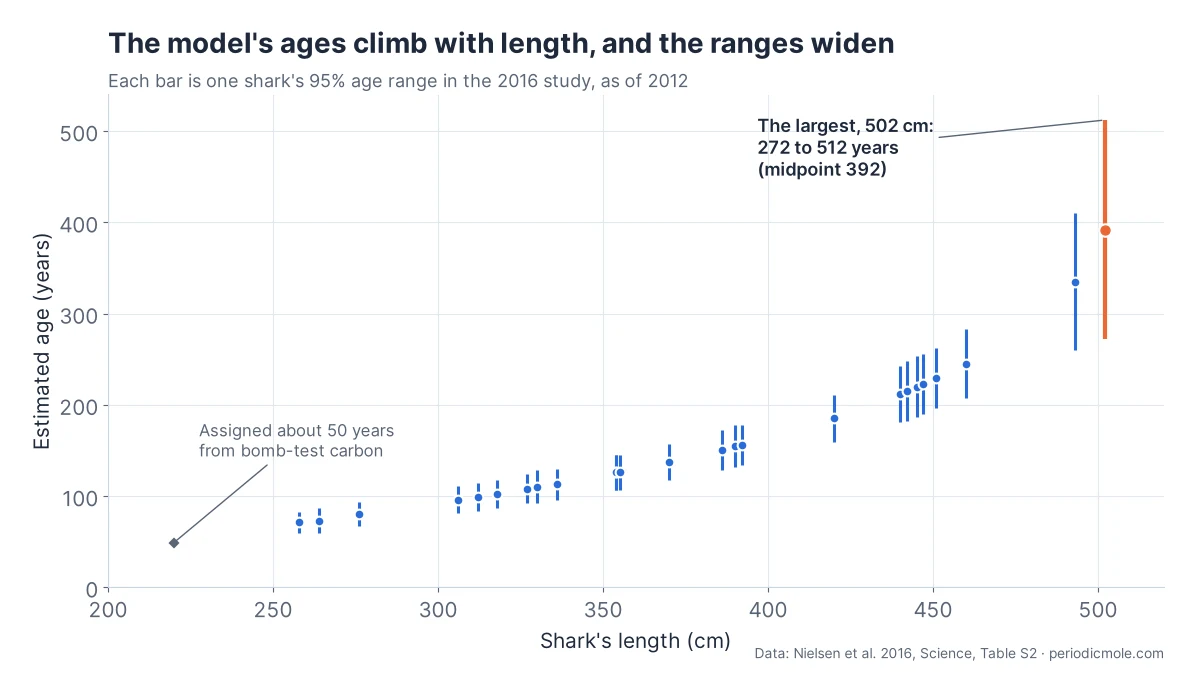
We plotted the age ranges of the 25 sharks born before the bomb pulse, from the paper's supplementary Table S2, with the anchor shark's assigned age of about 50 at the left. The smallest sharks get the tightest ranges, and every shark under 300 centimeters comes out younger than 100. The two longest sharks get the widest ranges, because the model's growth curve flattens out near 5 meters. The 493-centimeter shark came out at 335 years and the 502-centimeter shark at 392, so 9 more centimeters stand for 57 more years (our arithmetic).
How sure are scientists that the oldest shark is 392?
The evidence that Greenland sharks live for centuries is strong. The exact 392 is much less certain.
Why is shark no. 28 the oldest?
Shark no. 28 ranks oldest in the 2016 study because of her length. The model assumes "a strict sequence of birth dates according to shark length," so it ranks a longer shark as older. In the raw measurements (Table S1), two smaller sharks had clearly less carbon-14 than shark no. 28, three had a little less, and one had about the same. On carbon alone, they'd look as old as she does or older.
Shark no. 28 is also one of three sharks that fit the model poorly. The model gives each shark a score for how well its carbon reading matches the age it assigns, and the authors count 60 or more as a good fit. Shark no. 28 scores 35.9. The authors point to a mix of local differences in seawater carbon and sharks that break the size order, where a bigger shark is younger than a smaller one.
Could the sharks be younger or older than the model says?
The 2016 model has Greenland sharks growing faster than Hansen's one reliably measured shark did. Between 258 and 306 centimeters, the model's sharks gain about 2 centimeters a year (our arithmetic from Table S2), four times what Hansen's tagged shark grew at that size. That rests on a single tagged shark. If growth really is that slow, though, these sharks would be even older than the model says.
The late end of her birth range can move, too. When the team re-ran the model with the anchor shark born later, or with a different shark as the anchor, the late end moved from 1740 to between 1799 and 1827. That would put her at about 185 to 213 years at the low end (our arithmetic). The early end stayed near 1500. The authors found those runs fit the data worse, and wrote that her estimated age held up under these changes.
Has anyone checked the 2016 ages since?
In 2019, a review by 19 authors, including Nielsen, called the eye-lens ages "baseline age estimates" that "still need to be verified with an independent, accurate, and precise age determination technique." In 2020, Nielsen and colleagues wrote that, because a newer ocean curve, Marine20, had replaced Marine13, "age estimates are currently being reevaluated." Searching the OpenAlex and Europe PMC research databases, we found no published re-evaluation as of October 2026.
Since 2016, we found no peer-reviewed paper (one checked by other scientists before publication) in which anyone gives these sharks a younger age. The only scientists we found arguing which way the number might be off are Augustine and colleagues, who built a 2017 model of how much energy the sharks use. They wrote that 392 years "is probably too short for life at 2 °C, rather than too long."
Try it free. Bond Forge is free to play with a starter set of elements, no account needed. Full access is $59 for a year: every game and all 118 elements, with progress saved. No subscription.
FAQ
Is the 400-year-old Greenland shark still alive?
No. The shark behind the "400-year-old" headlines was a 502-centimeter female caught between 2010 and 2013 as unintended bycatch off Greenland. The 2016 team sampled only sharks that already had fatal injuries, and they were killed right after capture. Her estimated age, 392 ± 120 years, puts her birth between 1500 and 1740.
Can Greenland sharks live 500 years?
Possibly. The oldest shark in the 2016 study had an age range of 272 to 512 years, so 500 is inside it. The study's own claim is the lower figure, that its findings "seem to corroborate" a life span of at least 272 years for sharks over 5 meters long. In 2020, the same lead author wrote that the ages were being re-evaluated with a newer calibration curve. No fish is known to live longer than the Greenland shark, which the 2016 team called the longest-lived vertebrate known; the 507-year-old ocean quahog is a clam.
When do Greenland sharks become adults?
Female Greenland sharks reach adulthood at well over a century old. The 2016 team put it at 156 ± 22 years or more, the age of the study's 392-centimeter shark, because females were then thought to mature at over 400 centimeters. In 2020, the same lead author found the smallest mature females are about 3.9 meters long and wrote that females mature "no earlier than 134 years of age."
Why do Greenland sharks live so long?
Scientists are still working that out. Cold may play a part. In a 2017 model of the sharks' energy use for life at 2 °C, Augustine and colleagues found 392 years more likely too short than too long. In 2026, a team that read the species' genome, its full set of genes, found extra copies of genes linked to DNA repair, immune defense and resistance to cancer, with signs that natural selection favored them. In a 2026 study of their eyes, another team found no obvious signs of age damage in the retinas of sharks estimated, from their length, to be over a century old.
Related
Elements in real life: where carbon, nitrogen and the rest of the periodic table turn up around you
Sources
- Augustine, S., K. Lika and S. A. L. M. Kooijman (2017). Comment on the Ecophysiology of the Greenland Shark, Somniosus microcephalus. Polar Biology 40: 2429–2433.
- Butler, P. G., et al. (2013). Variability of Marine Climate on the North Icelandic Shelf in a 1357-Year Proxy Archive Based on Growth Increments in the Bivalve Arctica islandica. Palaeogeography, Palaeoclimatology, Palaeoecology 373: 141–151.
- Edwards, J. E., et al. (2019). Advancing Research for the Management of Long-Lived Species: A Case Study on the Greenland Shark. Frontiers in Marine Science 6: 87.
- Fogg, L. G., et al. (2026). The Visual System of the Longest-Living Vertebrate, the Greenland Shark. Nature Communications 17: 39.
- George, J. C., et al. (1999). Age and Growth Estimates of Bowhead Whales (Balaena mysticetus) via Aspartic Acid Racemization. Canadian Journal of Zoology 77(4): 571–580. The 211-year figure and its 177–245 range as reported by Guinness World Records, "Longest-lived whale."
- Guinness World Records. Oldest person ever (Jeanne Louise Calment).
- Hansen, P. M. (1963). Tagging Experiments with the Greenland Shark (Somniosus microcephalus) in Subarea 1. ICNAF Special Publication 4: 172–175.
- Heaton, T. J., et al. (2020). Marine20, the Marine Radiocarbon Age Calibration Curve (0–55,000 cal BP). Radiocarbon 62(4): 779–820.
- Hua, Q., et al. (2022). Atmospheric Radiocarbon for the Period 1950–2019. Radiocarbon 64(4): 723–745.
- Kutschera, W. (2019). The Half-Life of 14C: Why Is It So Long? Radiocarbon 61(5): 1135–1142.
- Libby, W. F. (1960). Radiocarbon Dating. Nobel Lecture.
- Nielsen, J., et al. (2016). Eye Lens Radiocarbon Reveals Centuries of Longevity in the Greenland Shark (Somniosus microcephalus). Science 353: 702–704, with its Supplementary Materials (Tables S1 and S2, the model, and the sensitivity runs). The age chart plots Table S2, plus the anchor shark's assigned age of 49 ± 5 years, a model input.
- Nielsen, J., et al. (2020). Assessing the Reproductive Biology of the Greenland Shark (Somniosus microcephalus). PLoS ONE 15(10): e0238986.
- NOAA Global Monitoring Laboratory. Carbon isotopes: chemistry, radioactive decay, and the bomb spike.
- Oxford Radiocarbon Accelerator Unit. Radiocarbon dating, calibration, and methods.
- Reimer, P. J., et al. (2013). IntCal13 and Marine13 Radiocarbon Age Calibration Curves 0–50,000 Years cal BP. Radiocarbon 55(4): 1869–1887.
- Yang, K., et al. (2026). The Greenland Shark Genome: Insights into Lifespan Extremes and Population Dynamics. PNAS 123(21): e2601272123.