
How Accurate Is Carbon Dating?
15 min read
Short answer: Carbon dating works on things that died within the last 50,000 years. For a sample a few thousand years old, a good lab measures its radiocarbon age give or take 30 years. In calendar years, that usually becomes a range 120 to 200 years wide, with a 95% chance of holding the true date.
Scientists have used carbon dating on a man murdered in the Alps more than 5,000 years ago, on the linen of the Shroud of Turin, and on wood that Vikings cut in Newfoundland. With carbon dating and a marker left by Cold War nuclear bomb tests, they showed that a Greenland shark caught in the 2010s was probably born before the United States existed. Carbon dating can't date a dinosaur, though.
How does carbon dating work?
Carbon dating works because living things keep taking in carbon, a tiny share of which is radioactive, and dead things stop. When Ötzi, the man murdered in the Alps, died more than 5,000 years ago, his body stopped taking in carbon, and the radioactive share of that carbon has been running down ever since. A radioactive atom has an unstable center that sooner or later breaks apart on its own, turning the atom into a different element.
Every atom has a tiny center called the nucleus, made of protons, which carry a positive charge, and neutrons, which carry none. The number of protons, called the atomic number, determines the element: every carbon atom has six, so carbon is element 6. The number of neutrons can vary. Atoms of one element with different numbers of neutrons are called isotopes, and the number in an isotope's name counts its protons and neutrons together. Carbon-12 has six protons and six neutrons and makes up about 99% of carbon. Carbon-13, with seven neutrons, is about 1%. Carbon-14, with eight neutrons, is also called radiocarbon. It is rare: about one carbon atom in every trillion, too small a share to show up in those percentages (NOAA, the U.S. National Oceanic and Atmospheric Administration).
Carbon-14 is made in the sky. Cosmic rays, fast particles from outer space, smash into atoms in the upper atmosphere and knock loose neutrons. Air is mostly nitrogen, so a loose neutron usually hits a nitrogen-14 atom, which has seven protons and seven neutrons. The nucleus takes in the neutron and throws out a proton. It still holds 14 particles in all, but with one proton fewer, its atomic number drops from 7 to 6: the nitrogen atom is now carbon-14. In symbols, n + ¹⁴N → ¹⁴C + p.
The new carbon-14 combines with oxygen to make carbon dioxide, which plants take in during photosynthesis. Animals eat the plants, and other animals eat those animals. So plants and animals on land, you included, hold carbon-14 in about the same proportion as the air (Oxford Radiocarbon Accelerator Unit). Sea life is an exception, explained below. Cosmic rays keep making new carbon-14 about as fast as the old carbon-14 breaks down, so the amount in the air stays roughly steady (Hua and colleagues, 2022).
Carbon-14 makes you slightly radioactive. A 60-kilogram person holds enough carbon-14 that about 2,500 of its atoms break down every second (Japan's Ministry of the Environment). That's part of the natural background radiation around us all the time. The Health Physics Society puts the dose from all the radioactive atoms in what we eat and drink at about 5% of a person's average yearly radiation.
Each carbon-14 atom eventually undergoes beta decay: one neutron in its nucleus turns into a proton. The nucleus shoots out a newly made electron, called a beta particle, and a tiny particle called an antineutrino, which flies off and plays no part in the dating. The nucleus still holds 14 protons and neutrons in all, but with seven protons, the atom is nitrogen-14 again: ¹⁴C → ¹⁴N + e⁻ + ν̄. While a plant or animal is alive, carbon-14 from food or air replaces the atoms that decay, so the level holds steady. When it dies, the replacement stops, and the carbon-14 starts to run down.
Carbon-14 decays on a fixed schedule. When any one atom decays is random, but half of any large number of them decays in about 5,700 years, a span called its half-life. Half of what remains decays in the next 5,700 years, and so on: the same fraction each time, not the same number of atoms. Heat, cold, pressure and chemical reactions don't change the half-life, because it is set inside the nucleus. Many textbooks give 5,730 years, the best value available in 1962. Today's best value, an average of many careful measurements, is 5,700 ± 30 years (Kutschera, 2019), where ± means "give or take."
| Half-lives since death | Years since death | Carbon-14 left |
|---|---|---|
| 0 | 0 | 100% |
| 1 | 5,700 | 50% |
| 2 | 11,400 | 25% |
| 3 | 17,100 | 12.5% |
| 4 | 22,800 | 6.25% |
| about 8.8 | 50,000 | about 0.2% |
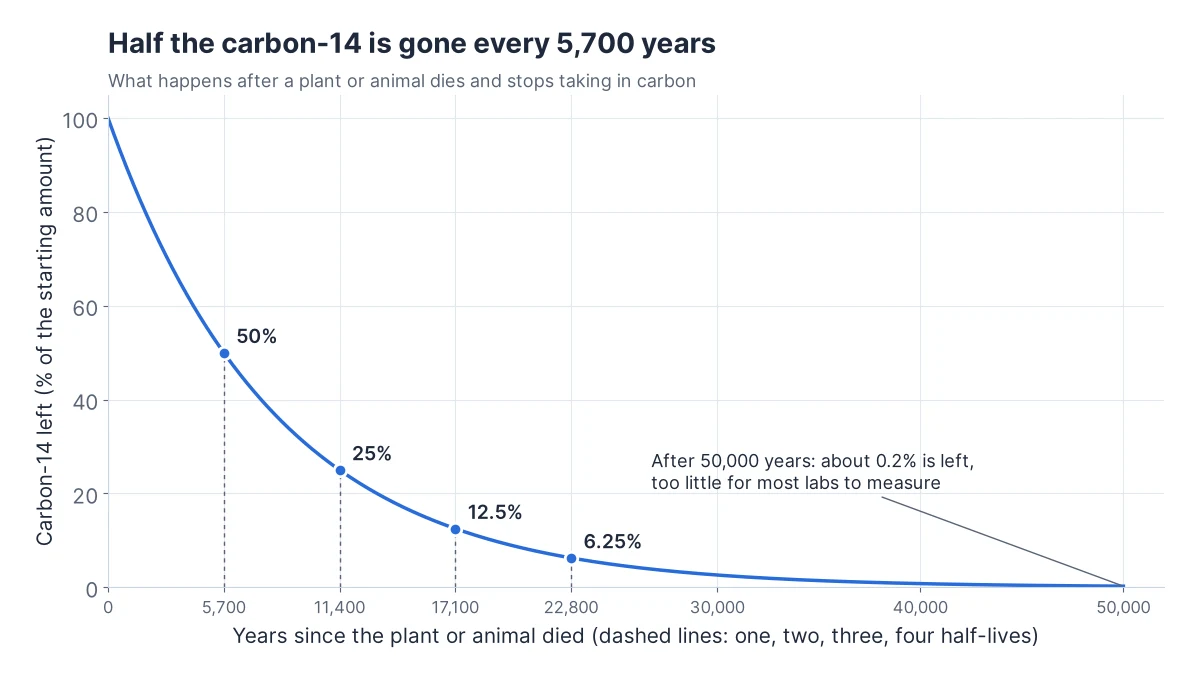
Labs compare a sample's carbon-14 with its carbon-12 and carbon-13, which don't decay and make a steady yardstick, so the size of the sample doesn't matter. If a piece of charcoal holds a quarter as much carbon-14 per gram of carbon as living wood does, two half-lives have passed since that wood grew: roughly 11,400 years. That is only a first estimate. It assumes the share of carbon-14 in the air held constant, and it didn't. When this wood grew, the air held about a fifth more carbon-14 than in 1950, so calibration, explained below, moves the charcoal to about 13,000 years ago.
How accurate is carbon dating?
Carbon dating is precise to a few decades in the lab and to a century or two on the calendar. For a sample a few thousand years old, a good lab measures the carbon-14 closely enough to pin its radiocarbon age to about 25 to 30 years either way. Converting that to calendar years widens it: the 95% range is rarely narrower than 120 years and often closer to 200 (Oxford Radiocarbon Accelerator Unit). So the accuracy depends on two steps, measuring the carbon-14 and converting the measurement into a calendar date.
Willard Libby, the chemist who developed the method, tested it on wood whose age was already known from history or tree rings. In 1949 he and James Arnold dated samples including a deck board from the funeral boat of the Egyptian king Sesostris III. They also dated wood from the tombs of the pharaohs Zoser and Sneferu.
| Sample (Arnold and Libby, 1949) | Known age (years) | Carbon-14 age (years) |
|---|---|---|
| Giant sequoia, inner rings (about 980 BC) | 2,928 ± 52 | 3,005 ± 165 |
| Sesostris III funeral boat | 3,792 ± 50 | 3,700 ± 400 |
| Tombs of Zoser and Sneferu | 4,600 ± 75 | 4,750 ± 250 |
A tree's rings stop taking in carbon the year they grow, so the inner rings of a sequoia cut down in 1874 were already nearly 3,000 years old. "The agreement between prediction and observation is seen to be satisfactory," Arnold and Libby wrote. Libby won the 1960 Nobel Prize in Chemistry for the method.
Libby's ranges ran to hundreds of years because he measured carbon-14 by counting decays with counters, detectors that register each particle a decaying atom shoots out. His counters needed about 8 grams of pure carbon, which meant burning roughly an ounce of wood to carbon dioxide and turning that back into carbon (Arnold and Libby, 1949).
Labs today use accelerator mass spectrometry (AMS), a machine that speeds up charged atoms and sorts them by mass. It counts the carbon-14 atoms one at a time instead of waiting for them to decay, and it needs about a milligram of carbon, often less (NOSAMS, Woods Hole). For a sample a few thousand years old, the Oxford lab aims to measure carbon-14 to about 0.3%, which puts the radiocarbon age within about 25 to 30 years. Labs usually quote that as a 68% range, meaning a 68% chance the true value falls inside it. A 95% range is about twice as wide (Jull and colleagues, 1995). Older samples carry wider ranges: about ±95 years for a sample 18,500 radiocarbon years old (NOSAMS).
A lab reports its measurement as a radiocarbon age, in radiocarbon years "before present" (BP), where present is fixed at AD 1950 by international agreement (Stuiver and Polach, 1977). A radiocarbon age isn't a calendar age yet, for two reasons. Labs still compute it with Willard Libby's half-life of 5,568 years, the figure they kept when the better value arrived in 1962. And the air's share of carbon-14 has changed over time. Calibration turns a radiocarbon age into a calendar date: AD years count forward from year 1, and BC years count backward before it, so 3359 BC is older than 3105 BC.
Calibration is the second step. Over the last 3,000 years, the share of carbon-14 in the air has varied by only a few percent (Oxford Radiocarbon Accelerator Unit). Farther back the swings were much larger: by our calculation from the IntCal20 data, the air between 10,000 and 55,000 years ago held 10% to 70% more carbon-14 than in 1950.
To correct for those swings, researchers measured carbon-14 in tree rings, because each ring grows in a single year and locks in that year's carbon. By matching the patterns of thick and thin rings between living trees and older dead wood, they chained trees into one long record. They used bristlecone pines from the United States, waterlogged oaks from Ireland and Germany, and kauri, giant conifers from New Zealand. Their tree-ring record reaches back about 14,000 years, and the last 12,300 are tied to exact calendar years. Researchers extended the record back 55,000 years with lake and sea sediments, cave formations and corals, which they can date in other ways. The result is the current international curve, IntCal20 (Reimer and colleagues, 2020). Labs read a sample's calendar date off that curve.
Calibration often turns one measurement into two possible ranges. We took the result three labs published in 1988 for the Shroud of Turin, 691 ± 31 radiocarbon years, and recalibrated it with IntCal20. The curve wiggles because the air's carbon-14 rose and fell over the centuries. So the measurement's 95% range crosses it in two places: AD 1273 to 1318 (a 65.5% chance) or AD 1360 to 1388 (a 30% chance). Together the two make up the 95% range: a 95% probability that the true date falls in one of them.
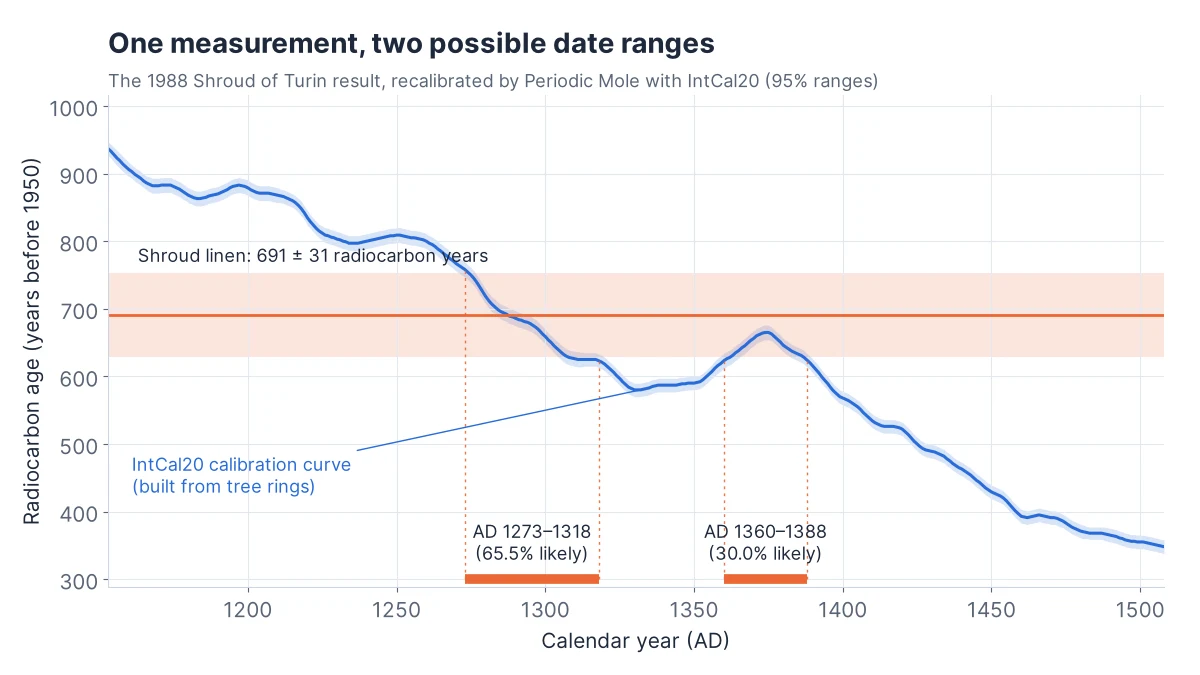
In all, the Shroud's two ranges run from AD 1273 to 1388, a little under the 120 years the Oxford lab gives as a usual minimum. The curve falls steeply in the late 1200s, so a wide band of radiocarbon ages fits a short stretch of calendar years.
What can't carbon dating date?
Carbon dating works on things that took in carbon from the air, which almost always means things that were once alive. And it works only if that happened within roughly the last 50,000 years.
- Rocks, metal and pottery. They usually can't be dated directly, because they never took in carbon from the air the way a living thing does. A lab can date organic material stuck to them, like food residue in a pot (Oxford Radiocarbon Accelerator Unit).
- Dinosaurs. The last dinosaurs died about 66 million years ago, roughly 11,600 half-lives of carbon-14. Not one carbon-14 atom from their lifetimes would be left. Geologists date the volcanic rock layers above and below such fossils with isotopes that have far longer half-lives, such as potassium-40, whose half-life is 1.25 billion years (USGS).
- Anything older than about 50,000 years. By then only about 0.2% of the carbon-14 remains, and a trace of contamination could outweigh it. Labs report such samples as "greater than" an age instead of giving one.
- Sea creatures, without a correction. Carbon in seawater carries a smaller share of carbon-14 than carbon in the air. So shells and fish bones look about 400 years older than they are in warm oceans, and more than 1,000 years older near the poles. Labs calibrate them against a separate marine curve, Marine20, with a correction for the local sea. Marine20 isn't meant for polar waters (Heaton and colleagues, 2020).
- Contaminated samples. Carbon is so common in the environment that contamination from material of a different age "is always possible," the Oxford Radiocarbon Accelerator Unit warns. Adding just 1% modern carbon to a 50,000-year-old sample makes it measure about 35,000 years old. The same 1% moves a 5,000-year-old sample only to about 4,950 (Taylor and Southon, 2012). Labs scrub samples chemically and turn away ones they can't trust.
Why doesn't ordinary carbon dating work after 1950?
Ordinary carbon dating can't give an age for anything that grew after the mid-1950s, because nuclear weapons tests flooded the air with extra carbon-14. The year 1950 itself is a bookkeeping zero, not a limit: it is the "present" in "before present."
Above-ground nuclear tests made huge amounts of new carbon-14: the neutrons they released hit nitrogen-14 in the air, the same reaction cosmic rays drive (Libby, 1960). The level in the air began climbing in 1955. By mid-1963, the air far from the equator in the Northern Hemisphere held nearly twice as much carbon-14 as in the early 1950s (Hua and colleagues, 2022). A test ban treaty took effect in October 1963, and since then the extra carbon-14 has been draining into the oceans and plants. The drop isn't radioactive decay, which is far too slow to show in 60 years (NOAA).
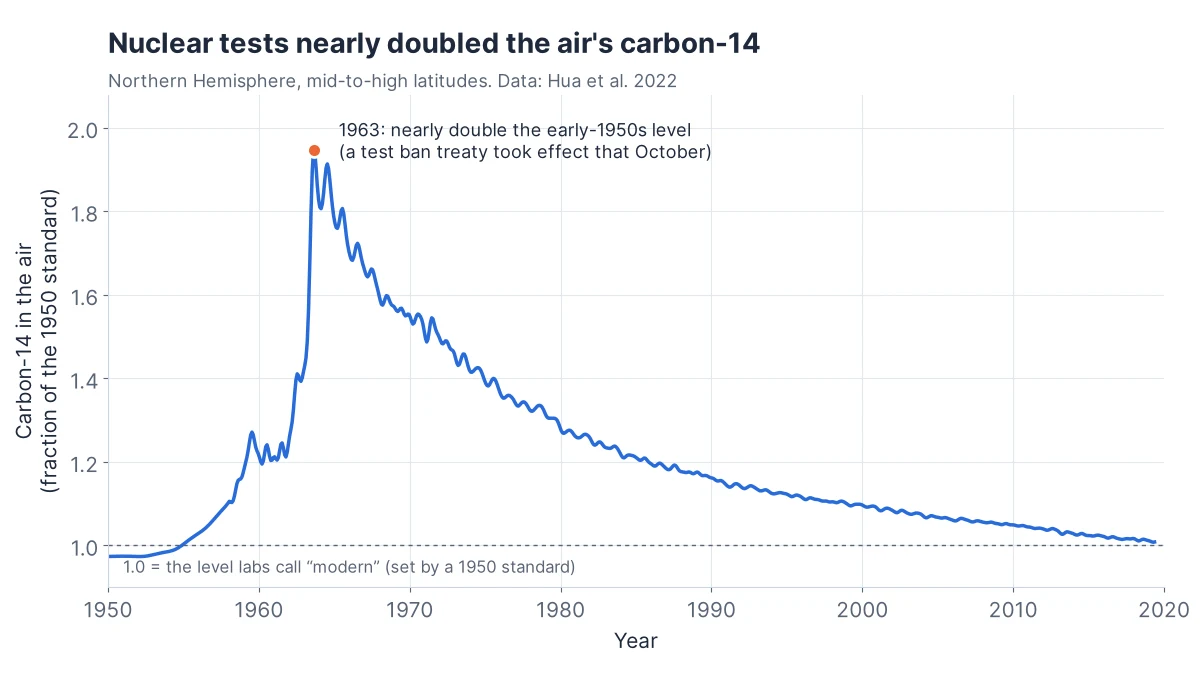
Scientists call the bomb-test spike in carbon-14 the bomb pulse, and they turned it into a new way to date recent things. Because the level changed so fast, they can match a sample to the year it formed, often within one to a few years (Hua and colleagues, 2022). Most levels appear twice on the curve, once on the way up before 1963 and once on the way down after. Scientists use other clues to pick the right side.
When people burn coal and oil, the carbon-14 level moves the other way, down. Coal and oil are millions of years old and contain no carbon-14, so burning them dilutes the carbon-14 in the air. In 2015 Heather Graven calculated that by 2050, fresh plant material could have the same carbon-14 level as samples from AD 1050, and labs couldn't tell them apart by radiocarbon dating. Ambitious cuts in emissions could keep the level near where it was before the industrial age, she found.
What has carbon dating been used for?
Scientists have used carbon dating on mummies, ancient scrolls, cave paintings, sharks and stolen ivory. For 13 of 14 Dead Sea Scrolls, the radiocarbon dates matched the dates scholars had estimated from the handwriting or found written on the scrolls (Bonani and colleagues, 1992).
Ötzi the Iceman
Ötzi the Iceman is the mummy that Erika and Helmut Simon, two German hikers, found at 3,210 meters in the Ötztal Alps on September 19, 1991. He had been murdered (South Tyrol Museum of Archaeology). The first expert to examine him guessed he was at least 4,000 years old.
Labs in Zurich and Oxford dated Ötzi independently, using AMS because the scientists could spare only tiny samples of such a rare find. Zurich's measurements of his tissue, his bone and the grass found with him all agreed, averaging 4,550 ± 27 radiocarbon years. The Zurich team calibrated that to between 3359 and 3105 BC (Bonani and colleagues, 1994).
At Ötzi's age, radiocarbon years run several hundred years short of calendar years, which is why 4,550 radiocarbon years means more than 5,000 calendar years. We recalibrated the same measurement with IntCal20 and got 3369 to 3104 BC, nearly the same answer 30 years later.
Vikings in Newfoundland, AD 1021
Archaeologists had collected 55 radiocarbon dates from the Viking camp at L'Anse aux Meadows in Newfoundland, Canada, but their ranges spread across the whole Viking Age, AD 793 to 1066. In 2021 a team led by Kuitems narrowed it to one year.
In AD 993, a burst of cosmic radiation, possibly from the Sun (Miyake and colleagues, 2013), raised the carbon-14 in the air. That spike shows up in the same year's ring in trees all over the world. The team found it in three pieces of wood that someone had cut with metal blades, tools the local Indigenous people didn't make at the time. Counting rings from the spike out to the bark gave the year each tree was cut: AD 1021.
Kuitems and colleagues note that 1021 is when the trees were cut, not necessarily when the Vikings arrived. Miyake and colleagues found the first of these one-year spikes, between AD 774 and 775, in the rings of Japanese cedar trees in 2012.
The Shroud of Turin
The Shroud of Turin is a linen cloth marked with faint front and back images of a man. Many people believe it was used to wrap Jesus's body (Damon and colleagues, 1989). In 1988, labs in Arizona, Oxford and Zurich each dated about 50 milligrams of its linen, along with three control fabrics of known age. The controls came out as expected. The shroud's linen came out at 691 ± 31 radiocarbon years, which the labs calibrated to AD 1260 to 1390 with at least 95% confidence. They called the result "conclusive evidence that the linen of the Shroud of Turin is mediaeval."
Three teams reanalyzed the raw data in 2019 and 2020: Casabianca and colleagues, Walsh and Schwalbe, and Di Lazzaro and colleagues. They argued that the three labs' results disagree more than they should. Di Lazzaro's team suggested that the labs' cleaning removed contamination unevenly. None of their summaries proposes a different date, and Di Lazzaro's team asks whether the shroud should be dated again.
In 2026 the Arizona lab re-examined its unused 1988 fragments, found no contamination, and said the labs stand by the result (Freer-Waters and Jull, 2026). When we recalibrated the measurement with IntCal20, both of our ranges fell inside the original one.
A shark older than the United States
In 2016, Nielsen and colleagues dated 28 Greenland sharks using the center of the eye's lens, which forms before birth and stays the same for life. Only the smallest sharks carried bomb carbon, so the team knew those had been born after the early 1960s. For the larger ones, the team combined radiocarbon dates with a mathematical model of how fast the sharks grow. They calibrated those dates with a marine curve, because sharks get their carbon from the sea. The biggest, at 502 centimeters long, came out at 392 ± 120 years old, a 95% range of 272 to 512. Even the low end of the main model puts its birth before 1776. The team also estimated that females don't mature until they are at least 156 ± 22 years old, and a 2020 study by the same lead author put it at no earlier than 134. We tell the whole story, including how sure anyone can be of the exact age, in Greenland Shark Lifespan: How Do We Know?
Poached ivory and your own brain
The bomb pulse works on anything that grew after 1955. In 2016, Thure Cerling and his colleagues dated 231 tusks from 14 large ivory seizures made between 2002 and 2014. The ivory was poached, meaning it came from elephants killed illegally. About 90% came from elephants that had died less than three years before the ivory was seized, so the tusks came from recent poaching. Only one of the 231 came from an elephant that had died more than six years before. In 2005, Spalding and colleagues measured carbon-14 in the DNA of human brain cells. The neurons in the occipital cortex, at the back of the brain, turned out to be as old as the person: the brain doesn't make new ones there after birth.
Try it free. Bond Forge is free to play with a starter set of elements, no account needed. Full access is $59 for a year: every game and all 118 elements, with progress saved. No subscription.
FAQ
What is the half-life of carbon-14? About 5,700 years: today's best value is 5,700 ± 30. Many textbooks still give 5,730, the best value available in 1962. Radiocarbon labs still compute ages with Willard Libby's figure of 5,568 years by international agreement. The scientists who build the calibration curve use the same figure, so the choice cancels out when a lab converts a result to calendar years.
Why can't rocks or dinosaur bones be carbon dated? Most rocks never took in carbon from the air, and the ones built by living things, like coal and limestone, are millions of years old, so their carbon-14 is long gone. Dinosaur fossils are far too old too: the last dinosaurs died about 66 million years ago, roughly 11,600 half-lives of carbon-14. Geologists date the rock layers around such fossils with isotopes that have far longer half-lives, such as potassium-40.
How far back can carbon dating go? About 50,000 years, the practical limit at most labs. The Oxford lab treats 55,000 radiocarbon years as its limit for bone, and labs report anything older as "greater than" an age. Researchers have used carbon dating to place nearly all of the black charcoal drawings in France's Chauvet Cave at 37,000 to 33,500 years old (Quiles and colleagues, 2016).
Is anything more accurate than carbon dating? For the right sample, yes. Counting tree rings gives the exact year each ring grew. Two sharper forms of carbon dating come close to that. Scientists use the bomb pulse to date things that grew after 1955 to within one to a few years. Researchers used a one-year spike in carbon-14 to find the exact year Vikings cut wood in Newfoundland: AD 1021. For samples older than about 50,000 years, geologists switch to isotopes with much longer half-lives, such as potassium-40, which reach back millions of years.
Does carbon dating only work half the time? No. A 2022 article on The Conversation, a news site where researchers write about their work, ran the headline "Radiocarbon dating only works half the time." Its author, Eran Elhaik, meant that only about half of ancient human remains can be dated, because some skeletons have too little organic material left or are contaminated. His point was about finding a usable sample, and he wrote that his own method, based on ancient DNA, "is not a substitute for radiocarbon dating."
Related
Elements in real life: where carbon, nitrogen and the rest of the periodic table turn up around you
Sources
- Arnold, J. R., and W. F. Libby (1949). Age Determinations by Radiocarbon Content: Checks with Samples of Known Age. Science 110: 678–680.
- Bonani, G., et al. (1992). Radiocarbon Dating of Fourteen Dead Sea Scrolls. Radiocarbon 34(3): 843–849.
- Bonani, G., et al. (1994). AMS 14C Age Determinations of Tissue, Bone and Grass Samples from the Ötztal Ice Man. Radiocarbon 36(2): 247–250.
- Casabianca, T., et al. (2019). Radiocarbon Dating of the Turin Shroud: New Evidence from Raw Data. Archaeometry 61(5): 1223–1231.
- Cerling, T. E., et al. (2016). Radiocarbon Dating of Seized Ivory Confirms Rapid Decline in African Elephant Populations. PNAS 113(47): 13330–13335.
- Damon, P. E., et al. (1989). Radiocarbon Dating of the Shroud of Turin. Nature 337: 611–615.
- Di Lazzaro, P., et al. (2020). Statistical and Proactive Analysis of an Inter-Laboratory Comparison: The Radiocarbon Dating of the Shroud of Turin. Entropy 22(9): 926.
- Elhaik, E. (2022). Radiocarbon Dating Only Works Half the Time – We May Have Found the Solution. The Conversation, September 7.
- Freer-Waters, R., and A. J. T. Jull (2026). Analysis of Textile Fragments from the 1988 Radiocarbon Samples of the Turin Shroud. npj Heritage Science 14: 263.
- Graven, H. D. (2015). Impact of Fossil Fuel Emissions on Atmospheric Radiocarbon and Various Applications of Radiocarbon over This Century. PNAS 112(31): 9542–9545.
- Health Physics Society (2020). Common Sources of Radiation. Fact sheet.
- Heaton, T. J., et al. (2020). Marine20, the Marine Radiocarbon Age Calibration Curve (0–55,000 cal BP). Radiocarbon 62(4): 779–820.
- Hua, Q., et al. (2022). Atmospheric Radiocarbon for the Period 1950–2019. Radiocarbon 64(4): 723–745. The bomb-pulse chart plots its Northern Hemisphere zone 1 data.
- Japan Ministry of the Environment (2018). Natural Radioactive Materials in the Body and Foods. Basic Information on Radiation, section 2.5.
- Jull, A. J. T., et al. (1995). Radiocarbon Dating of Scrolls and Linen Fragments from the Judean Desert. Radiocarbon 37(1): 11–19.
- Kuitems, M., et al. (2021 online; 2022 in print). Evidence for European Presence in the Americas in AD 1021. Nature 601: 388–391.
- Kutschera, W. (2019). The Half-Life of 14C: Why Is It So Long? Radiocarbon 61(5): 1135–1142.
- Libby, W. F. (1960). Radiocarbon Dating. Nobel Lecture.
- Miyake, F., et al. (2012). A Signature of Cosmic-Ray Increase in AD 774–775 from Tree Rings in Japan. Nature 486: 240–242.
- Miyake, F., K. Masuda and T. Nakamura (2013). Another Rapid Event in the Carbon-14 Content of Tree Rings. Nature Communications 4: 1748.
- Nielsen, J., et al. (2016). Eye Lens Radiocarbon Reveals Centuries of Longevity in the Greenland Shark. Science 353: 702–704.
- NOAA Global Monitoring Laboratory. Carbon isotopes: chemistry, radioactive decay, and the bomb spike.
- NOSAMS, Woods Hole Oceanographic Institution. Sample requirements.
- Oxford Radiocarbon Accelerator Unit. Radiocarbon dating, calibration, and methods.
- Quiles, A., et al. (2016). A High-Precision Chronological Model for the Decorated Upper Paleolithic Cave of Chauvet-Pont d'Arc. PNAS 113(17): 4670–4675.
- Reimer, P. J., et al. (2020). The IntCal20 Northern Hemisphere Radiocarbon Age Calibration Curve (0–55 cal kBP). Radiocarbon 62(4): 725–757. Our recalibrations of the Shroud and Ötzi measurements, and our figures for the air's past carbon-14, use its published data.
- South Tyrol Museum of Archaeology. Ötzi: the discovery; the Iceman.
- Spalding, K. L., et al. (2005). Retrospective Birth Dating of Cells in Humans. Cell 122(1): 133–143.
- Stuiver, M., and H. A. Polach (1977). Discussion: Reporting of 14C Data. Radiocarbon 19(3): 355–363.
- Taylor, R. E., and J. Southon (2012). On the Resolution of 14C Dating Anomalies. Radiocarbon 54(3–4): 979–991.
- U.S. Geological Survey. Geologic Time: Radiometric Time Scale.
- Walsh, B., and L. Schwalbe (2020). An Instructive Inter-Laboratory Comparison: The 1988 Radiocarbon Dating of the Shroud of Turin. Journal of Archaeological Science: Reports 29: 102015.