Atomic number 29
Copper
Transition metal
In the real world

Quick facts
- Atomic mass
- 63.546
- Group
- 11
- Period
- 4
- State (STP)
- solid
- Electronegativity
- 1.90
- Common ox. states
- +1, +2
Properties
Electron configuration
[Ar] 3d¹⁰ 4s¹
- Ionization energy
- 745.5 kJ/mol
- Electron affinity
- 119.2 kJ/mol
- Melting point
- 1357.77 K (1084.6 °C)
- Boiling point
- 2835.00 K (2561.8 °C)
How dangerous is it?
1/5 · Low risk
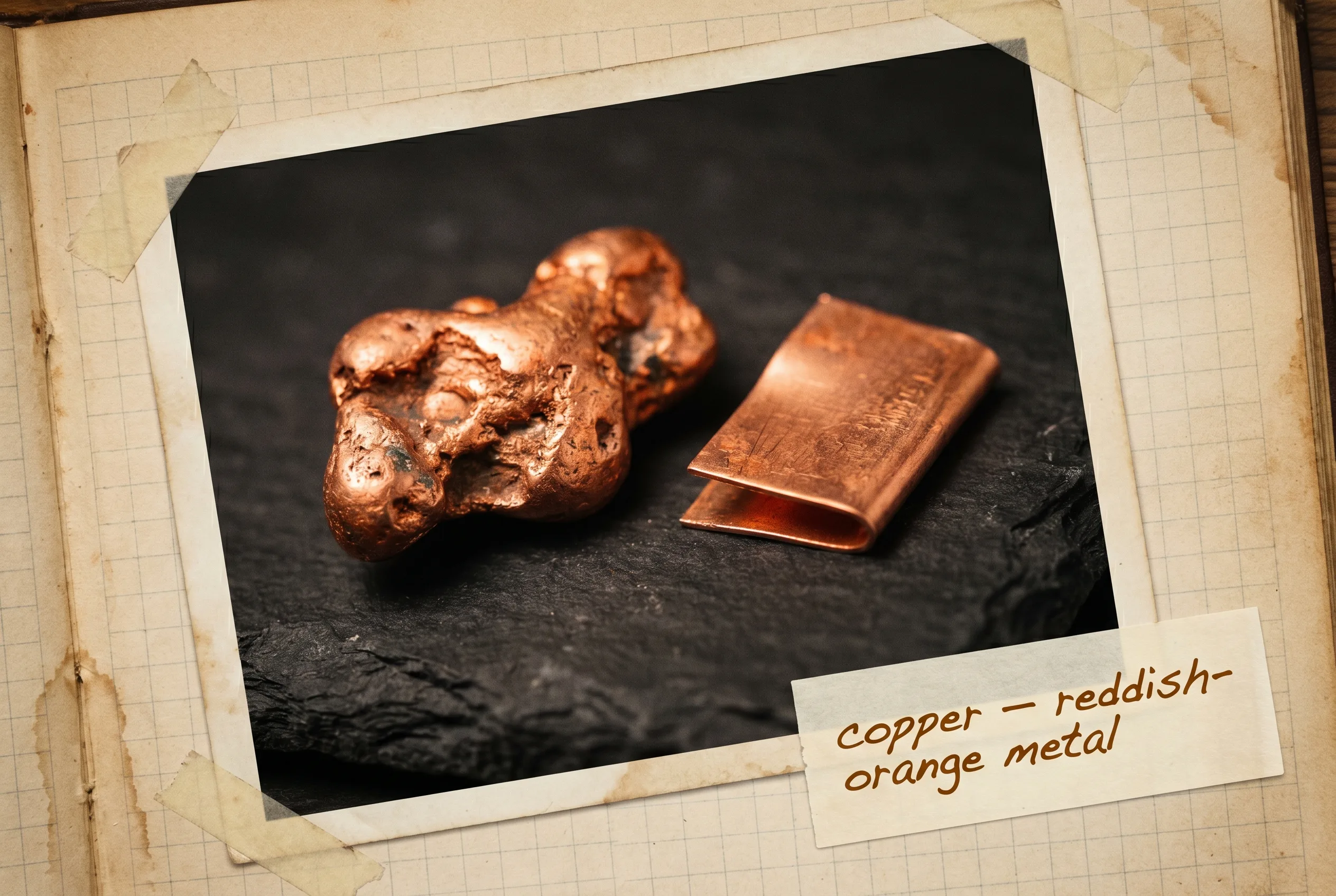
The reddish metal in wires and pipes is safe to hold. The only mild caution is its dust or fume, which can irritate if you breathe a lot of it.
- ToxicImmediate
Breathing copper dust or freshly made fume can irritate the nose and throat. (the dust and fume, not the solid metal)
The dust and fume are kept down with ventilation; the solid metal needs no special care.

How it bonds
Copper is one of the textbook electron-config exceptions: 3d¹⁰ 4s¹ (filled d shell) is more stable than the expected 3d⁹ 4s². Forms +1 (Cu₂O, red) and +2 (CuSO₄·5H₂O, the famous blue copper sulfate). Copper's high electronegativity and noble character make it useful for wiring and plumbing - it doesn't corrode easily in air.